 vs

CueForge vs MergeLabs
Both are in our Event planning & production category. CueForge is best for show callers, producers and AV companies building run-of-show documents for corporate events; MergeLabs is best for event agencies, PCOs and AMCs coordinating many suppliers and stakeholders.
The short answer: CueForge turns a client agenda into a technical run-of-show with AI, for show callers and AV teams, and has a free plan with Pro at $15 a month. MergeLabs (sold as Cothena) is a coordination workspace for agencies and PCOs that keeps schedules, runsheets, bookings and guest itineraries in one place, from $1,000 per event. Pick CueForge to build cue sheets quickly, MergeLabs to coordinate many suppliers.
Built from each vendor's own website and our research profiles. How we research
Side by side
“Not published” means we couldn't find it on the vendor's own pages.
CueForgeMergeLabsStrengths and considerations
CueForge
What stands out
- Purpose-built for technical show flows rather than attendee-facing agendas
- Revisions merge into existing cues instead of regenerating from scratch
Worth checking
- Very early-stage product with little public company information
- Production planning only; no registration, attendee or marketing features
- No integrations beyond file import/export are described
MergeLabs
What stands out
- Built around production operations (runsheets, itineraries, day-of coordination) rather than marketing attribution
- Retains event knowledge across editions through cloneable playbooks
- Multilingual guest itineraries suited to international incentive and customer programmes
Worth checking
- Very early-stage company with a single public case study
- No named integrations or security certifications
- Not a lead-capture or marketing-attribution tool
Notable customers
Organizations each vendor names on its own website: customer stories first, then testimonials and logos.
CueForge
None found on its website.
MergeLabs
The main difference between CueForge and MergeLabs
CueForge produces the show flow, while MergeLabs coordinates the people around it. CueForge generates a run-of-show from an uploaded agenda, including multi-room Excel workbooks, then lets you edit it in a grid with color-coded segments, scripts linked to cues, and client share links where clients leave cell-level notes. Its update-from-agenda tool applies a revised agenda as reviewable diffs without wiping production cues. It runs in-person and hybrid events.
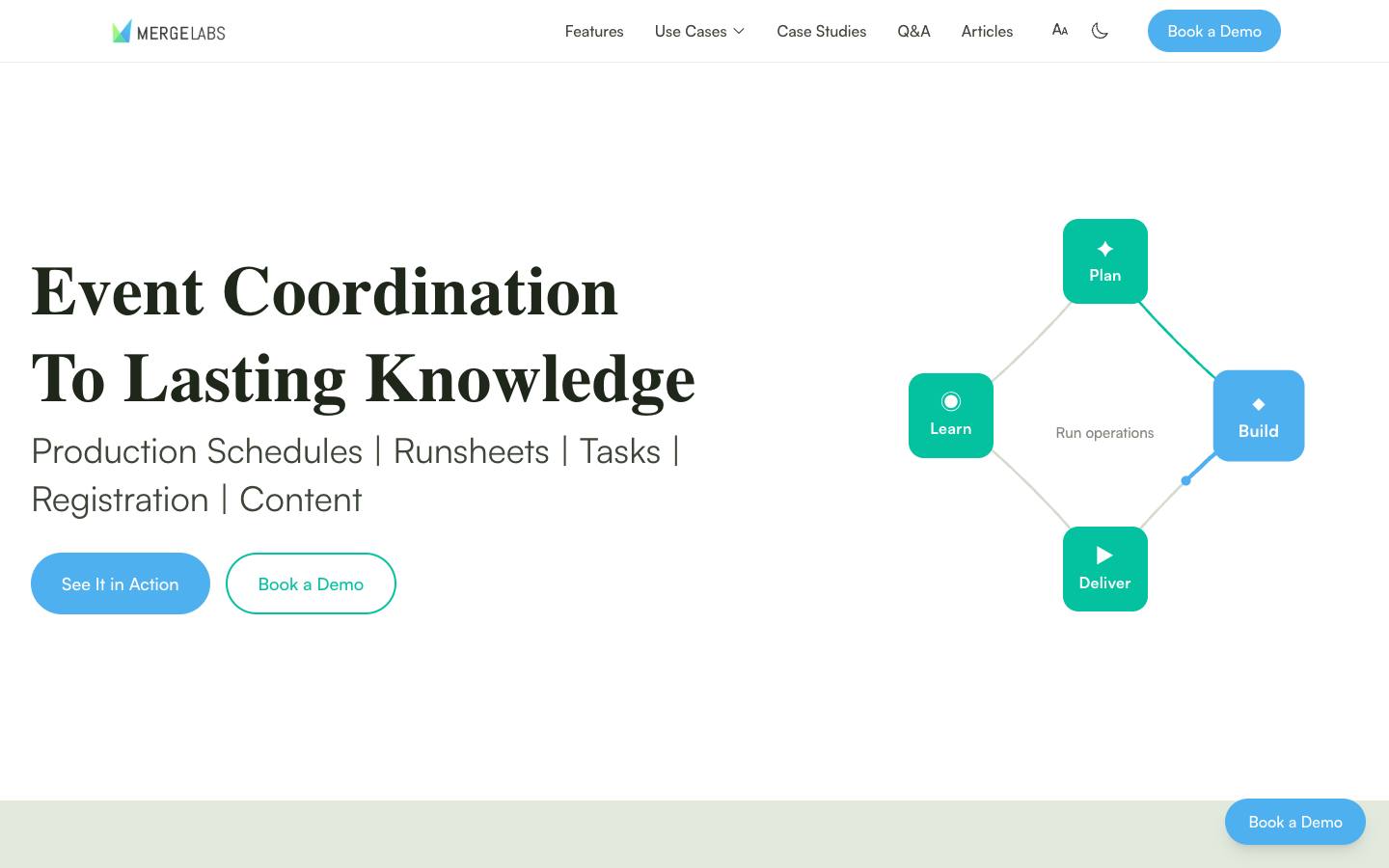
MergeLabs is aimed at event agencies, PCOs and AMCs. A master production schedule generates runsheets, venue agendas and stakeholder-specific views, activities track owners, tasks and blockers, and whole events clone as playbooks for the next edition. It adds booking pages and guest itineraries with QR access and no login. The overlap is the runsheet, but MergeLabs handles bookings and itineraries around it, and CueForge goes deeper on cue generation for show calling.
CueForge vs MergeLabs pricing
CueForge has a free plan (checked October 2026) with 1 new event per month, 10 AI generations a month, PDF and Excel export and version history. Pro is $15 a month, or $144 a year, for up to 15 concurrent events, 25 AI generations, an AI assistant with 200 edits a month, crew, client and technical exports, and show flow translation. New signups get a 7-day Pro trial with no credit card. AI credit packs cost $5 and $10.
MergeLabs sells its product as Cothena, priced as a one-time Single Event licence or an annual subscription (checked November 2026). Single Event is $1,000 per event, with unlimited users and spaces and $35 of AI usage. Annual is $5,000 a year, billed annually ($417 a month), with unlimited events, users and spaces and $350 of AI usage a year. The Custom plan is quoted and adds custom integrations, an API and SLA-backed support. Fixed euro and pound price lists also exist, excluding VAT. There's no free plan or trial.
Features and integrations
Neither lists CRM or marketing connectors. CueForge lists 4 file-based integrations: Excel, PDF, Word (DOCX) import and Google Docs through exported files. MergeLabs lists 7, mostly payment providers (Stripe, Adyen, Mollie, Revolut, Square, SumUp) plus a custom email server for notifications, and says storefronts embed on your website through its API.
AI differs in purpose. CueForge's AI generates the show flow, fills GFX, camera and livestream columns, reviews production risks and edits by instruction. MergeLabs stores conversations and content as structured data, with connecting AI tools marked coming soon. We didn't find security certifications on either vendor's public pages; MergeLabs is a German GmbH whose privacy policy is written to GDPR.
Which should you choose?
Choose CueForge if you're a show caller, producer or AV company turning client agendas into cue sheets for corporate events, and want to start free and pay by the month.
Choose MergeLabs if you're an agency, PCO or in-house team running roadshows or recurring programs with many suppliers, and want reusable playbooks and multilingual guest itineraries. It was founded in 2023, is independent, and runs as a fully remote team based in Germany. Its single public customer is Nikon Lenswear.