 vs

Jujama vs Whova
Both are in our Event apps category. Jujama is best for life sciences and pharma companies running partnering events, investor meetings or conferences; Whova is best for associations, academic and government conferences wanting an engaging attendee app with built-in registration.
The short answer: Jujama is a small Scranton-based event app and virtual platform with a life sciences and pharma focus, strong on matchmaking and one-to-one meeting scheduling. Whova is a larger event app covering registration, abstracts, exhibitors and onsite tools for associations, universities and corporates, with a SOC 2 Type 2 attestation. Neither publishes prices. Choose Jujama for partnering-style pharma events; choose Whova for broader conference management.
Built from each vendor's own website and our research profiles. How we research
Side by side
“Not published” means we couldn't find it on the vendor's own pages.
JujamaWhovaStrengths and considerations
Jujama
What stands out
- Deep life sciences references and partnering-style meeting tools
- Flexible video approach that plugs in the organizer's own provider
- Combines in-person app and virtual platform
Worth checking
- Pricing not published
- Few named software integrations (no CRM listed)
- Security certifications aren't described
Whova
What stands out
- Strong attendee networking and community features within the app
- Broad module set from abstracts to exhibitors in one vendor
- Fast support response times, including weekend coverage
- SOC 2 Type 2 and PCI DSS attestations
Worth checking
- No public price list; quotes scale with attendee count
- Named CRM and marketing automation integrations aren't detailed publicly, so confirm B2B marketing data flows
- No AI features advertised on the main site
Notable customers
Organizations each vendor names on its own website: customer stories first, then testimonials and logos.
Jujama
Whova
- University of New South Wales
- Sunway University
- Air Force Civil Engineering Center
- Alberta Health Services
- Purdue University
- USC Keck School of Medicine
- American Marketing Association
- Philippine Federation of Chemistry Societies
- African Women in Media
- Asia Pacific Advanced Network
- Physical Society of Taiwan
- Alaska Library Association
The main difference between Jujama and Whova
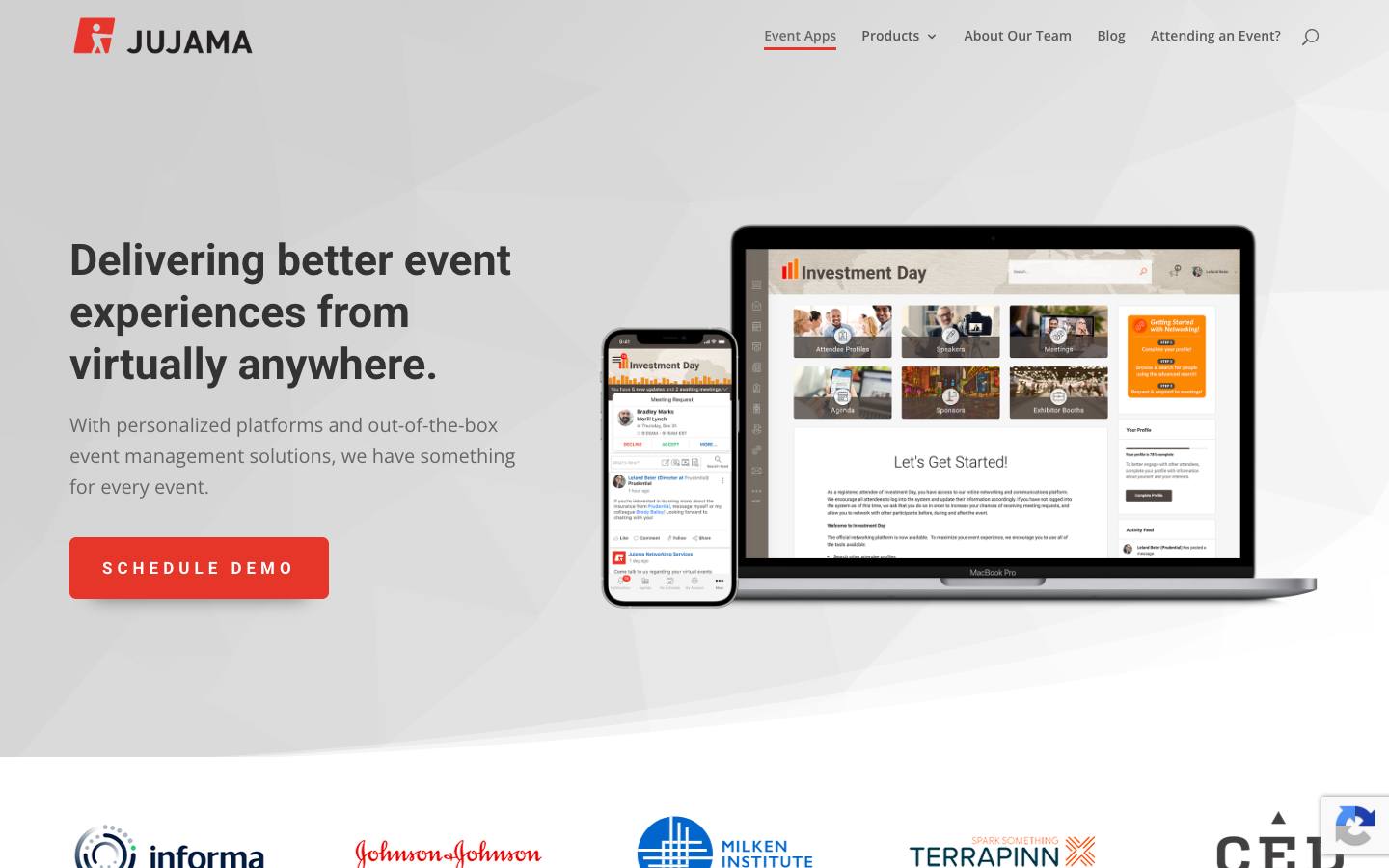
The main difference is specialization against breadth: Jujama is built around attendee matchmaking and meeting scheduling for life sciences and partnering events, while Whova is a full conference toolkit for associations, academic meetings and corporates. Jujama (founded 2009, Scranton, Pennsylvania, 11 to 50 employees) offers a mobile and desktop event app, a virtual and hybrid platform, machine-learning matchmaking, one-to-one and group messaging with built-in video calls, virtual exhibitor booths and audience analytics. Its customers on the page include Merck, AstraZeneca, AbbVie, Johnson & Johnson and event organizers Informa and Terrapinn.
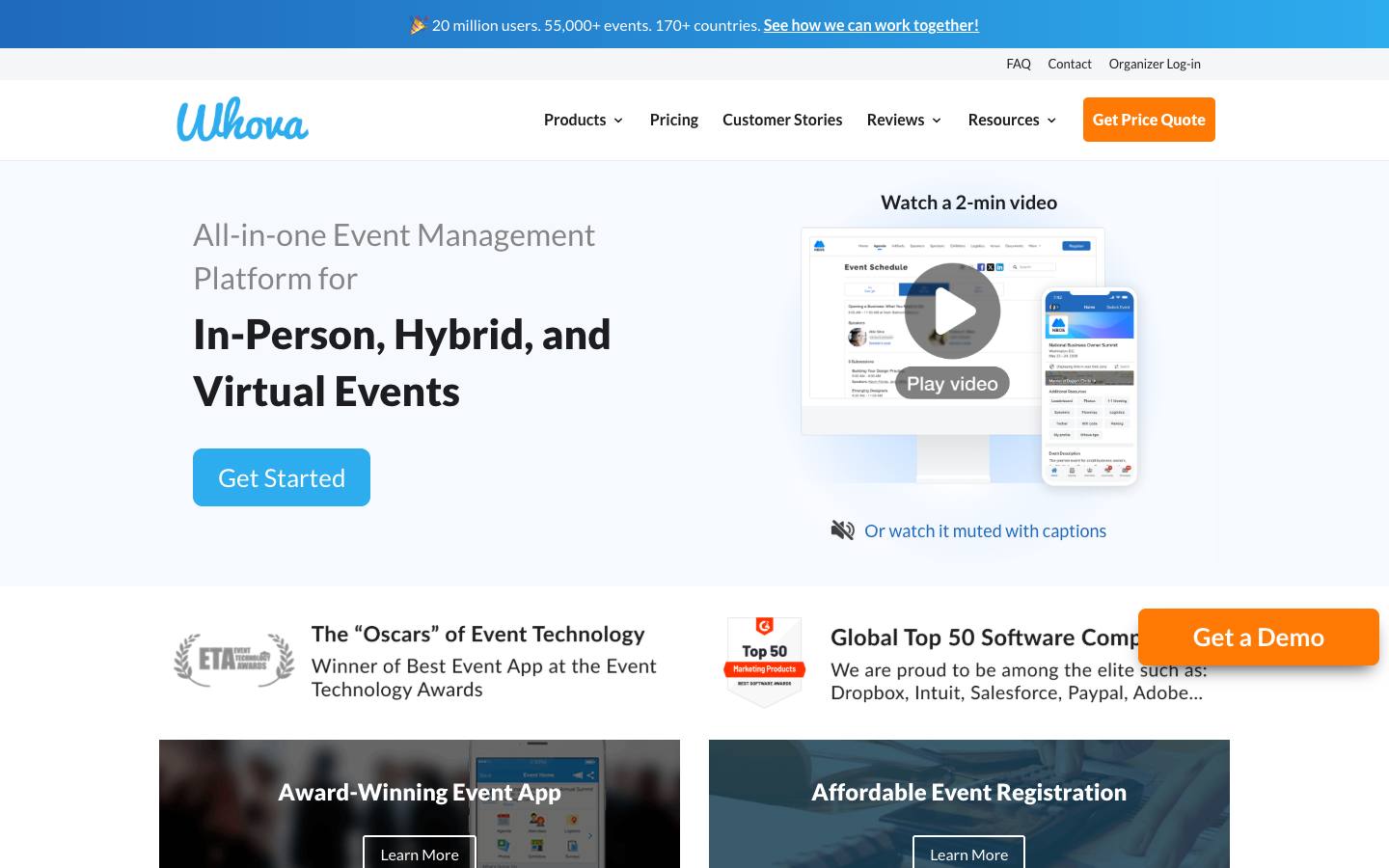
Whova (founded 2012, San Diego, 51 to 200 employees) starts from registration and Stripe-backed ticketing and adds call-for-speakers abstracts, exhibitor and sponsor tools with lead retrieval, badge printing, self check-in kiosks and certificates; hybrid delivery and a MicroEvents option cover online and small recurring gatherings. Its customers on the page range from Google and Hilton to Purdue University and the United Nations.
The overlap is the attendee app with agenda, messaging and networking. Beyond that, Jujama doesn't list registration, ticketing or abstract tools on its public pages, so teams needing those would pair it with other software or lean on Whova.
Jujama vs Whova pricing
Neither vendor publishes a starting price, so the comparison starts with quotes. Jujama sells custom pricing by demo request or phone, with no published plans, free plan or free trial. Whova also quotes on request, and its price grows with attendee numbers and how many events you run. A trial is available once you've seen a demo, but the length isn't stated.
Because both are quote-based, send each the same brief: format (in person, virtual or hybrid), event dates, expected attendees and whether you need registration, abstracts or matchmaking. Jujama's client concierge handles training, support and project coordination for each event, so ask whether that's included in the quote. For Whova, ask what the per-event versus annual structure looks like if you run several events.
Features and integrations
Jujama's differentiators are matchmaking that pairs attendees by shared interests and meeting tools for partnering events, plus a flexible video approach that plugs in the organizer's own streaming provider. Whova's strengths are its range of modules and its attendee community features, with quick support responses that include weekends.
On integrations, Whova lists 17 and Jujama lists 3, limited to YouTube and LinkedIn and Twitter sharing. Neither lists Salesforce. Whova lists HubSpot, Mailchimp, Constant Contact, Zoom, Webex, Microsoft Teams and association systems such as iMIS, MemberClicks and YourMembership, and offers Zapier. Jujama lists no CRM, so teams moving attendee data into a CRM should confirm how that works.
On security, Whova documents SOC 2 Type 2, PCI DSS for its online registration and a public subprocessor page. For Jujama we found a privacy policy covering GDPR transfers with standard contractual clauses, but no SOC 2, ISO 27001, DPA or subprocessor list (checked October 2026).
Which should you choose?
Choose Jujama if you run life sciences partnering events, investor meetings or conferences where scheduled one-to-one meetings are the main value, and you like a vendor that assigns a concierge to each event. It has a phone line and handles project coordination. Accept that integrations and security documentation are thin, and verify what you need in writing.
Choose Whova if you need registration, abstract management, exhibitor lead retrieval and onsite check-in in one app, or run a mix of large conferences and small recurring events. It suits associations and academic or government conferences, and its Capterra rating is 4.8 from 2,493 reviews. Procurement teams that want a SOC 2 Type 2 attestation on file will find it only on Whova's side.