Best Speaker Management Software in 2027: The Buyer's Shortlist
By EventMarketingSoftware.com · Published November 24, 2026 · 13 tools compared
Speaker management software handles everything after a speaker says yes: a portal with tasks and deadlines, reminders, bios, headshots and slides, and an agenda that stays in sync. Sessionboard covers the most of that list among dedicated tools. Lineup Ninja suits exhibition organizers, Sessionize costs $499 an event, and Cvent, RainFocus and Bizzabo include a speaker portal in their platforms.
Our top picks
- 1
 SessionboardBest for conference teams that want speaker portals, tasks, contracts and a speaker CRM beside their registration platformFrom $985/yr (Starter); speaker portals on quoted Pro plans
- 2
 Lineup NinjaBest for B2B exhibition and conference organizers running many content stages on one annual licenseFrom £2,900/year
- 3
 SessionizeBest for tech and developer conferences that want a speaker dashboard and unlimited speakers for a flat per-event feeFrom $499/event
Key takeaways
- Dedicated speaker tools publish prices, and they're low next to event platforms. Sessionize is $499 an event, Sessionboard starts at $985 a year, Speaker Dream is free for one event and $1,499 a year for 12, and Lineup Ninja showed £2,900 a year, all checked November 2026. Platforms with a speaker portal start at $7,500 an event at Accelevents and $10,000 a year at Zuddl.
- The speaker portal is often on a higher plan or sold as an add-on. Sessionboard includes portals with tasks and documents only on its quoted Pro and Enterprise plans, and Bizzabo and Zuddl sell portals as add-ons. Accelevents lists its speaker portal on all four plans.
- Check what the portal actually tracks. Sessionboard, Lineup Ninja, Cvent, Bizzabo and Zuddl document speaker task lists, while Sessionize and Whova collect the same details through custom forms and scheduled emails. Ask to see the view that shows who still owes what.
- A standalone tool is only as good as its handoff. Sessionboard lists 83 integrations and sends sessions and speakers to registration and app platforms, Lineup Ninja publishes to websites, event apps and digital signage, and Sessionize offers a live embed and a read-only API. Platforms such as Cvent, RainFocus and Whova avoid the sync because speakers sit on the same record as the agenda.
- Agreements, travel and promotion are where tools differ most. Sessionboard lists contracts on Pro and Enterprise, Zuddl accepts signed agreements as uploads, and EventsAir manages travel and hotel allocations in the same platform. For promotion, Sessionize makes social banners for accepted sessions and Whova gives speakers shareable images.
Free tool: Speaker card generator. Make a branded "I'm speaking" graphic for every confirmed speaker in LinkedIn sizes, one at a time or in bulk from a CSV. Free, no watermark, made in your browser.
Side-by-side comparison
The same criteria for every pick: speaker portal and tasks, asset collection, communication and tracking, agenda and platform sync, published pricing and packaging, security documentation. A dash means the vendor doesn't publish it.
| Tool | Starting price | Free plan / trial | CRM | Capterra | App Store | Security |
|---|---|---|---|---|---|---|
| Sessionboard | From $985/yr (Starter); speaker portals on quoted Pro plans | – | Salesforce, HubSpot | – | – | SOC 2 Type II, SAML SSO, DPA |
| Lineup Ninja | From £2,900/year | – | – | – | – | DPA |
| Sessionize | From $499/event | Free plan, Free trial | – | – | – | DPA |
| Speaker Dream | From $1,499/year | Free plan | – | – | – | – |
| AgendaForge | $2,000 per event (Core); Pro $4,000 per event | – | – | – | – | DPA |
| Cvent | Quote only | – | Salesforce, HubSpot, Dynamics, Marketo | ★ 4.5 (1,099) | ★ 4.8 (40,670) | SOC 2 Type II, ISO 27001, DPA |
| RainFocus | Quote only | – | Salesforce, HubSpot, Marketo | ★ 4.0 (1 review) | ★ 5.0 (5) | SOC 2 Type II, ISO 27001 |
| Bizzabo | From $499/user | – | Salesforce, HubSpot, Marketo | ★ 4.4 (171) | ★ 4.6 (14) | SOC 2 Type II, ISO 27001 |
| Whova | Quote only | Free trial | HubSpot | ★ 4.8 (2,493) | ★ 4.8 (252,682) | SOC 2 Type II |
| Zuddl | From $10,000/year | – | Salesforce, HubSpot, Marketo | ★ 4.5 (11) | ★ 3.0 (2 ratings) | SOC 2 Type II, ISO 27001, SAML SSO, DPA |
| Accelevents | From $7,500/event | Free trial | Salesforce, HubSpot, Marketo | ★ 4.7 (164) | ★ 3.7 (23) | SOC 2 Type II, ISO 27001, SAML SSO |
| EventsAir | Quote only | – | Salesforce, HubSpot, Dynamics, Marketo | ★ 4.7 (80) | ★ 2.2 (63) | SOC 2 Type II, SAML SSO |
| eventPower | Quote only | – | Salesforce | – | ★ 4.2 (16) | DPA |
This guide starts where a call for papers ends. Collecting pitches, blind review and scoring belong in our call for papers software guide, and peer-reviewed research belongs in our abstract management software guide. Here the question is how you get 40 or 400 confirmed speakers to hand in what you need, on time, and how their details reach the website, the event app and the AV team without retyping.
We compared 13 products using our vendor profiles, published pricing and each vendor's own product and help pages. Prices and features marked November 2026 were confirmed on the vendor's page that month, and the rest come from our October 2026 research.
Who this guide is for. This guide is for content, program and event marketing teams at B2B companies, commercial conference producers and associations that run events with more than a handful of speakers: user conferences, industry summits, exhibitions with content stages and annual meetings. It's most useful when speakers are already confirmed, invited or accepted, and the work is now chasing bios, headshots, slides and AV needs, answering the same logistics questions and keeping the agenda right across your website and app.
Not sure which one fits your team?
Answer a few questions about your events, team and CRM and get a free shortlist of tools that fit, with pricing and security details side by side.
Get a free shortlistThe best speaker management software in 2027
We picked 13 products and ordered them by fit for the main job: managing confirmed speakers through to the stage. The first five are dedicated speaker and content tools that run beside your registration platform, and all five publish a starting price. The next eight are event platforms with a real speaker portal or module on the same record as registration and the agenda. For each, look at what the portal tracks, how reminders work and which plan the portal is on.
1. Sessionboard, best for conference teams that want speaker portals, tasks, contracts and a speaker CRM beside their registration platform
- Price
- From $985/yr (Starter); speaker portals on quoted Pro plans
- Languages
- English, German, Spanish, French
- Syncs with
- Salesforce, HubSpot
- Security
- SOC 2 Type II, SAML SSO, DPA
- Customers include
- Diversified, Nonprofit Marketing Summit (Community Boost), Northwest Event Show
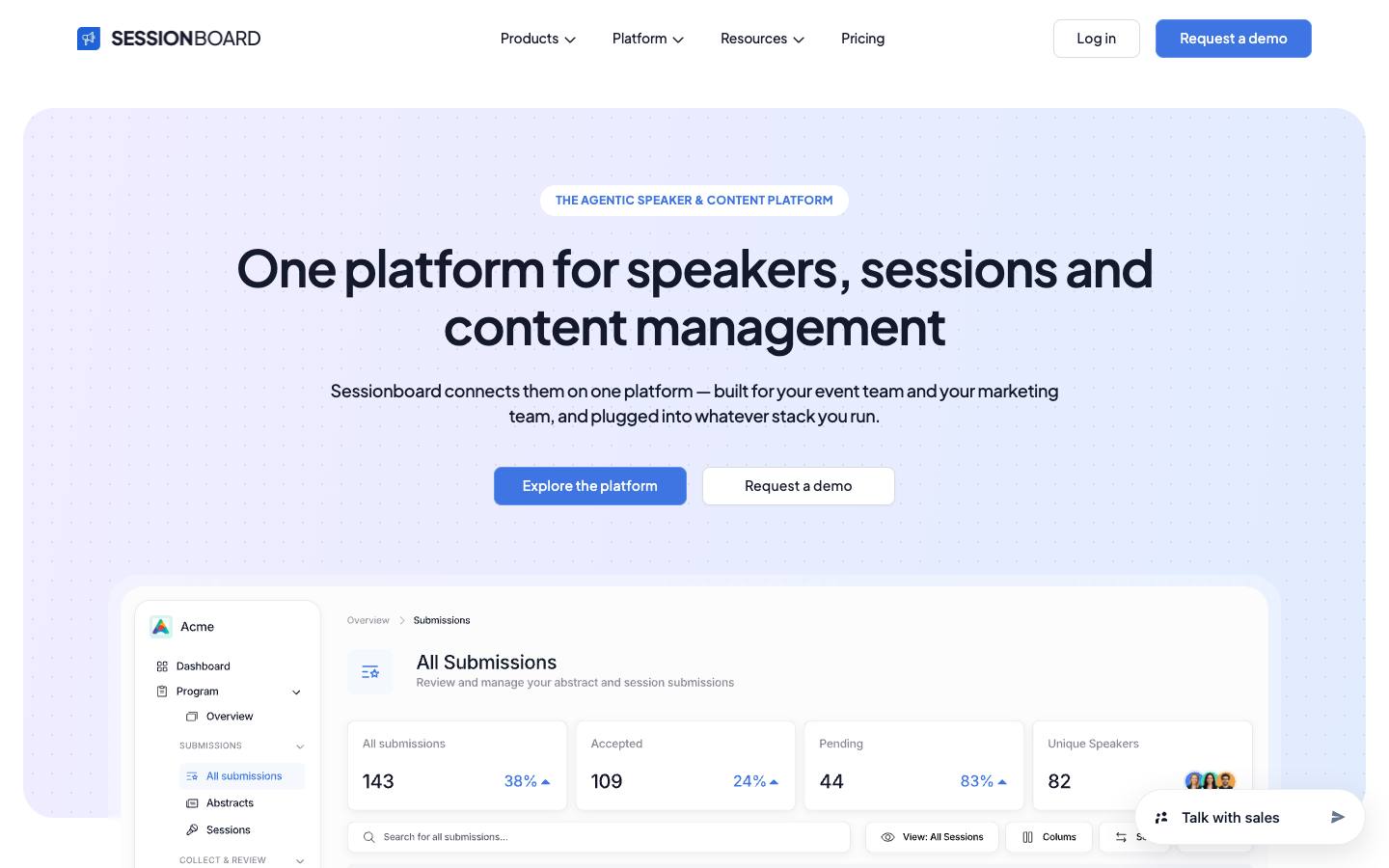
Sessionboard, founded in 2022 in Atlantic Beach, Florida, runs speakers, sessions and the agenda on one record next to your registration platform. Each speaker gets a portal through an emailed link, where they update their bio, upload files and work through assigned tasks, and organizers choose which fields speakers can edit.
More on SessionboardLess on Sessionboard
Founded: 2022 · HQ: Atlantic Beach, Florida · Team: 11-50 people · Formats: In-person, Virtual, Hybrid, Webinar
Tasks and file requests carry deadlines, reminders go out automatically to speakers with open tasks, and a tasks dashboard shows who still owes what across sessions and events (checked November 2026). Speaker share kits with graphics, social copy and tracked links are part of its Marketing product, sold from $945 a year and listed as included on Pro and Enterprise. Its site lists 83 integrations and counts more than 230,000 speakers and 300,000 sessions on the product, and one customer story cites 790+ sessions and 1,100+ speakers.
Pricing has moved from quote-only to published entry plans (checked November 2026). Starter is $985 a year for one event with up to 25 speakers, and Growth is $2,485 a year for three events with up to 75 speakers each. Both are self-serve and cover the call for speakers, decision emails, the agenda and website embeds. Speaker portals with tasks and documents, contracts sent singly or in bulk, the report builder and in-product messaging sit on Pro and Enterprise, which are quoted per event by speaker count. The speaker CRM is free up to 500 active contacts, and its Platform version with cross-event reports starts at $3,745 a year. Its security policy states SOC 2 Type II, and named customers include Informa, Clarion Events, Dynatrace and AVIXA.
- Speaker CRM free up to 500 active contacts
What stands out
- Speaker portals with tasks, deadlines and automatic reminders
- Published entry plans from $985 a year
- Contracts sent one by one or in bulk on Pro and Enterprise
Worth checking
- Speaker portals aren't on the self-serve Starter and Growth plans
- Pro and Enterprise are quoted per event
Best suited for. Sessionboard fits conference producers, associations and B2B marketing teams that manage dozens to hundreds of speakers per event and keep registration on another platform. If you only need a speaker dashboard and group emails for one event, Sessionize costs less.
2. Lineup Ninja, best for B2B exhibition and conference organizers running many content stages on one annual license
- Price
- From £2,900/year
- Languages
- English
- Security
- DPA
- Customers include
- Easyfairs, Association of Equipment Manufacturers (ConExpo-Con/Agg), Closerstill Media
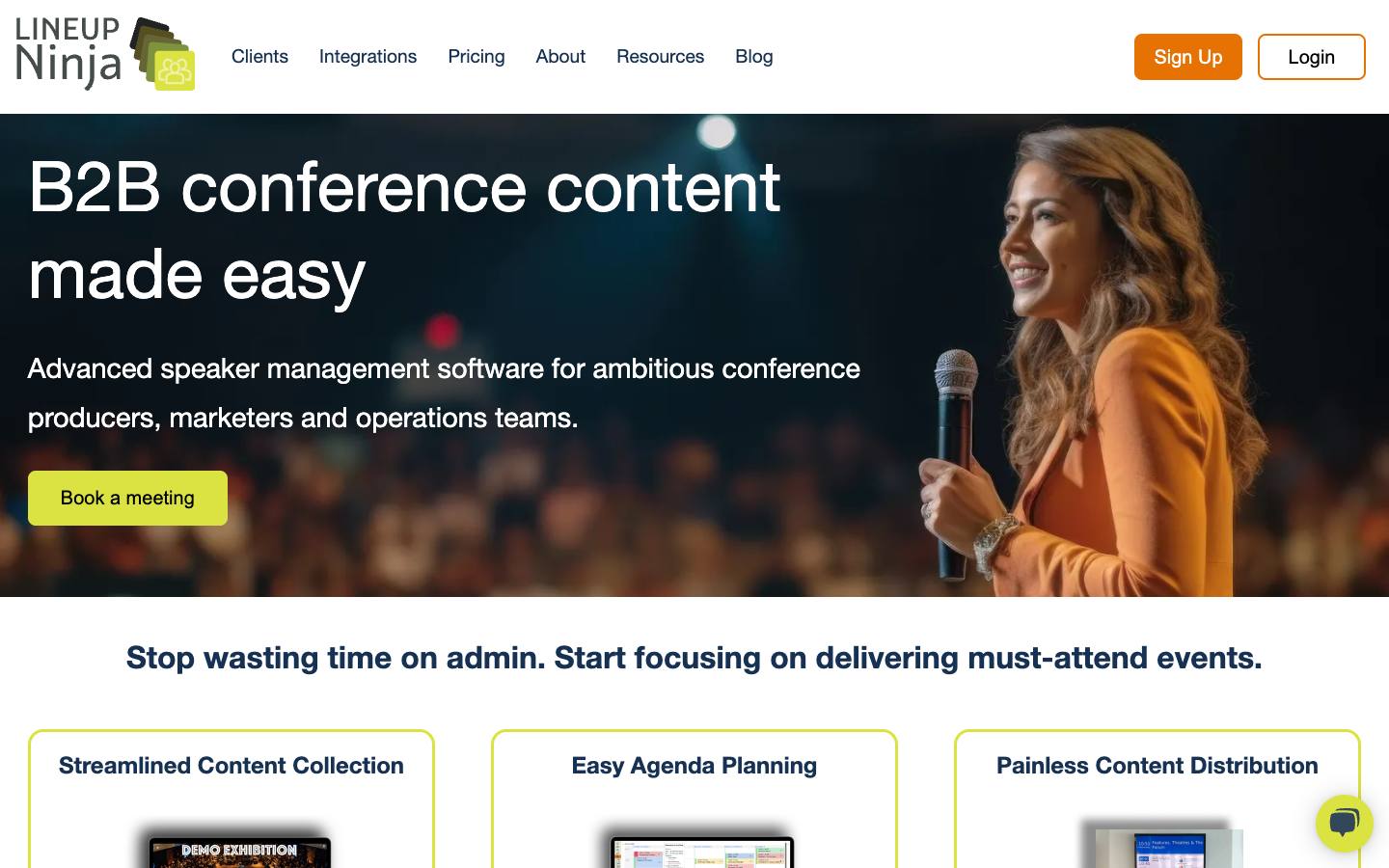
Lineup Ninja is a Leeds, UK tool, founded in 2017, that collects speaker content, builds the agenda and publishes it to your website, event apps and digital signage. Its own pricing page calls it speaker management software, and it's used by exhibition organizers such as Clarion Events, CloserStill Media, Easyfairs and Diversified Communications.
More on Lineup NinjaLess on Lineup Ninja
Founded: 2017 · HQ: Leeds, United Kingdom · Team: 2-10 people · Formats: In-person, Hybrid, Virtual
Speakers get a portal that works as one place for their tasks and messages. Through it they submit details, upload slides and videos and complete onboarding tasks, while automated speaker emails and reminders do the chasing. Teams can build their own content collection workflow, and a lineup diversity report shows the make-up of the program. The agenda builder checks speaker availability and clashes and can schedule by rules. Published content goes to the show website, a no-install agenda web app, digital signage and connected platforms. Connectors include Swapcard, Grip, Swoogo, ExpoPlatform, Map Your Show and Guidebook, with Zapier and Make for the rest.
Pricing is an annual license per team with unlimited events. The calculator on its pricing page showed £2,900 a year at 100 speakers a year, and the vendor says it won't bill overages but will review usage in later years (checked November 2026). Onboarding and training is a £600 flat fee, configuring an existing integration is £250, and bespoke work is £1,000 a day. Integrations, configurable workflows and digital signage are only available with Professional support. There are no CRM or marketing automation connectors, the interface is English only, and it publishes no security certifications.
- Lineup diversity reporting
What stands out
- Speaker portal with tasks and automated speaker emails
- Unlimited events on one annual license
- Publishes to websites, event apps and digital signage
Worth checking
- Integrations need the Professional support option
- No security certifications published
Best suited for. Lineup Ninja fits exhibition and conference organizers that run several shows a year with multi-stage content programs. Teams that need Salesforce or HubSpot connections or contracts in the portal should look at Sessionboard.
3. Sessionize, best for tech and developer conferences that want a speaker dashboard and unlimited speakers for a flat per-event fee
- Price
- From $499/event
- Try it
- Free plan, Free trial
- Languages
- English
- Security
- DPA
- Customers include
- The Linux Foundation, Global Azure, XDEV Software
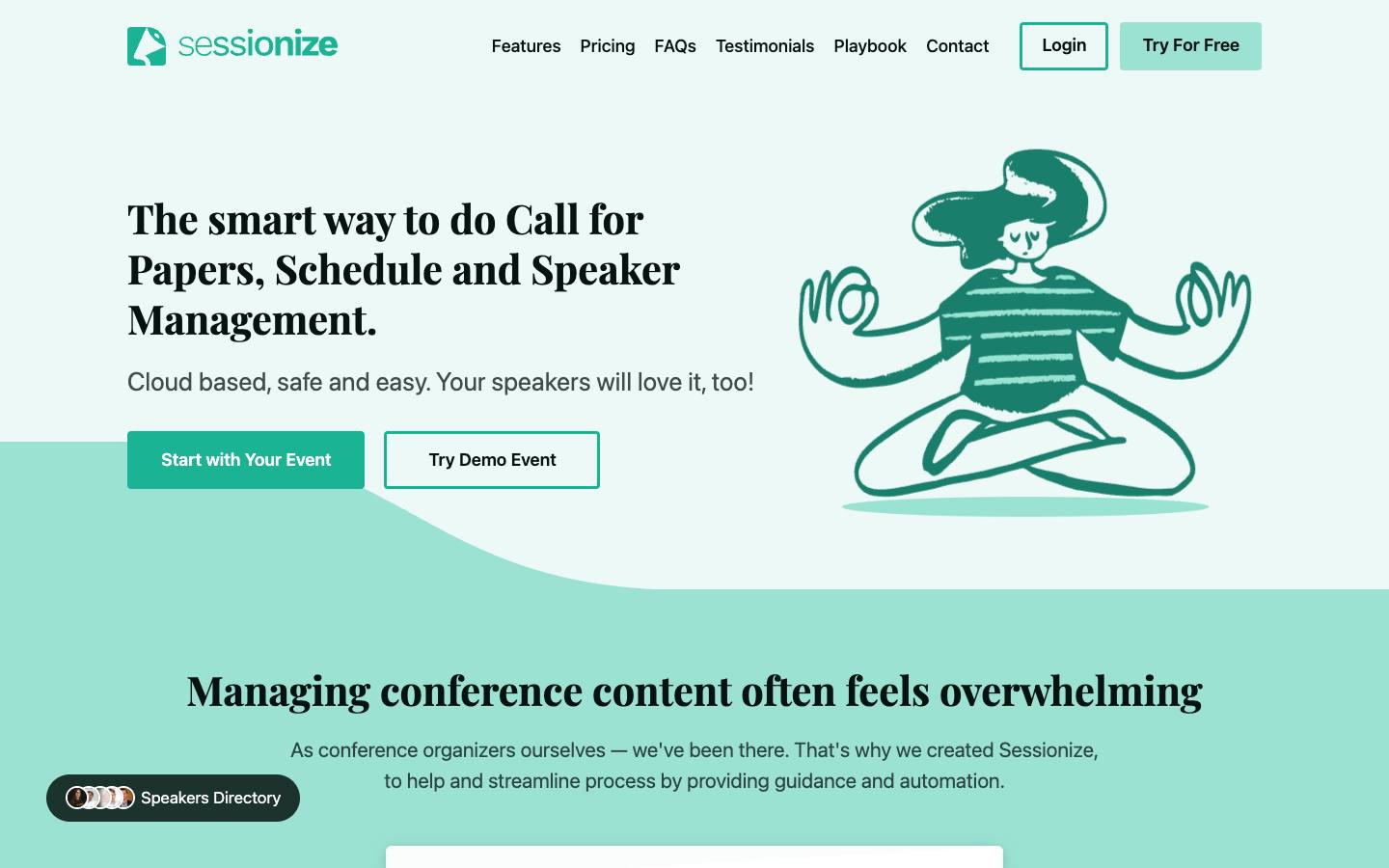
Sessionize, built in Zagreb, Croatia and founded in 2017, is best known for its call for speakers, but much of the product covers what happens after acceptance. It costs $499 plus tax per professional event with every feature included and no cap on speakers, sessions or team members, and it's free for community events (checked November 2026).
More on SessionizeLess on Sessionize
Founded: 2017 · HQ: Zagreb, Croatia · Team: 2-10 people · Formats: In-person, Virtual, Hybrid
Organizers send accepts and declines and ask speakers to confirm. Each speaker then gets a Speaker Dashboard, a single page with everything they need for the event. Custom forms collect extras such as presentation files and travel details, and you can download every speaker photo in one click or all collected files as one ZIP. Group emails go to accepted speakers or to every speaker, and a log keeps each message sent. Scheduled speakers get calendar placeholders and can subscribe to a calendar of their own sessions that stays in sync.
For promotion, Sessionize creates shareable social banners for every accepted session. The schedule publishes as a live embed, a read-only API feed, plain text for mailings and a print-ready PDF, plus an attendee schedule app that works offline. Organizers can also flag no-shows and late cancellations. What it doesn't document is a per-speaker task list with deadlines and automatic reminders, or speaker agreements. There are no CRM or registration connectors, the trust center lists no security certifications, and data is hosted in Ireland and the Netherlands. Named users include Microsoft, JetBrains, NDC Conferences and droidcon.
- Live embed and read-only API
What stands out
- $499 per professional event, unlimited speakers
- Speaker Dashboard and custom forms for files and travel details
- Social banners for every accepted session
Worth checking
- No documented task deadlines or automatic reminders
- No CRM or registration connectors
Best suited for. Sessionize fits developer conferences, user groups and B2B events that want an inexpensive, widely used way to brief speakers and publish the schedule. Teams that need task deadlines, reminders and contracts should compare Sessionboard or Lineup Ninja.
4. Speaker Dream, best for small conference teams that want a speaker portal, asset kit and inbox with a free starting plan
- Price
- From $1,499/year
- Try it
- Free plan
- Languages
- English
- Customers include
- Community Week
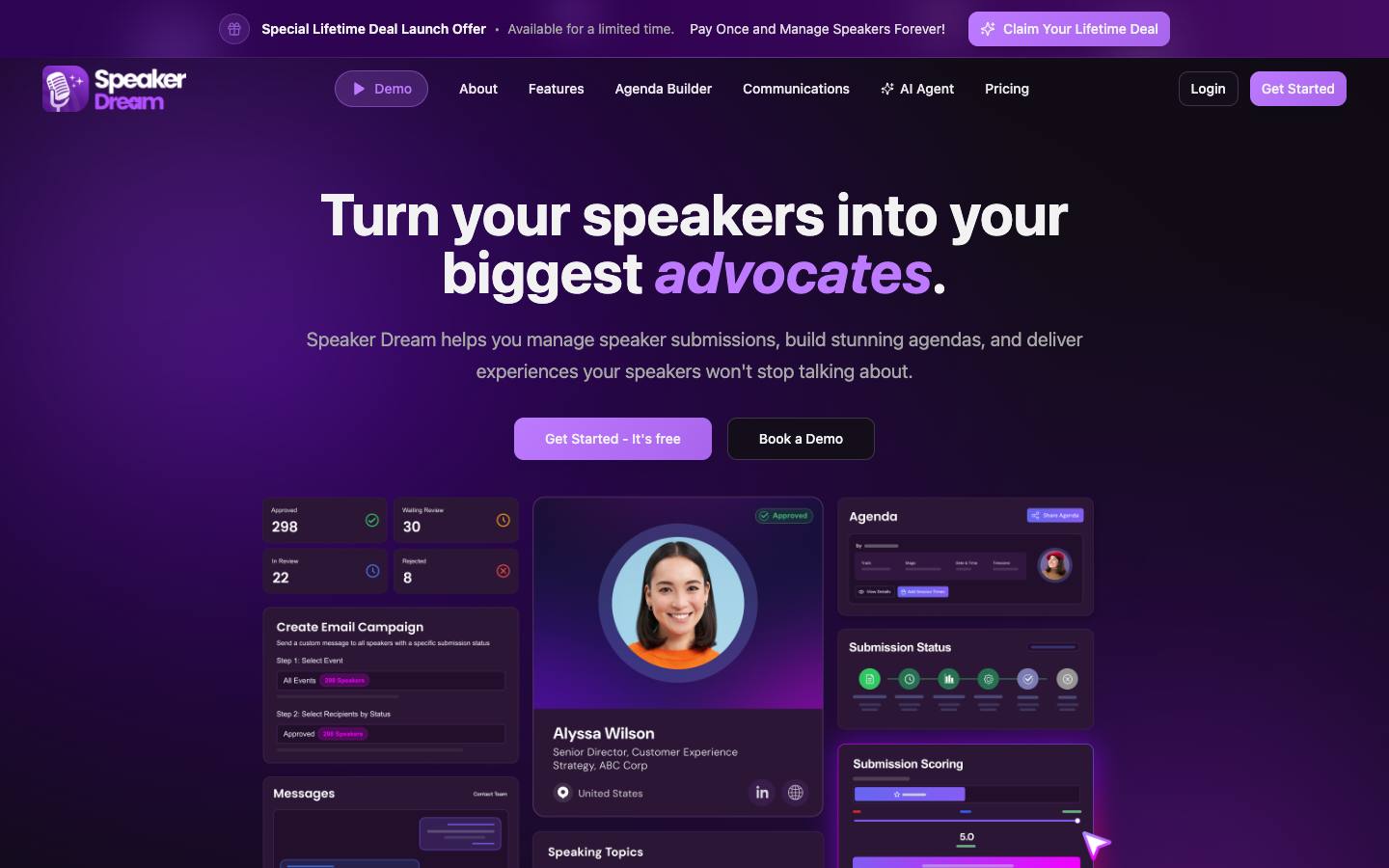
Speaker Dream is a UK tool based in Norwich, started by the organizer of London and Toronto Community Week. It covers the call for papers, a speaker portal, a reusable speaker database, asset collection, messaging and an agenda builder, and its Starter plan is free for one event with unlimited speakers.
More on Speaker DreamLess on Speaker Dream
HQ: Norwich, United Kingdom · Formats: In-person
Speakers use the portal to edit their bio and talk details, and they can apply to several events with one profile. The speaker kit collects headshots, slides, PDFs and video links, assigns files to the right session and keeps versions, and organizers can share branded marketing kits back with speakers. A unified inbox keeps messages next to each speaker's submission, with browser push notifications. Bulk email can be filtered by event, approval status or stage, with templates and send statistics. Public speaker pages with bios, sessions and materials are generated automatically, and the agenda builder flags time conflicts.
Pricing is published (checked November 2026). Starter is free with one admin and 1,000 one-time email credits. Professional is $1,499 a year, or $2,999 once as a lifetime deal, for 12 events a year, up to five admins, 100,000 email credits a year and a custom domain. Enterprise starts at $10,000 with unlimited admins and custom integrations. Its site doesn't describe task deadlines or automatic reminders. It lists no native integrations, API or Zapier app outside Enterprise custom work, and no data processing agreement or security documentation. The only named customer is run by its founder.
- $1,499 a year for 12 events
What stands out
- Free Starter plan for one event with unlimited speakers
- Speaker kit with file versions
- Unified inbox and filtered bulk email
Worth checking
- No native integrations or API below Enterprise
- No security documentation and few named customers
Best suited for. Speaker Dream fits community and small commercial conferences that want speaker assets and messages in one place without a big contract. Teams that need connectors to a registration platform or event app should look at Lineup Ninja or Sessionboard.

5. AgendaForge, best for independent conference organizers that want a speaker portal, agenda and ticketing at a flat per-event price
- Price
- $2,000 per event (Core); Pro $4,000 per event
- Languages
- English
- Security
- DPA
- Customers include
- Stable Summit
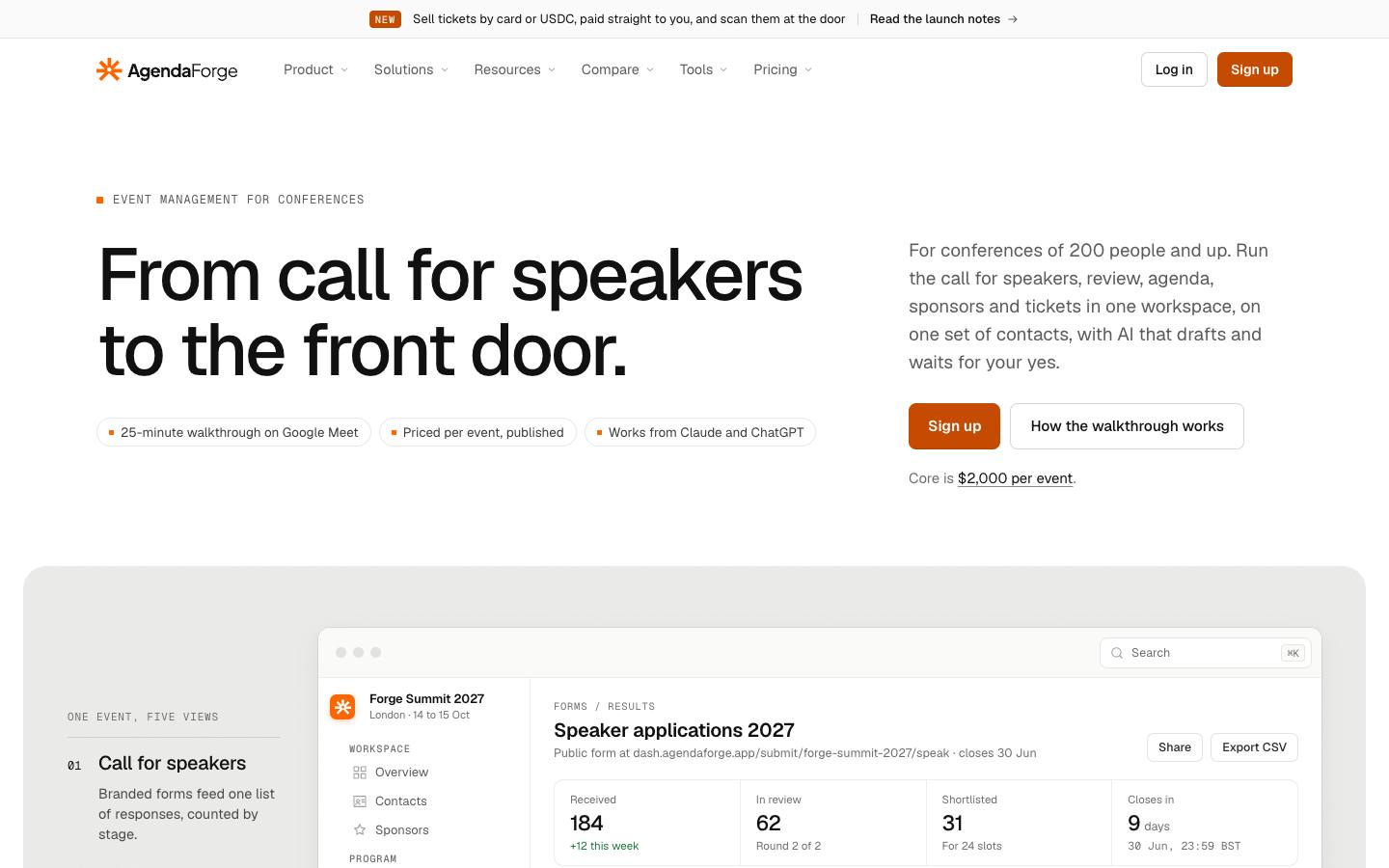
AgendaForge is an early-stage conference workspace that runs speaker applications, review, the agenda, a speaker portal, sponsor intake, ticketing and check-in in one place. It's aimed at conferences of roughly 200 attendees and up, and it publishes per-event prices: Core is $2,000 and Pro is $4,000 (checked November 2026).
More on AgendaForgeLess on AgendaForge
Team: 1 people · Formats: In-person
Speakers sign in to the portal with a code, with no password, and see their own sessions, the tasks you've set and the files you've asked for. Headshots and bios save to the speaker's contact record, and a design studio turns them into speaker cards to share. Email goes out from the workspace as a template or a written note to any selection of contacts, and every send is logged. The agenda builder flags a double-booked speaker as soon as a session is placed, and the agenda embeds on your website and updates when sessions move.
An AI Event Coordinator drafts emails and proposes changes to speakers and sessions, and outside assistants such as Claude and ChatGPT can work on an event through an MCP server. Either way, a person on your team approves each change before it applies. Core includes 500 registrations, 50 speakers and five seats, and Pro is unlimited with white-label and your own domains. Connectors cover Luma, Ticket Tailor, Slack, ClickUp and Google Sheets, plus Zapier, Make, a REST API and webhooks. The trade-offs are those of a very young vendor: two named customers, Stable Summit and Capital Summit, no SOC 2 audit of its own, no CRM connector, and EU data residency as a paid add-on. Its pages don't describe task deadlines or reminders.
- AI changes held for human approval
What stands out
- Passwordless speaker portal with tasks and file requests
- Speaker cards generated from headshots and bios
- $2,000 per event with 50 speakers on Core
Worth checking
- Very early-stage vendor with two named customers
- No SOC 2 audit of its own
Best suited for. AgendaForge fits independent and community conference organizers that want speakers, agenda and tickets in one tool and are comfortable with a new vendor. Larger teams that need security certifications and an established customer base should pick Sessionboard or a full platform.
6. Cvent, best for teams already on Cvent that want speaker tasks and reminders tied to their event sessions
Quote only
- Price
- Quote only
- Capterra
- 4.5/5 from 1,099 reviews
- App Store
- 4.8/5 from 40,670 ratings
- Languages
- Support offered in 12 languages; event sites support multiple languages via language management
- Syncs with
- Salesforce, HubSpot, Dynamics, Marketo
- Security
- SOC 2 Type II, ISO 27001, DPA
- Customers include
- 6sense, Cognizant, Purdue University
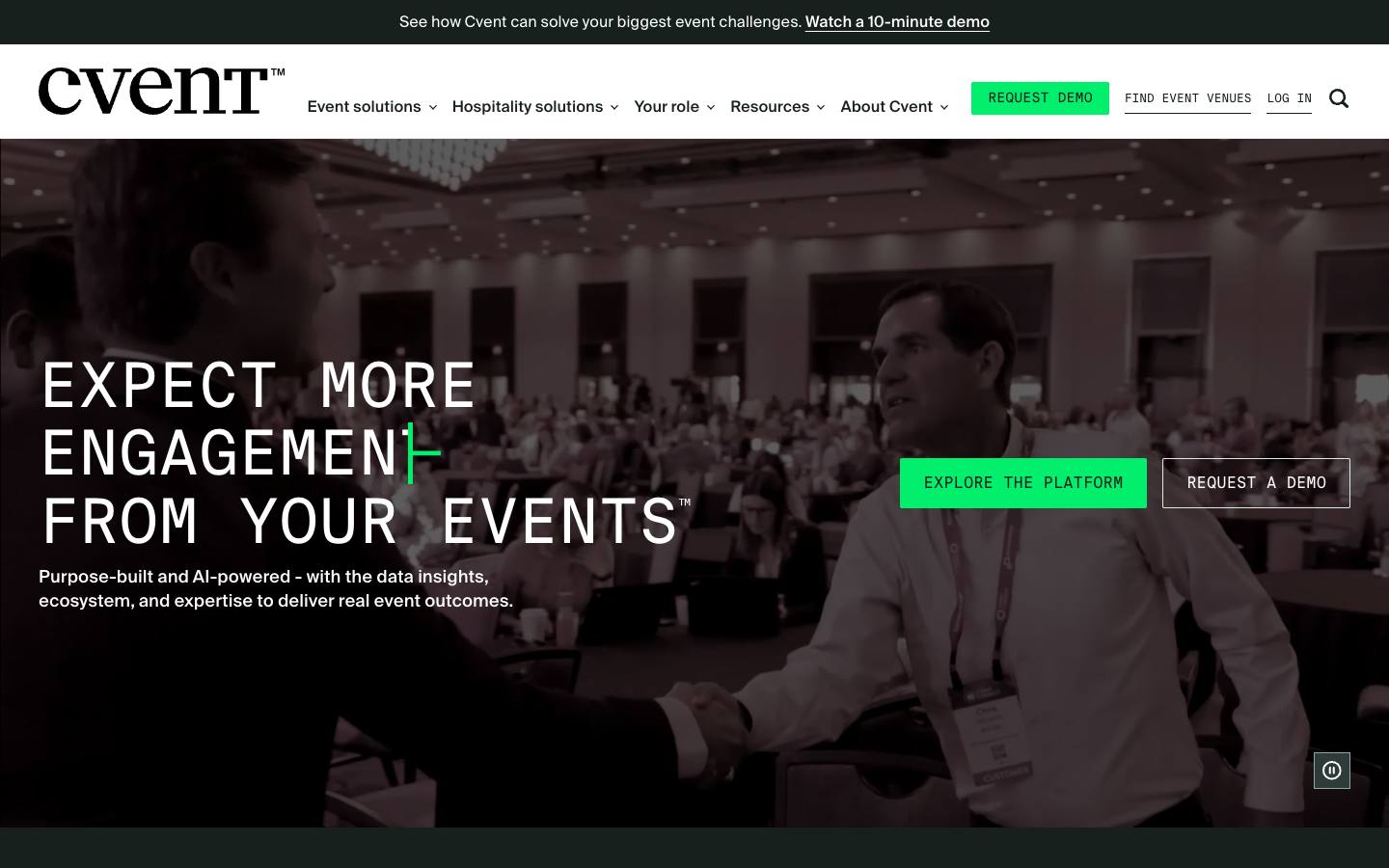
Cvent, founded in 1999 and based in Tysons Corner, Virginia, covers speakers through its Speaker Resource Center, a speaker-facing site that works with its event management product. Cvent's help center describes it as one place to manage all your speakers, with communication, task tracking and reports (checked November 2026).
More on CventLess on Cvent
Founded: 1999 · HQ: Tysons Corner, Virginia · Team: 5,001-10,000 people · Formats: In-person, Virtual, Hybrid, Webinar
Planners add speakers to the event and decide whether they can edit their personal details and their session's name and description. Tasks can be tied to a specific session and marked required, and they can collect files such as a resume or links such as a personal website. The site is branded to match the event, speakers get an invitation email to log in, and task reminders keep them on schedule. Speaker profiles live in an account-level library that's reused across events, reports show which sessions have speakers assigned, and event websites include a speaker page built from the same records.
Cvent doesn't publish prices. Products are licensed individually under a Professional tier with 15 user logins or an Enterprise tier with all logins, API access and single sign-on, so ask whether the Speaker Resource Center and call for papers are in your contract (pricing page checked October 2026). It holds SOC 2 Type II and ISO 27001, connects to Salesforce, Marketo, HubSpot and Microsoft Dynamics, and has a 4.48 Capterra rating from 1,099 reviews as of October 2026. Teams with heavy speaker programs sometimes add a dedicated tool, and Sessionboard lists a Cvent integration.
- SOC 2 Type II and ISO 27001
What stands out
- Speaker Resource Center with session-specific tasks
- Task reminders and speaker reports
- Speaker library reused across events
Worth checking
- No published pricing, and products are licensed separately
- Only makes sense alongside Cvent event management
Best suited for. Cvent fits corporate and association teams that already run registration and the agenda on Cvent and want speaker tasks in the same system. If you aren't a Cvent customer, a dedicated tool such as Sessionboard or Sessionize is a far smaller commitment.

7. RainFocus, best for enterprise user conferences that want a speaker portal on the same data as registration and the session catalog
Quote only
- Price
- Quote only
- Capterra
- 4.0/5 from 1 review
- App Store
- 5.0/5 from 5 ratings
- Syncs with
- Salesforce, HubSpot, Marketo
- Security
- SOC 2 Type II, ISO 27001
- Customers include
- Autodesk, Trimble, Ellucian
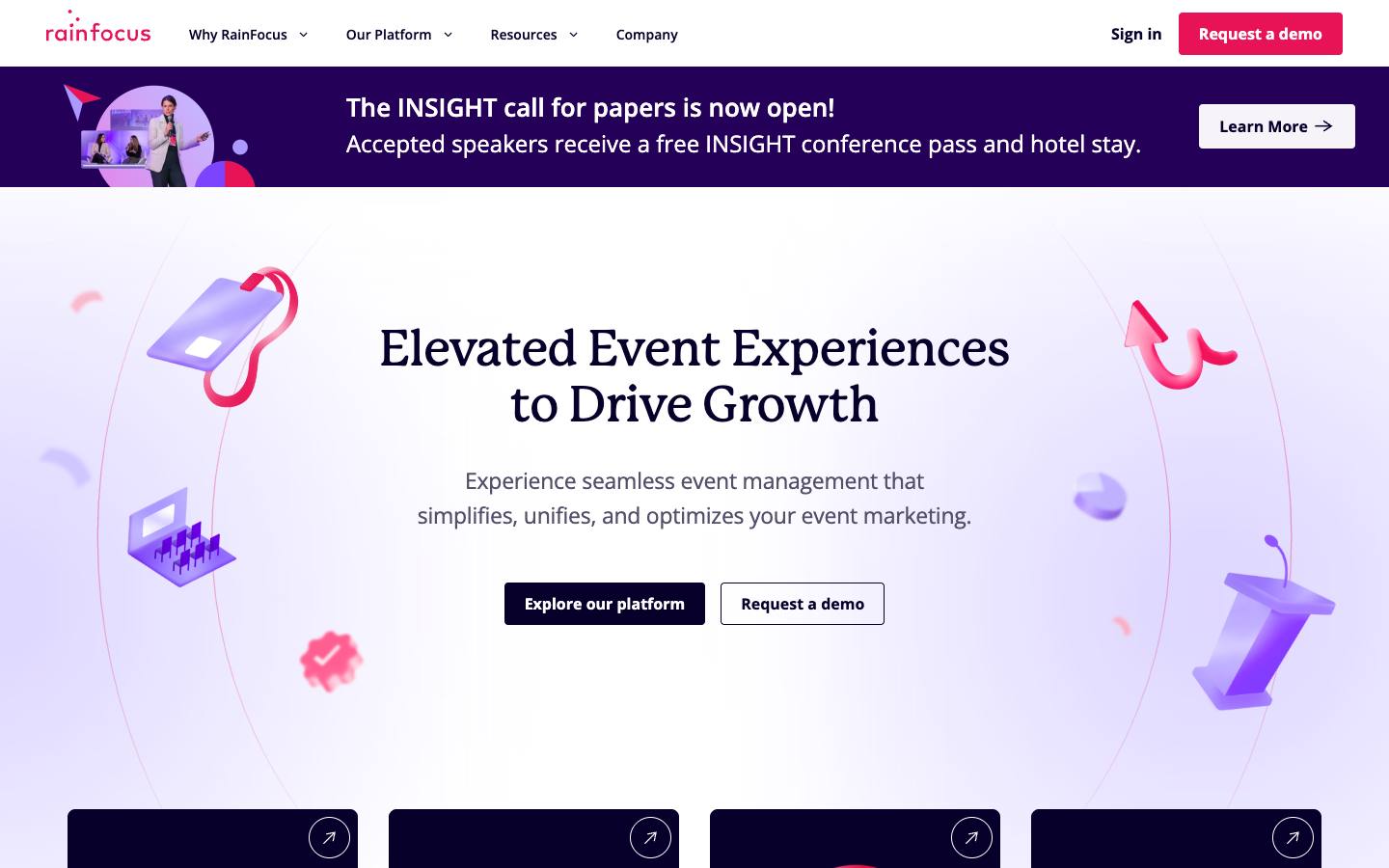
RainFocus, founded in 2013 in Lindon, Utah, is an enterprise event platform known for very large tech user conferences, with customers including Adobe, Cisco, Oracle, Red Hat and ServiceNow. Its speaker enablement module gives speakers a portal that sits on the same attendee and session data as registration, the catalog and the mobile app.
More on RainFocusLess on RainFocus
Founded: 2013 · HQ: Lindon, Utah · Team: 201–500 people · Formats: In-person, Virtual, Hybrid, Webinar
RainFocus describes the portal as a central place where speakers complete the work assigned to them, publish their material and connect with attendees (checked November 2026). Bios, headshots and session details collected there feed speaker promotion, and the portal connects to the call for papers module in the same platform. During the event, speakers can run chat, Q&A, polls and reactions for in-person and virtual audiences. Afterward, attendee surveys show which speakers and topics landed, which helps decide who to invite back. The vendor points to LiveWorx as a customer that used it to manage speakers for a virtual event.
Pricing is quote only and aimed at enterprise budgets (October 2026). The platform connects to Salesforce through its own app and to Marketo, Eloqua and HubSpot, and the vendor cites more than 40 connectors. It lists SOC 2 and ISO 27001:2022. Its public pages are light on detail: they name speaker tasks without describing deadlines, reminder rules or a report of outstanding items, and they don't mention speaker agreements or travel. Ask for a walkthrough of the speaker workspace with your own task list before you commit, and check how changes made by speakers are approved.
- Salesforce app plus Marketo, Eloqua and HubSpot
What stands out
- Speaker portal on the same data as registration and the catalog
- Bios, headshots and session details collected in the portal
- Speaker-run chat, Q&A and polls
Worth checking
- No published pricing
- Public pages don't detail reminders or task reports
Best suited for. RainFocus fits enterprise marketing teams running a flagship user conference with hundreds of speakers and a wider event portfolio. Mid-sized teams with one conference a year will find a dedicated speaker tool beside their registration platform simpler and cheaper.
8. Bizzabo, best for B2B event teams with invited speaker lineups that want a branded speaker portal inside their event platform
From $499/user
- Price
- From $499/user
- Capterra
- 4.4/5 from 171 reviews
- App Store
- 4.6/5 from 14 ratings
- Languages
- English
- Syncs with
- Salesforce, HubSpot, Marketo
- Security
- SOC 2 Type II, ISO 27001
- Customers include
- Compass, DJI, HubSpot
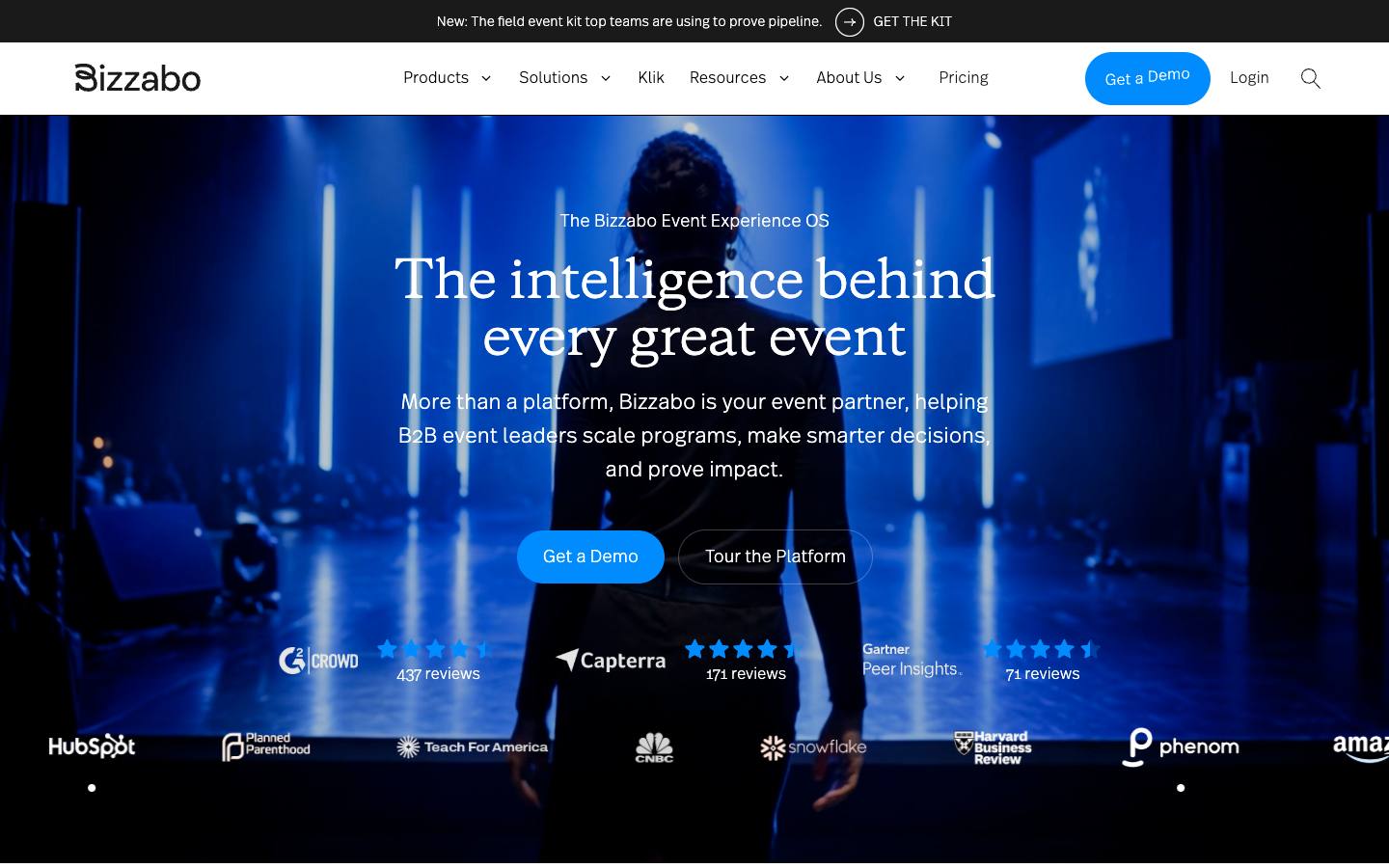
Bizzabo, founded in 2011 in New York, is a B2B event platform with a dedicated Speaker Portal. It publishes a starting price of $499 per user a month billed annually with a three-user minimum, or $17,999 a year, with unlimited events and registrations (pricing page checked October 2026).
More on BizzaboLess on Bizzabo
Founded: 2011 · HQ: New York, United States · Formats: In-person, Virtual, Hybrid, Webinar
Bizzabo says the portal brings speaker tasks into one place with automated reminders, and lets speakers upload and manage bios, headshots and session materials (checked November 2026). It's a branded, self-service site that the vendor says supports any number of speakers and multi-session agendas. Agendas are built with a drag-and-drop editor across days and tracks and embed on the event website, so the two stay in sync. In our feature research we found the portal but no published call for papers or review workflow, so it suits curated lineups where marketing invites the speakers.
The catch is packaging. Speaker and sponsor portals are premium add-ons that aren't priced publicly, alongside CRM integrations, single sign-on and API access, and Bizzabo sells annual subscriptions only (October 2026). Native connectors cover Salesforce, HubSpot, Marketo and Pardot. It lists SOC 2 Type II and ISO 27001 and has a 4.37 Capterra rating from 171 reviews as of October 2026. Named customers include HubSpot for INBOUND, Phenom and Inductive Automation. Ask for the speaker portal price in the first quote, and ask to see how a speaker's edits are approved before they publish.
- SOC 2 Type II and ISO 27001
What stands out
- Speaker Portal with tasks and automated reminders
- Speakers upload bios, headshots and session materials
- Agenda embed that stays in sync with the website
Worth checking
- Speaker portal is an unpriced premium add-on
- No published call for papers workflow
Best suited for. Bizzabo fits B2B marketing teams that run several conferences and field events a year on one platform and invite their speakers directly. If you run an open call or need a single event, a dedicated speaker tool or a per-event platform fits better.

9. Whova, best for conferences that want speaker forms, messaging and promo images feeding an attendee app
Quote only
- Price
- Quote only
- Try it
- Free trial
- Capterra
- 4.8/5 from 2,493 reviews
- App Store
- 4.8/5 from 252,682 ratings
- Syncs with
- HubSpot
- Security
- SOC 2 Type II
- Customers include
- University of New South Wales, Sunway University, Air Force Civil Engineering Center
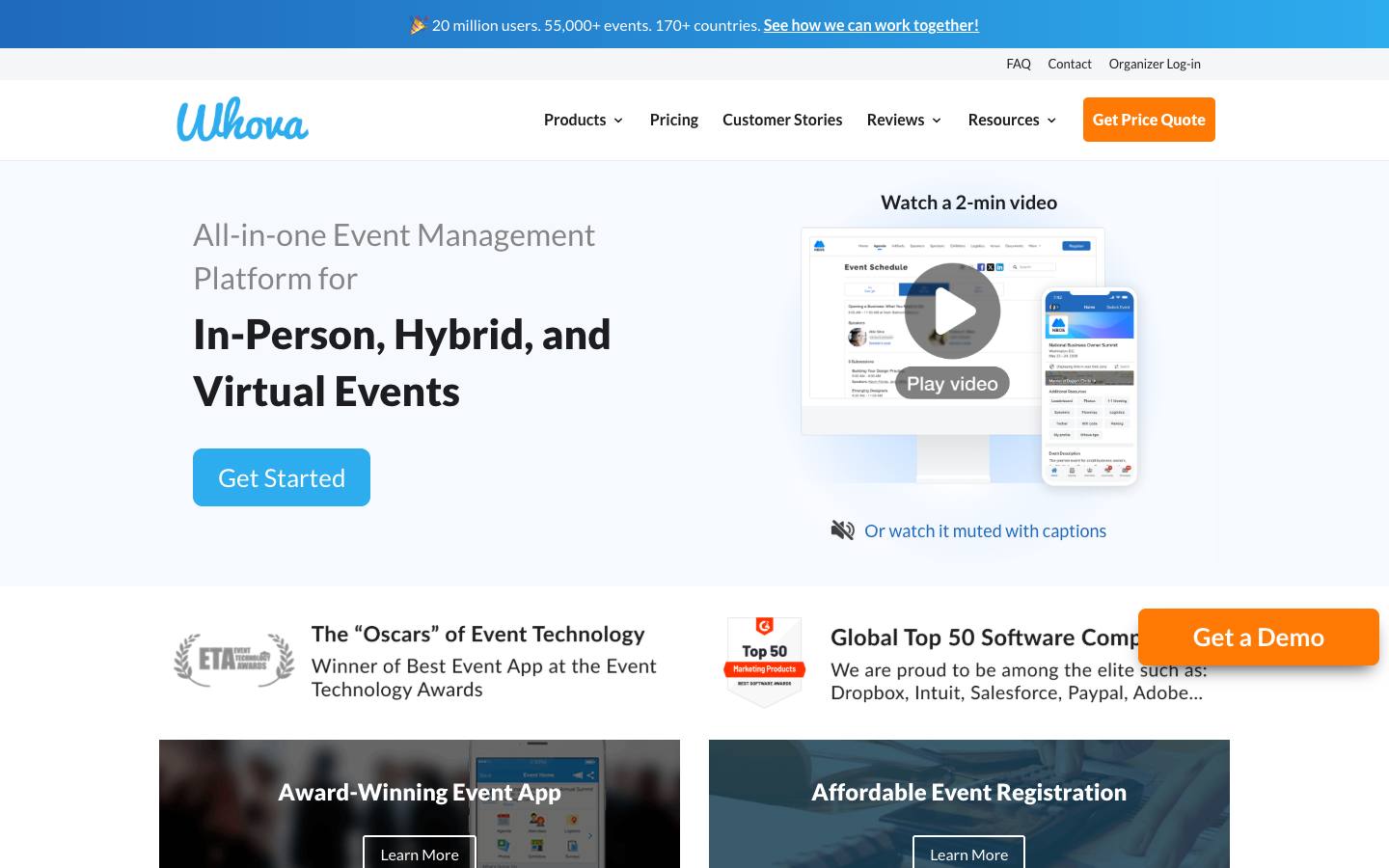
Whova, founded in 2012 in San Diego, pairs its event app with a Speaker Center that acts as a hub for speaker details. Speakers added to a session on the agenda appear in the Speaker Center automatically, and accepted speakers from its call for speakers land there too (checked November 2026).
More on WhovaLess on Whova
Founded: 2012 · HQ: San Diego, California · Team: 51-200 people · Formats: In-person, Virtual, Hybrid
Instead of a task list, Whova uses speaker forms. Speakers fill in their own bio, photo, documents and session information, and organizers add custom fields for things like AV needs, dietary restrictions and accessibility needs. Scheduled emails link speakers to their forms, which cuts individual follow-ups. Speaker email templates cover welcome, logistics and registration messages, and organizers can email the whole speaker group or message one speaker through the app or web portal, with timestamps showing what was sent. Updates sync to the event app, the agenda and speaker web pages, which can be embedded on your own site or hosted by Whova.
For promotion, Whova produces shareable images for LinkedIn, Facebook and X, and speakers get promo images for their own sessions. Pricing is by quote based on format, length, attendee count and events per year (October 2026). It lists SOC 2 Type II and integrates with HubSpot, iMIS and Zapier, but it lists no Salesforce or Marketo connector. It holds a 4.8 Capterra rating from 2,493 reviews as of October 2026. Its speaker page doesn't describe task deadlines, speaker agreements or travel booking.
- Updates sync to the app, agenda and speaker pages
What stands out
- Speaker forms with custom fields such as AV needs
- Group and individual speaker messaging
- Promo images for speakers to share
Worth checking
- No published pricing
- No Salesforce or Marketo connector listed
Best suited for. Whova fits associations, academic and corporate conferences that want speaker details, the agenda and the attendee app from one vendor. Teams that need task deadlines with reminders or contracts should look at Sessionboard or Cvent.
10. Zuddl, best for B2B marketing teams that want a speaker portal with task lists and document uploads on a seat-based license
From $10,000/year
- Price
- From $10,000/year
- Capterra
- 4.5/5 from 11 reviews
- App Store
- 3.0/5 from 2 ratings
- Syncs with
- Salesforce, HubSpot, Marketo
- Security
- SOC 2 Type II, ISO 27001, SAML SSO, DPA
- Customers include
- Motive, NASSCOM, Google
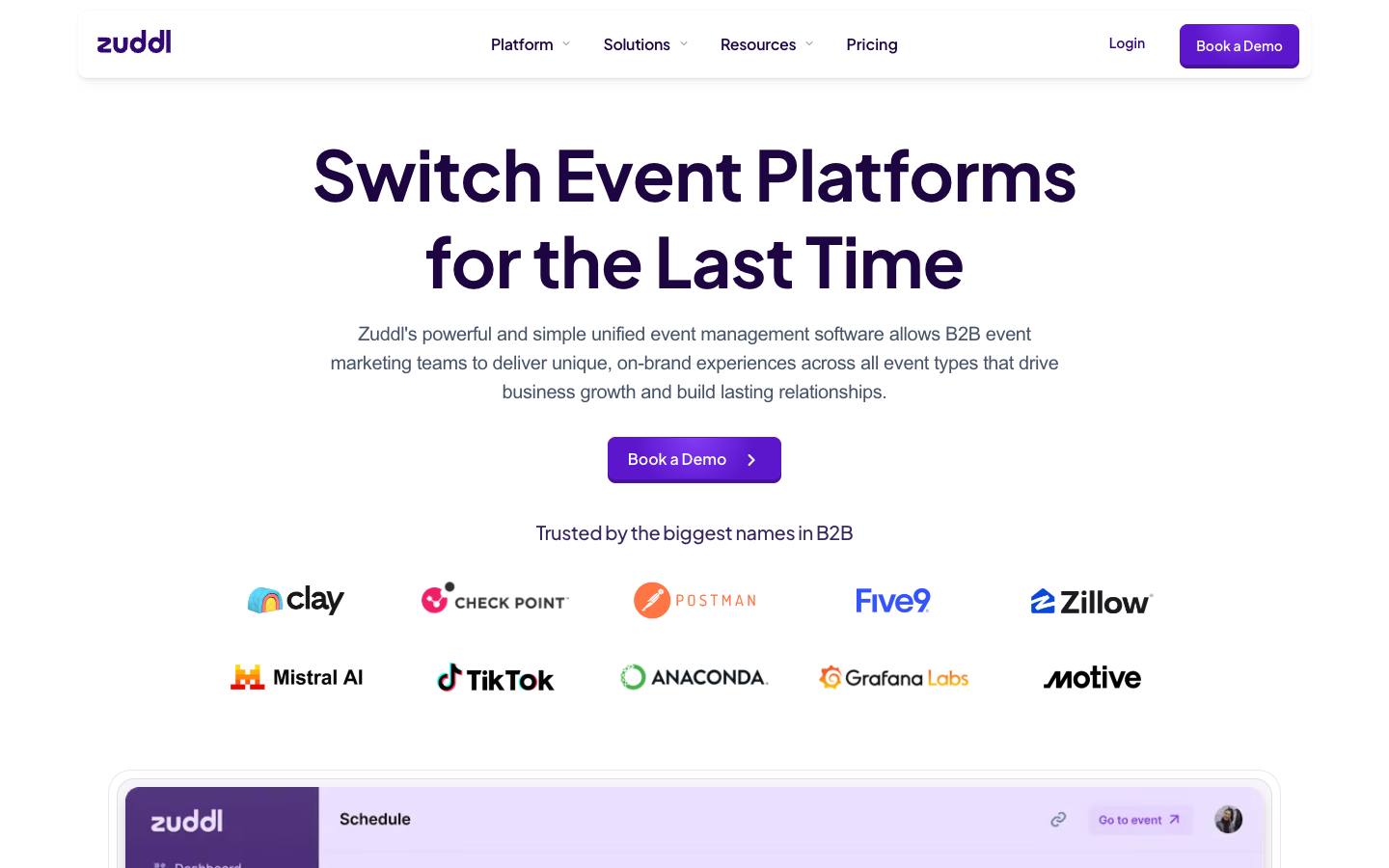
Zuddl, founded in 2020 and based in San Francisco, is a B2B event platform for webinars, field events and conferences with a combined speaker and exhibitor portal. Licenses start at $10,000 a year for two organizers, with no per-event or per-registration fees (checked November 2026).
More on ZuddlLess on Zuddl
Founded: 2020 · HQ: San Francisco, California · Team: 51–200 people · Formats: In-person, Virtual, Hybrid, Webinar
The portal gives speakers a place to track their tasks, and Zuddl's page shows a speaker task list with due dates and review statuses. Document uploads make the portal the hub for signed agreements and session presentations, which makes Zuddl one of the few vendors in this guide to mention agreements at all. Speakers can also publish session content and see self-serve session analytics, with attendance and interaction data in real time. In our feature research the portal handled tasks and speaker details, but we found no call for papers or review workflow, so it fits invited lineups.
Portals are an optional add-on on top of the license, alongside the mobile app and event hub, and a platform fee scales with account size, so the full cost needs a quote. Extra collaborator licenses are $170 a month billed annually. Zuddl lists SOC 2 Type II, ISO 27001:2022 and ISO 27701, and says its integrations with Salesforce, HubSpot, Marketo and Eloqua are native. Named customers include BigCommerce, Zylo, Tricentis and Motive, and most teams go live in two to three weeks. Its Capterra rating is 4.45 from 11 reviews as of October 2026. The portal page doesn't describe reminders or bio and headshot collection.
- SOC 2 Type II, ISO 27001 and ISO 27701
What stands out
- Speaker task list with due dates and review statuses
- Uploads for signed agreements and presentations
- No per-event or per-registration fees
Worth checking
- Portals are a paid add-on
- No call for papers workflow found
Best suited for. Zuddl fits B2B marketing teams running webinars, field events and a flagship conference on one license with invited speakers. Teams that run an open call or want portal pricing up front should compare Accelevents or a dedicated tool.

11. Accelevents, best for mid-market teams that want a speaker portal included on every plan of an all-in-one platform
From $7,500/event
- Price
- From $7,500/event
- Try it
- Free trial
- Capterra
- 4.7/5 from 164 reviews
- App Store
- 3.7/5 from 23 ratings
- Languages
- English
- Syncs with
- Salesforce, HubSpot, Marketo
- Security
- SOC 2 Type II, ISO 27001, SAML SSO
- Customers include
- University of Waterloo, Carnival Cruise Line, Payoneer
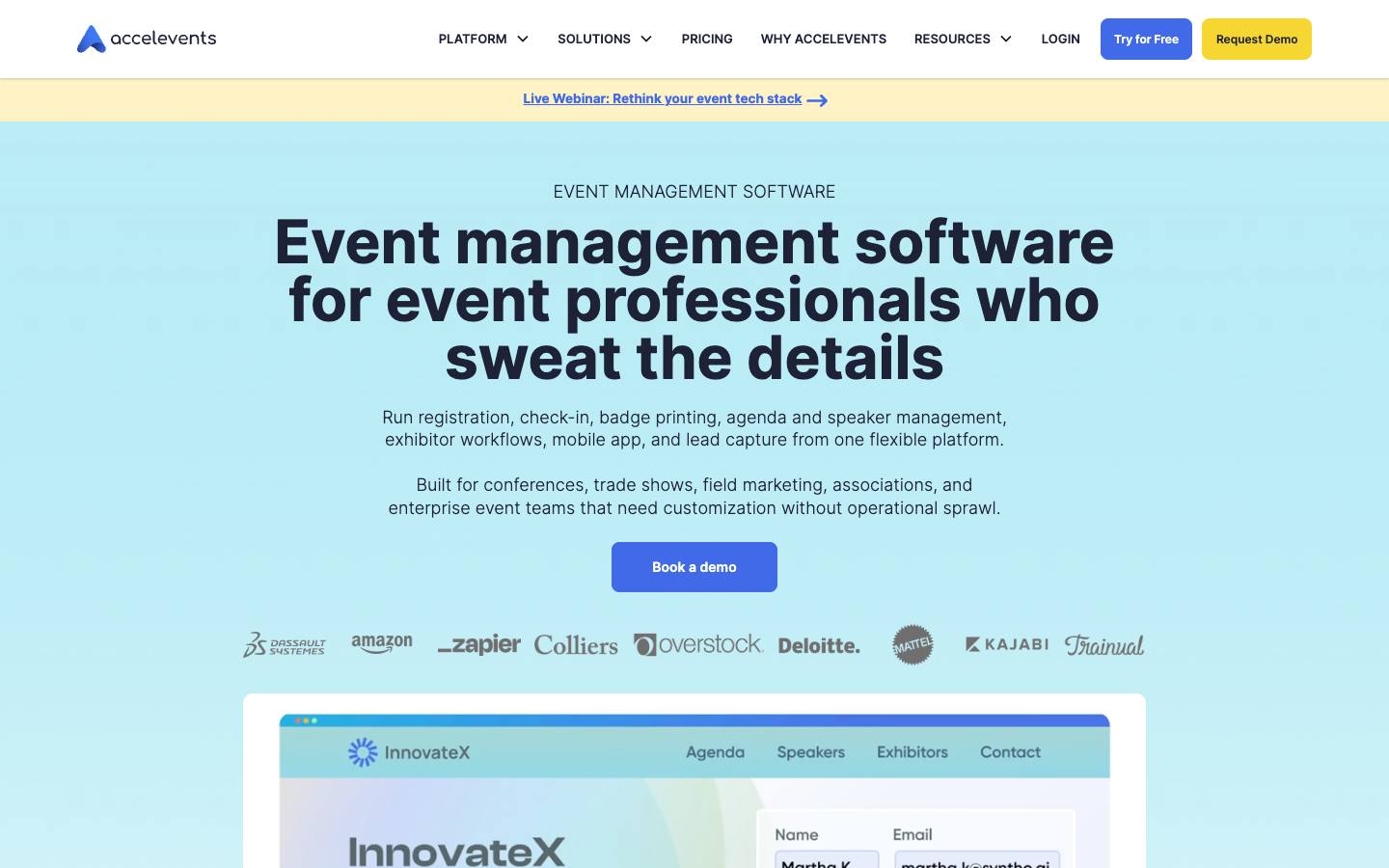
Accelevents, founded in 2015 in Boston, is an all-in-one event platform that lists its speaker portal on all four plans. Professional starts at $7,500 for a single event and Business at $13,500 a year for unlimited events (checked November 2026), and every plan includes unlimited admin seats.
More on AcceleventsLess on Accelevents
Founded: 2015 · HQ: Boston, MA · Team: 51-200 people · Formats: In-person, Virtual, Hybrid, Webinar
Each speaker gets a personal portal to complete a profile, upload a headshot and session handouts, test camera and microphone, and see their speaking schedule. Organizers add speakers and sessions by hand or by bulk import, and edits update the agenda in real time. Speaker profiles and session details show in the mobile app and virtual event hub. A call for speakers adds a register-as-a-speaker button, a form with conditional logic, and approve, deny or waitlist decisions with automated emails, and the vendor says confirmations and reminders can be scheduled. After the event, reports cover session registration, attendance, views, document downloads and feedback.
Check the packaging of the call for speakers: the plan comparison lists abstract management and call for speakers as a paid add-on, while the Enterprise plan card lists it as included. The mobile app, virtual hub and single sign-on are paid add-ons too (October 2026). Accelevents lists SOC 2 Type II and ISO 27001, connects natively to Salesforce, HubSpot and Marketo, and includes an MCP server on all plans. It has a 4.73 Capterra rating from 164 reviews as of October 2026, and named customers include Amazon Robotics, Zapier and Deloitte. Its speaker page doesn't describe task lists, deadlines or a report of outstanding items.
- Unlimited admin seats
What stands out
- Speaker portal on all four plans
- Published prices from $7,500 an event
- Camera and microphone test in the portal
Worth checking
- Call for speakers may be a paid add-on
- No speaker task lists or deadline tracking described
Best suited for. Accelevents fits associations, agencies and B2B marketing teams that want registration, agenda, speakers and onsite tools from one vendor with a published starting price. Programs that need detailed speaker task tracking should add or choose a dedicated tool such as Sessionboard.

12. EventsAir, best for PCOs and associations that manage presenters, AV requirements, travel and accommodation in one platform
Quote only
- Price
- Quote only
- Capterra
- 4.7/5 from 80 reviews
- App Store
- 2.2/5 from 63 ratings
- Languages
- Global language support (languages not listed)
- Syncs with
- Salesforce, HubSpot, Dynamics, Marketo
- Security
- SOC 2 Type II, SAML SSO
- Customers include
- MIT, The University of Sydney, ASEAN-Australia Special Summit
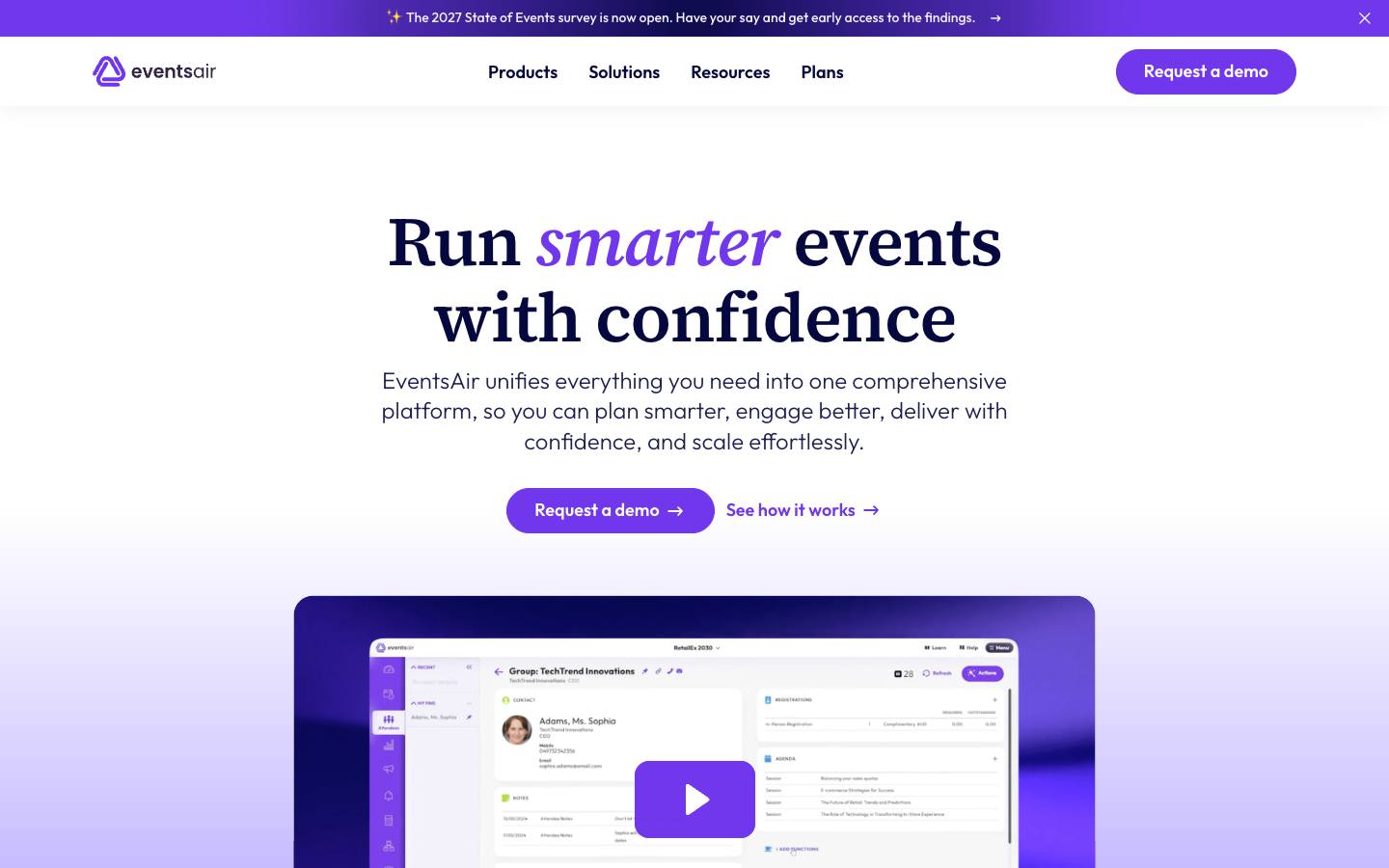
EventsAir, developed by Australia's Centium Software and founded in 1990, is an all-in-one platform popular with professional conference organizers, associations and universities. It manages presenters and speakers alongside registration, abstracts, travel and accommodation, and every license includes the full feature set.
More on EventsAirLess on EventsAir
Founded: 1990 · HQ: Eight Mile Plains, Queensland · Team: 51-200 people · Formats: In-person, Virtual, Hybrid
Presenters use a portal to submit and edit abstracts, upload supporting materials and manage their submissions (checked November 2026). The platform tracks presentation files and AV requirements for each presenter, keeps deadlines for submissions, reviews and scheduling, and sends an instant notification when a presenter checks in onsite. Speakers can run live polls and moderate Q&A, presenters can be given pre-scheduled meetings, and attendees can complete session surveys in the app. Reports cover presenter submissions, session engagement and survey feedback, on top of more than 150 predefined reports. Because the same system handles hotel allocations and travel, a speaker's logistics can sit beside their sessions.
Pricing is by quote across Single, Multi and Enterprise licenses, scoped by number of events, and Single covers one event with up to three platform users (pricing page checked October 2026). CRM and association system connections, including Salesforce and HubSpot, run through Smart Connectors sold as an add-on, and every plan includes a GraphQL API. EventsAir lists SOC 2 Type II and has a 4.65 Capterra rating from 80 reviews as of October 2026. Customers include Microsoft, MCI, ICCA and King's College London. Its presenter page doesn't describe automatic reminders, bio and photo collection or speaker agreements, so ask to see those steps.
- Onsite presenter check-in alerts
What stands out
- Presenter portal for materials and submissions
- Tracks presentation files and AV requirements
- Travel and hotel allocations in the same platform
Worth checking
- No published pricing
- CRM connectors are a paid add-on
Best suited for. EventsAir fits professional conference organizers and associations that handle speaker travel, hotel rooms and presentations for complex congresses. B2B marketing teams with a simpler speaker lineup will find a dedicated tool lighter to run.

13. eventPower, best for associations and government conferences that want speaker software with planner support
Quote only
- Price
- Quote only
- App Store
- 4.2/5 from 16 ratings
- Languages
- English
- Syncs with
- Salesforce
- Security
- DPA
- Customers include
- AICPA, Centers for Disease Control (CDC), Maxar
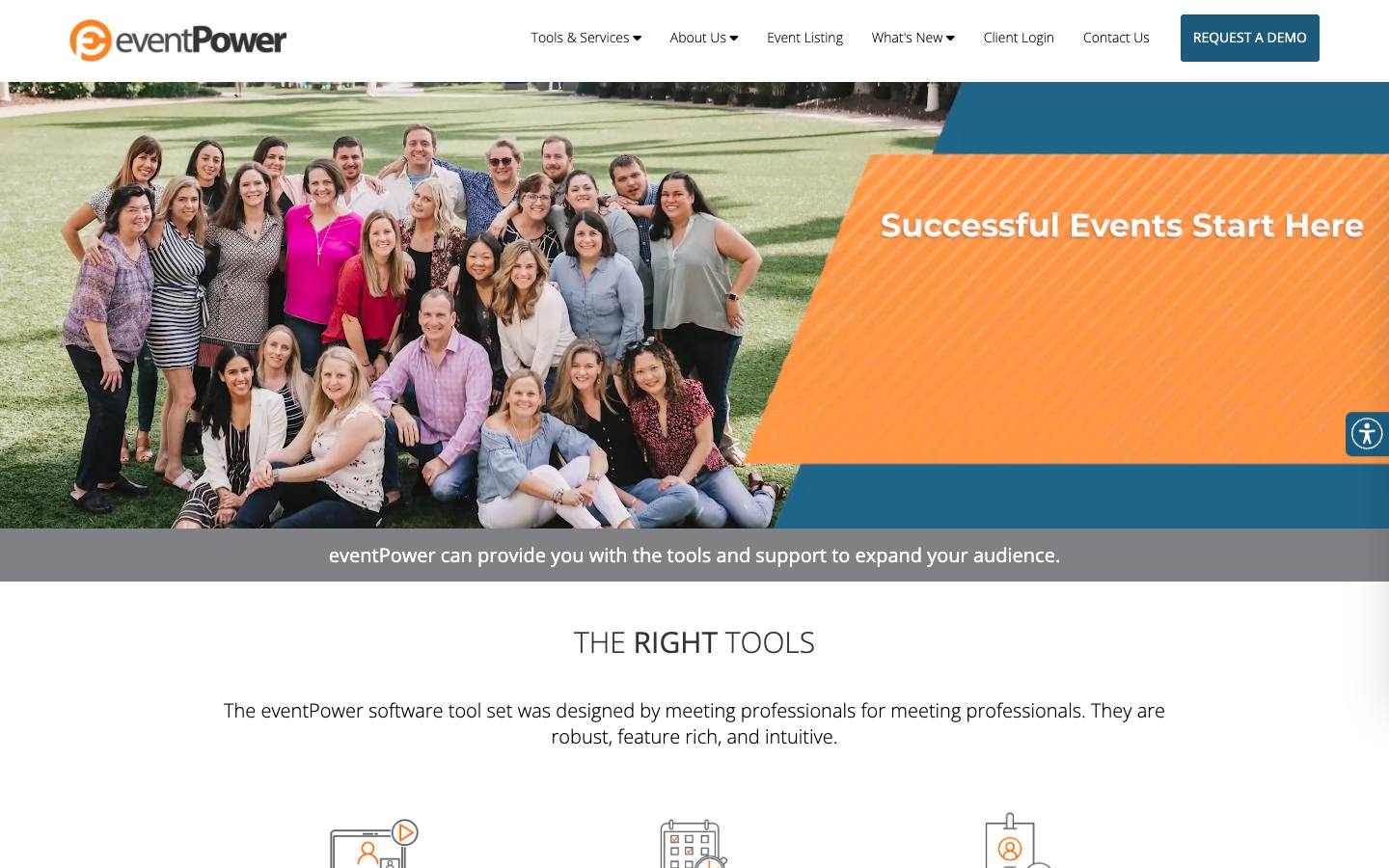
eventPower is a Tampa, Florida provider founded in 1996 by meeting planners who produced government and military conferences. It sells conference software together with a team of certified meeting professionals, and its speaker management module covers the period from a speaker's invitation to the moment they're on stage.
More on eventPowerLess on eventPower
Founded: 1996 · HQ: Tampa, Florida · Team: 51-200 people · Formats: In-person, Virtual, Hybrid
Each presenter gets a secure portal to upload a bio, headshot, slides and AV needs (checked November 2026). Organizers use it to share presenter kits, travel details, presentation templates and session instructions, and targeted messages go to groups by submission type, category or role. Agenda changes sync in real time to the event website, mobile app and streaming platforms without manual imports. A feature called FileSync loads updated presentations in the session rooms automatically, which removes a common onsite scramble. Custom reports pull speaker and session data on demand. The same vendor covers paper submission and review, registration, exhibits, matchmaking and lead retrieval.
No pricing is published (October 2026). Customers include the American Hospital Association, AICPA, the CDC, the US Department of Energy, AFCEA and Neo4j. Its integrations page lists association management, housing and event tools such as iMIS, Salesforce, Cvent and Swapcard without saying which are native, and it offers a public API. Its security page says it conforms to SOC 2 criteria with periodic audits but doesn't state a report type. The speaker page doesn't describe task lists, deadlines, reminders or speaker agreements, and the product isn't positioned for CRM-driven marketing programs.
- Planner services bundled with the software
What stands out
- Presenter portal for bios, headshots, slides and AV needs
- FileSync loads updated slides in session rooms
- Agenda sync to website, app and streaming
Worth checking
- No published pricing
- Not built for CRM-driven marketing programs
Best suited for. eventPower fits associations and public-sector organizers that want planner-led support with their speaker and conference software. Self-serve marketing teams that want published pricing and CRM attribution should look at Accelevents or Bizzabo.
Picks 6 to 13 are folded to keep the list short. Open any of them, or compare them all in the table above.
Also worth considering
Swoogo, Sched, Zoho Backstage, pretalx, Grenadine, SpotMe, Cadmium (Eventscribe), X-CD Technologies
The best speaker management software by use case
Media company running 15 conferences a year with registration on Cvent or Swoogo
Mid-market, Enterprise
Look at Sessionboard
portals, reminders, contracts and platform connectors
Exhibition organizer with content stages feeding Swapcard and digital signage
Mid-market, Enterprise
Look at Lineup Ninja
unlimited events on one annual license
Developer conference with 80 speakers and a volunteer team
Startup, Mid-market
Look at Sessionize
$499 an event with unlimited speakers
Community conference with no software budget
Startup
Look at Speaker Dream
free for one event with unlimited speakers
Corporate team already running registration and the agenda on Cvent
Mid-market, Enterprise
Look at Cvent
session-specific tasks and reminders in the same system
Enterprise software company with a flagship user conference
Enterprise
Look at RainFocus
speaker portal on the same data as the session catalog
B2B marketing team with invited speakers across webinars, field events and one summit
Mid-market, Enterprise
Look at Zuddl
task lists plus uploads for signed agreements
Association congress that also books speaker travel and hotel rooms
Mid-market, Enterprise
Look at EventsAir
travel and accommodation in the same platform
| If you need | Company size | Look at |
|---|---|---|
| Media company running 15 conferences a year with registration on Cvent or Swoogo | Mid-market, Enterprise | Sessionboardportals, reminders, contracts and platform connectors |
| Exhibition organizer with content stages feeding Swapcard and digital signage | Mid-market, Enterprise | Lineup Ninjaunlimited events on one annual license |
| Developer conference with 80 speakers and a volunteer team | Startup, Mid-market | Sessionize$499 an event with unlimited speakers |
| Community conference with no software budget | Startup | Speaker Dreamfree for one event with unlimited speakers |
| Corporate team already running registration and the agenda on Cvent | Mid-market, Enterprise | Cventsession-specific tasks and reminders in the same system |
| Enterprise software company with a flagship user conference | Enterprise | RainFocusspeaker portal on the same data as the session catalog |
| B2B marketing team with invited speakers across webinars, field events and one summit | Mid-market, Enterprise | Zuddltask lists plus uploads for signed agreements |
| Association congress that also books speaker travel and hotel rooms | Mid-market, Enterprise | EventsAirtravel and accommodation in the same platform |
What results look like
Figures customers report in the vendors' own published case studies. They describe one customer each, not what every buyer should expect.
13
Conferences run
Diversified with Sessionboard · Case study
2,600
KubeCon Europe 2024 submissions
The Linux Foundation with Sessionize · Case study
134+
Events per year
Autodesk with RainFocus · Case study
60%
App adoption rate
Compass with Bizzabo · Case study
90%
App adoption rate
University of New South Wales with Whova · Case study
75+
Annual events
Motive with Zuddl · Case study
How to choose
Background on what these tools do, how we ranked them and what to check before you buy. Open any topic.
What speaker management software actually is (and what it isn't)
Speaker management software runs the stretch between a speaker saying yes and that speaker walking on stage. It gives each speaker a portal or dashboard with a task list and deadlines, sends reminders, and collects the bio, headshot, slides, AV needs and travel details an event team would otherwise chase by email. It also handles bulk and one-to-one messages, ties each speaker to sessions, pushes approved profiles to the agenda on the event website and app, and shows organizers who still owes what. Some tools add speaker agreements, a cross-event speaker database and share graphics that speakers can post.
It isn't call for papers software, which collects session pitches and runs review and selection, though most products here include a call for speakers and hand accepted speakers straight to the portal. It isn't abstract management software, which handles peer-reviewed research, posters and proceedings for scientific meetings. An agenda builder places sessions into rooms and time slots and usually shares the same speaker records. A speakers bureau tool, which helps you find and book paid speakers, is a different product again, and so is the audio equipment sold as a loudspeaker management system.
For B2B event teams, the jobs are getting complete, on-brand speaker content in on time, cutting the back-and-forth email, keeping one source of truth when sessions move late, giving AV and production the right files, and turning speakers into a promotion channel for registration.
How we ranked these speaker management software tools
We checked each product against the jobs an event team has once speakers are confirmed, using our vendor profiles, published pricing and the vendors' own product and help pages. Speaker features were checked against vendor pages in November 2026.
1. Speaker portal and tasks
Whether speakers get a portal or dashboard with tasks, and whether deadlines and reminders are documented, from vendor product and help pages.
2. Asset collection
Which items the product collects, such as bios, headshots, slides, AV needs, agreements and travel details, from vendor pages.
3. Communication and tracking
Bulk and individual speaker messages, message logs and any report of outstanding items, from vendor pages.
4. Agenda and platform sync
How speaker and session data reaches the event website, app and registration platform: same record, native connector, embed or API feed.
5. Published pricing and packaging
Whether a price is published, any speaker or event limits, and whether the speaker portal sits on a higher plan or is an add-on, from vendor pricing pages.
6. Security documentation
SOC 2 and ISO 27001 status from our security research on each vendor's public pages.
More on our process in the methodology.
What to look for in speaker management software
Start with the speaker's side. Each speaker should get a portal or dashboard that shows their sessions, what you need from them and by when, ideally without another password to remember. Sessionboard, Lineup Ninja, Cvent, Bizzabo and Zuddl document task lists, and Sessionboard, Lineup Ninja, Cvent and Bizzabo document reminders. Sessionize and Whova reach a similar result with custom forms and scheduled emails.
Then check what gets collected: bio, headshot, slides, session description, AV needs, dietary and accessibility needs, travel details and a signed agreement. Look at who can edit what, and whether changes need approval before they publish. On the organizer's side you want bulk and one-to-one messages with a log, a view of who still owes what, and exports for the AV and production team. Finally, check how speaker profiles reach the agenda on your website and app, and whether the tool gives speakers a graphic to share.
What speaker management software costs
Dedicated tools publish prices (checked November 2026). Sessionize is free for community events and $499 per professional event with unlimited speakers. Sessionboard's Starter plan is $985 a year for one event and 25 speakers, and Growth is $2,485 a year for three events and 75 speakers each, with speaker portals on the quoted Pro and Enterprise plans. Speaker Dream is free for one event, then $1,499 a year for 12 events. Lineup Ninja showed £2,900 a year per team for unlimited events at 100 speakers a year, plus £600 for onboarding. AgendaForge is $2,000 an event with 50 speakers, or $4,000 unlimited.
Platforms cost more because the speaker portal comes with registration and the agenda. Accelevents starts at $7,500 an event with the portal included, and Zuddl starts at $10,000 a year with portals as an add-on (both checked November 2026). Bizzabo starts at $17,999 a year with the speaker portal as an unpriced add-on (checked October 2026). Swoogo sells its Call for Speakers add-on from $2,000 a year for one user on top of its platform (checked November 2026). Cvent, RainFocus, Whova, EventsAir and eventPower quote. Watch for speaker caps, per-event limits, paid onboarding and integration setup fees.
Dedicated speaker tool or your event platform's module
A platform module wins on simplicity. In Cvent, RainFocus, Whova, Accelevents and EventsAir, speakers sit on the same record as sessions and registration, so a changed bio or a moved session doesn't need a sync to reach the agenda. That works well when one team owns the program and the speaker list is modest.
A dedicated tool earns its place when speakers are the hard part: several hundred speakers, a portfolio of events that reuse the same people, contracts, or a content team that's separate from the registration team. Sessionboard lists 83 integrations and sends sessions and speakers to registration and app platforms, Lineup Ninja connects to apps such as Swapcard and Grip, and Sessionize and AgendaForge publish embeds and API feeds. If you add one, confirm there's a maintained connector to your registration platform and event app, and decide which system is the source of truth for session times.
How speaker management differs from call for papers and agenda tools
These categories overlap, and many products do more than one. Call for papers software, covered in our call for papers software guide, is about choosing speakers: a submission form, reviewers, scoring and decisions. Speaker management software starts once the decision is made, whether the speaker was accepted through a call or invited directly. That's why Bizzabo and Zuddl appear here with speaker portals even though we found no call for papers workflow in either.
Abstract management software, covered in our abstract management software guide, serves scientific and medical meetings with peer review, disclosures, posters and proceedings. Cadmium, X-CD Technologies and CTI Meeting Technology manage faculty and presentations for those meetings and are better judged there. An agenda builder, covered in our agenda builder guide, is about placing sessions in rooms and time slots. Most picks here include one, so compare them on speaker follow-through, not on the grid.
Questions to ask speaker management vendors
What does a speaker see when they log in, and do they need a password? Can we set tasks per session or per speaker type, with due dates and automatic reminders? Which items can speakers upload or edit themselves, and can we approve changes before they publish? Is there a view or report of who still owes what, and can we message only those speakers? Can we send and track speaker agreements, or collect a signed copy? Where do travel, hotel and AV details live? How do speaker profiles and session changes reach our website, event app and registration platform, and how often? Which plan includes the speaker portal, and are there caps on speakers or events? Can we reuse a speaker's profile at the next event? What security and privacy documents can you share?
How to get speakers to deliver on time
Ask for less, earlier. Send one welcome message with every deadline, then split the work into small tasks with their own dates: confirm the session title, then the bio and headshot, then AV and travel needs, then slides. Put the headshot size and slide template in the task itself. Chase only the speakers who are late, and do it from the tool so replies stay on the speaker's record. Give each speaker something back, such as their session time, room and a ready-made graphic to share. Our free speaker card generator makes those graphics in bulk from a CSV if your tool doesn't.
Where this fits in your event tech stack
Speaker management software sits between your content team and everything attendees see. Upstream, speakers arrive from a call for speakers or a direct invitation, sometimes started from a CRM record: Sessionboard, for example, offers an invite-to-speak action in Salesforce and HubSpot. Downstream, approved bios, headshots and session details flow to the registration platform (Cvent, Bizzabo or Swoogo), the event app (Swapcard, Grip or Whova) and the website agenda, natively in a platform or through connectors, embeds and API feeds in a standalone tool. Slides and AV needs go to the production team. Share graphics go back to speakers, either from the tool itself or from promotion tools such as Snöball and Gleanin, which both Sessionboard and Lineup Ninja list as integrations.
FAQ
What is speaker management software?
What is a speaker portal?
How much does speaker management software cost?
What free speaker management software is there?
How is speaker management software different from call for papers software?
How does speaker management software connect to the event app and website?
How do you manage speakers for a conference?
Is speaker management software the same as a loudspeaker management system?
Pick the speaker tool that fits your program
Count your speakers and events for the year.
List what each speaker has to hand in, and by when.
Decide whether speakers should live in your event platform or beside it.
Check which plan includes the speaker portal.
Then run one event's speaker list through a trial or demo.
Ready? Build your shortlist in two minutes, or try the free speaker card generator.
Get a free shortlistKeep reading
Related buyer's guides
How-to guides
Ratings link to their source and are shown as published on the date of our last check. Read our methodology.