Best Abstract Management Software in 2027: The Buyer's Shortlist
By EventMarketingSoftware.com · Published October 18, 2026 · Updated October 19, 2026 · 13 tools compared
Abstract management software runs the scholarly side of a conference: the submission portal, peer review, reviewer assignment, decisions, author notifications and the abstract book. Oxford Abstracts is the most accessible pick for academic and scientific meetings, with a free tier and per-event plans from $890. Fourwaves and Dryfta publish annual prices with blind review, Cadmium, X-CD and CTI serve large medical societies, and EasyChair, OpenConf and ConfTool suit program committees on tight budgets.
Our top picks
- 1
 Oxford AbstractsBest for academic and scientific conferences that want to start free and pay per eventFrom $890/event
- 2
 FourwavesBest for research conferences that want blind review, registration and an app on one annual planFrom $999/year
- 3
 Ex OrdoBest for scholarly societies whose committee changes every year and wants a guided, per-conference setupQuote only
Key takeaways
- Pricing is unusually transparent in this category. Eight of our 13 picks publish prices, from free tiers at Oxford Abstracts, Fourwaves, EasyChair, ConfTool and MeetingHand to paid plans of $890 an event, $999 a year and $1,499 a year (checked October 2026).
- Pricing models differ, so model your own volume. EasyChair charges per submission ($4.00 to $13.50), MeetingHand $4.90 per abstract or registration, Oxford Abstracts per event, and Fourwaves and Dryfta by annual abstract caps, so the same 300-abstract meeting can cost very different amounts.
- Review depth is the core test. Dryfta supports single, double and triple-blind review, Fourwaves includes conflict-of-interest detection with its peer review, and OpenConf and Converia assign reviewers by topic with conflict rules. Check how reviewers are matched and how scores roll up before anything else.
- Medical and large scientific societies need more than review. Cadmium, X-CD and CTI add speaker disclosures, ePoster collection, slide delivery to session rooms and continuing-education credit tracking. All three are quote-only and sold after a demo.
- Integrations are thin across the category. Most academic tools connect only to payment gateways and file exports, while Cadmium lists iMIS, Fonteva, Nimble AMS and Salesforce, Dryfta syncs with Salesforce and Converia connects to SAP and DATEV. If member data lives in an association management system, check that link first.
Free tool: CFP review scorer skill. A free skill for Claude, ChatGPT and any SKILL.md agent: it applies an anchored 1 to 5 rubric to submissions, flags duplicates and missing info, and drafts accept, waitlist and decline recommendations.
Side-by-side comparison
The same criteria for every pick: review workflow, reviewer assignment and conflicts, program and abstract book output, published pricing, integrations and data. A dash means the vendor doesn't publish it.
| Tool | Starting price | Free plan / trial | CRM | Capterra | App Store | Security |
|---|---|---|---|---|---|---|
| Oxford Abstracts | From $890/event | Free plan | – | – | – | – |
| Fourwaves | From $999/year | Free plan | – | – | – | SAML SSO, DPA |
| Ex Ordo | Quote only | – | – | – | – | DPA |
| Cadmium (Eventscribe) | Quote only | – | Salesforce, Dynamics | – | ★ 4.6 (8,239) | SOC 2 Type II, SAML SSO |
| X-CD Technologies | Quote only | Free trial | – | – | – | SOC 2 Type I |
| CTI Meeting Technology | Quote only | – | – | – | – | – |
| Dryfta | From $1,499/year | Free trial | Salesforce | – | – | SAML SSO, DPA |
| Converia | From €49/month | Free trial | – | – | – | SAML SSO, DPA |
| EasyChair | From $4/submission | Free plan | – | – | – | – |
| OpenConf | From $400/one-time | – | – | – | – | SAML SSO |
| ConfTool | Quote only | Free plan | – | – | – | DPA |
| MeetingHand | From $4.90/registration | Free plan | – | – | – | – |
| Smart Abstract | Quote only | – | – | – | – | – |
This guide is about peer-reviewed submissions: research abstracts, papers, posters and symposia judged by volunteer reviewers. If you're choosing speakers for a B2B or tech conference from session pitches, our call for papers software guide covers tools built for that job, such as Sessionize and Sessionboard. If you want registration, travel and housing on the same platform as your submissions, start with our conference management software guide.
We compared 13 abstract management tools using vendor pricing and product pages, public documentation and our security research, all checked in October 2026.
Who this guide is for. This guide is for associations, learned and medical societies, universities, research institutes, professional conference organizers (PCOs) and B2B conference producers whose program is built from submitted abstracts, papers or posters that a committee peer reviews. It's most useful when you have dozens to thousands of submissions, volunteer reviewers who need a simple workspace, and accepted work that has to become sessions, an abstract book or proceedings.
Not sure which one fits your team?
Answer a few questions about your events, team and CRM and get a free shortlist of tools that fit, with pricing and security details side by side.
Get a free shortlistThe best abstract management software in 2027
We picked 13 abstract management tools and ordered them by fit for the main job: collecting and peer reviewing submissions for scientific, medical and association conferences. The first picks are dedicated academic tools with published prices, followed by platforms for large medical and scientific societies, then budget and self-hosted options for program committees. For each, look at the review workflow, how pricing scales with your submission volume, and whether registration sits in the same system.
1. Oxford Abstracts, best for academic and scientific conferences that want to start free and pay per event
- Price
- From $890/event
- Try it
- Free plan
- Languages
- English
- Customers include
- Brightelm, SIETAR Europa, Society for Neuro-Oncology
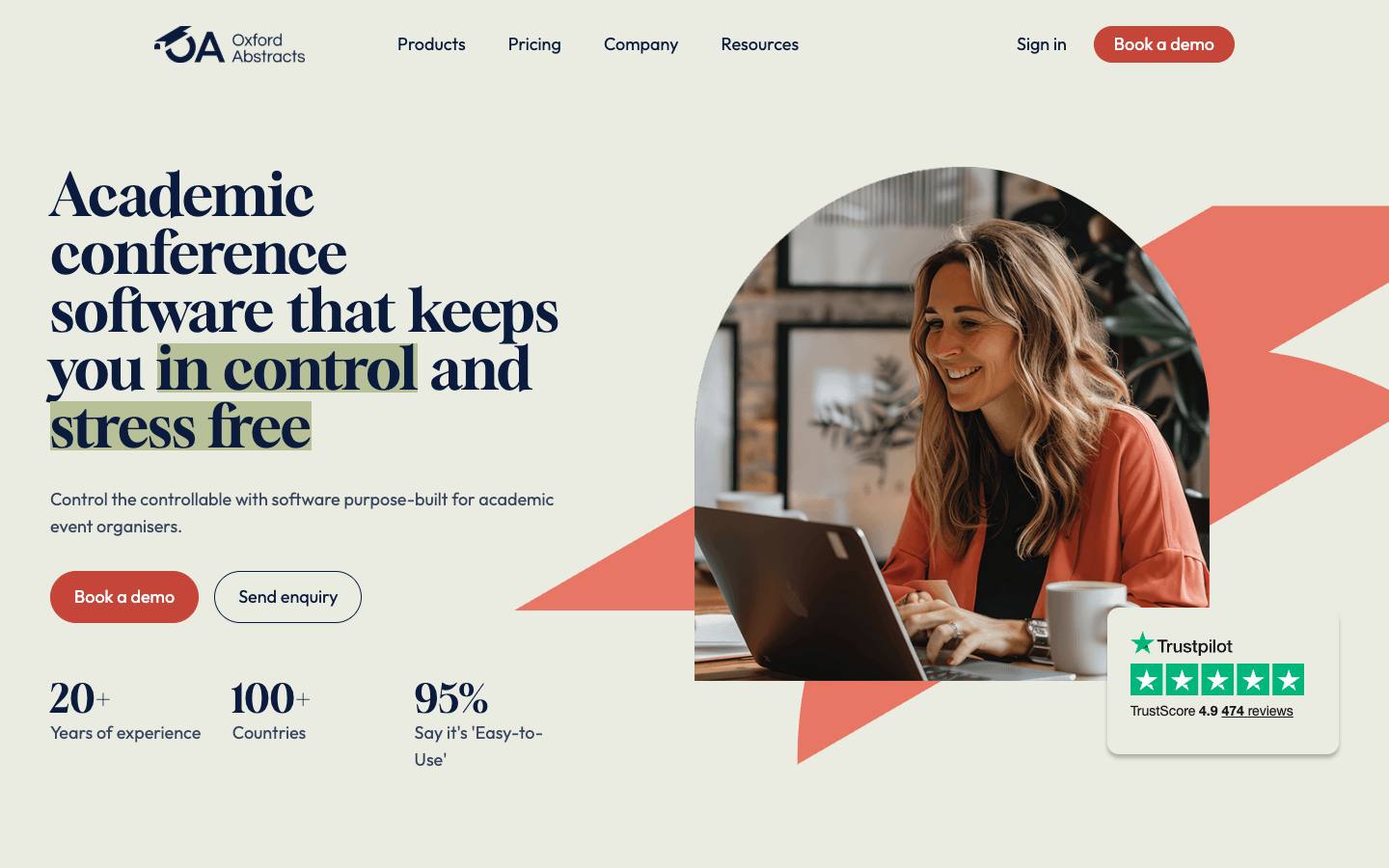
Oxford Abstracts is a UK platform built for academic and scientific conferences, centred on abstract submission, peer review and decisions. It has more than 20 years in abstract management, says it's trusted for over 1,000 events a year in 100-plus countries, and publishes per-event prices with a free entry tier.
More on Oxford AbstractsLess on Oxford Abstracts
Founded: 2004 · HQ: Acharacle, Scotland · Formats: In-person, Virtual, Hybrid
The free Basic tier includes unlimited submissions, the collect, review and decide workflow, reviewer progress tracking, customizable forms and emails, and event ticketing. Abstract Management costs $890 an event and adds detailed reports, instant abstract books, the option to show reviews to submitters, certificates, symposium handling and multi-stage submissions. Conference plans cost $2,290 an event and add a live conference site, program builder, attendee networking, live and on-demand content and an interactive poster gallery (checked October 2026, with GBP, EUR and AUD prices also shown).
Reviewers get an auto-saving workspace with bulk assignment, progress tracking and scheduled reminders. Named customers include the Institution of Engineering and Technology, the University of Oxford, UCLA, the Royal College of Surgeons of England and the Econometric Society. The integration list is limited to payment providers (Stripe, PayPal and Authorize.net), with no CRM connector or public API, and no security certification is published, so teams with an association management system or a formal vendor review should check those points early.
- Bulk reviewer assignment with scheduled reminders
What stands out
- Free Basic tier with unlimited submissions
- Abstract Management at $890 an event, Conference plans at $2,290
- Instant abstract books and an interactive poster gallery
Worth checking
- Integrations limited to payment providers
- No security certification published
Best suited for. Oxford Abstracts fits universities, learned societies and research bodies that want a dedicated review workflow and a free way to start. Medical societies needing CE credits, disclosures and AMS sync should look at Cadmium or X-CD instead.
2. Fourwaves, best for research conferences that want blind review, registration and an app on one annual plan
- Price
- From $999/year
- Try it
- Free plan
- Languages
- English, French
- Security
- SAML SSO, DPA
- Customers include
- Centre de recherche du CHU de Québec, CHU Sainte-Justine, Northern Ontario School of Medicine
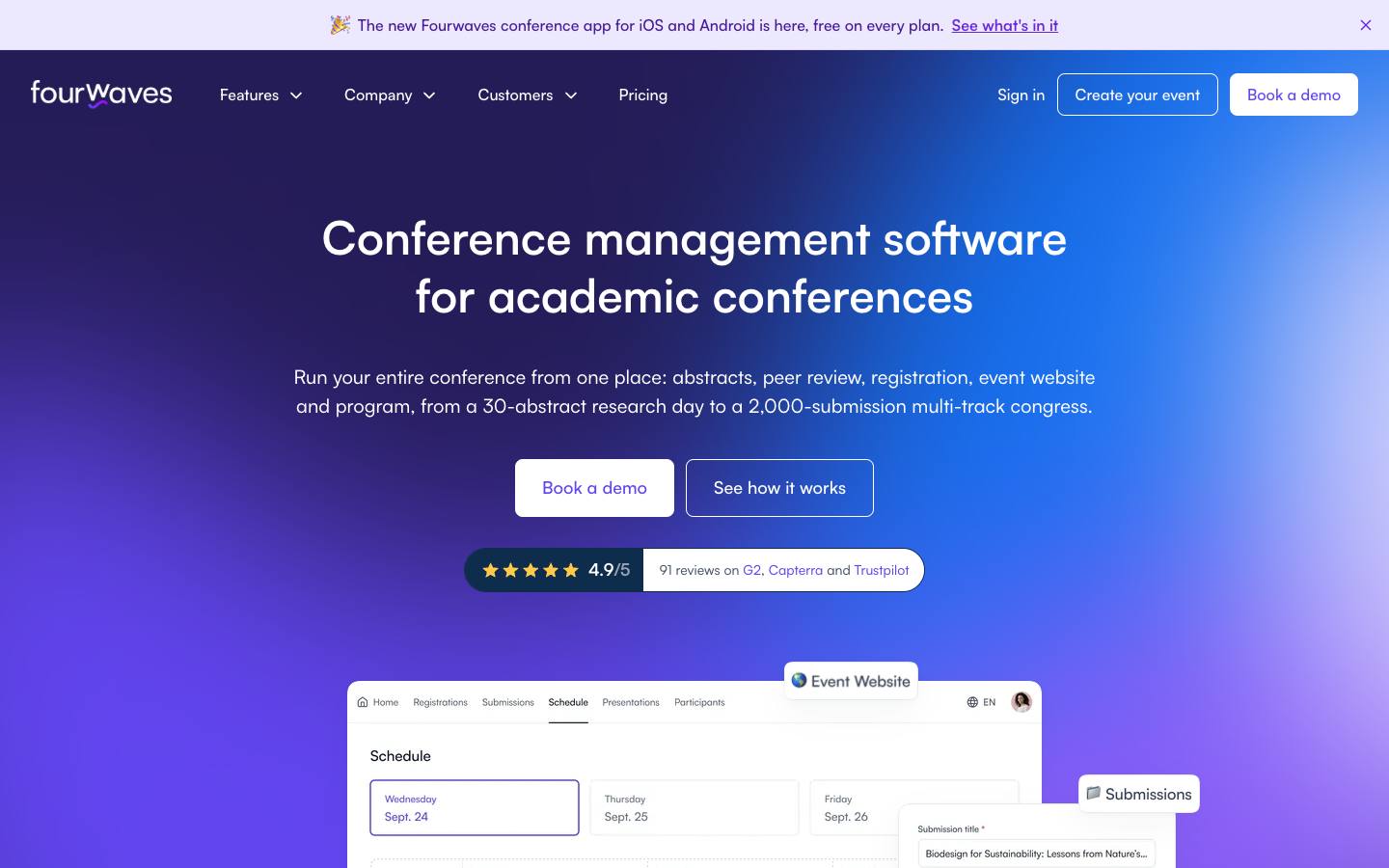
Fourwaves is a Quebec City company, founded in 2012, whose conference software is built for universities, research networks and scholarly societies. It combines abstract submission and peer review with registration, a no-code event website, a program builder, a free conference app and virtual poster sessions, with plans priced by abstract volume.
More on FourwavesLess on Fourwaves
Founded: 2012 · HQ: Quebec City, Canada · Team: 11-50 people · Formats: In-person, Virtual, Hybrid
Starter is free for 25 abstract submissions a year with unlimited registrations and events. Essential costs $999 a year for 100 abstracts and adds a badge generator and email communications. Advanced costs $2,599 a year for 300 abstracts and is the tier that adds peer review, certificates and an onboarding call. Pro is custom, with white label, tracks management and a dedicated account manager. A 2- or 3-year term takes 10% off and locks the price, and a 3% service fee applies when you collect card payments (checked October 2026). When the abstract cap is reached, new submissions pause until you upgrade.
Peer review is single or double-blind, with conflict-of-interest detection and scoring grids, and accepted work exports to a book of abstracts. Fourwaves lists Stripe and PayPal, a Zoom integration, SAML2 or Shibboleth single sign-on and a public API, and works in English and French. Named customers include MIT, Stanford, NASA, NIH, BASF and Memorial Sloan Kettering Cancer Center. It isn't built for marketing-led corporate events, and no formal security certification is named.
- 10% off and a price lock on 2- or 3-year terms
What stands out
- Free Starter plan for 25 abstracts a year
- Single or double-blind review with conflict-of-interest detection
- Unlimited registrations and a free conference app on every plan
Worth checking
- Peer review starts on the $2,599 Advanced plan
- New submissions pause when the abstract cap is reached
Best suited for. Fourwaves fits university departments and scholarly societies running one or more research meetings a year with up to a few hundred abstracts. Organizers with thousands of abstracts, invited faculty and CE credits should compare CTI or X-CD.
3. Ex Ordo, best for scholarly societies whose committee changes every year and wants a guided, per-conference setup
- Price
- Quote only
- Languages
- English
- Security
- DPA
- Customers include
- University of Cambridge, Trinity College Dublin School of Nursing & Midwifery, American Marketing Association
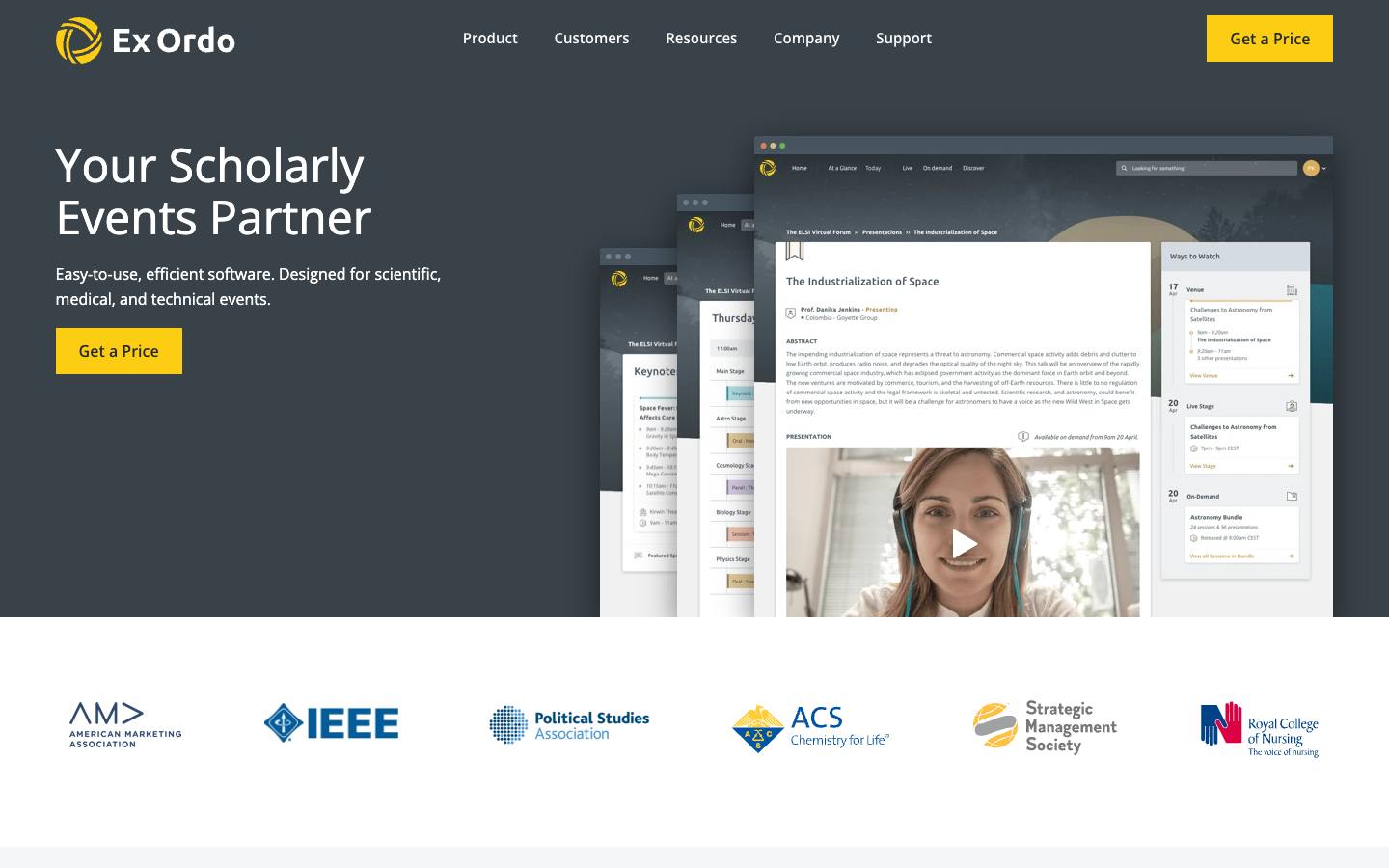
Ex Ordo is a Galway, Ireland platform, founded in 2011, built for scientific, medical, technical and academic conferences whose core workflow is the call for papers. It handles abstract and paper submission with reviewer matching and progress tracking, registration and payments, a program builder for panels and symposia, and a virtual event space.
More on Ex OrdoLess on Ex Ordo
Founded: 2011 · HQ: Galway, Ireland · Team: 11-50 people · Formats: In-person, Virtual, Hybrid
Submission forms cover abstracts, full papers, panels and symposia, and a communications dashboard messages authors, reviewers and delegates from one place, which suits volunteer committees that hand over each year. Registration takes card or bank transfer payments with automated reminders. Add-ons include a book of proceedings and a mobile conference app powered by Guidebook, and the virtual space keeps live and on-demand sessions available for 60 days after the event. Native lookups with the Naylor and Novi association management systems pull member tags and profile fields by email.
Pricing is per conference and only on request: a Get a Price form asks for expected submissions and currency (USD, GBP or EUR), checked October 2026. Ex Ordo assigns an onboarding team to each conference, with human support by email and phone from Ireland and the UK, and it raised $3 million in 2023 from angel investors and Enterprise Ireland. Named customers include the American Marketing Association, SPIE, the Society for Scholarly Publishing and Texas A&M University. Security certifications aren't published, and there are no CRM or Zapier connectors.
- Naylor and Novi AMS member lookups
What stands out
- Reviewer matching and progress tracking for abstracts, papers, panels and symposia
- Onboarding team assigned to each conference
- Book of proceedings and Guidebook-powered app as add-ons
Worth checking
- Pricing only on request
- No published security certifications
Best suited for. Ex Ordo fits scholarly and professional societies that run one conference a year and want hands-on help each time a new committee takes over. Teams that want a published price before talking to sales should compare Oxford Abstracts or Fourwaves.
4. Cadmium (Eventscribe), best for medical and professional associations that want abstracts, posters, CE and their AMS connected
- Price
- Quote only
- App Store
- 4.6/5 from 8,239 ratings
- Syncs with
- Salesforce, Dynamics
- Security
- SOC 2 Type II, SAML SSO
- Customers include
- ASCRS, Association of Rehabilitation Nurses, Microscopy Society of America
Cadmium, based in Forest Hill, Maryland, sells Eventscribe, a conference platform built around content for professional and medical associations. It manages abstract, scholarship and award submissions and reviews, speaker and presentation content, exhibitors, registration, an event website and app, and post-event content and certificates.
More on Cadmium (Eventscribe)Less on Cadmium (Eventscribe)
HQ: Forest Hill, MD · Team: 201-500 people · Formats: In-person, Virtual, Hybrid
Eventscribe sits alongside Cadmium's EthosCE and Elevate learning management systems and Warpwire video platform, so an association can carry accepted abstracts and recorded sessions into continuing education. The event app includes ePosters, session scanning, audience response and evaluations, and the Eventscribe app holds a 4.59 rating from 8,239 App Store ratings (checked October 2026). Its integration list is among the longest here for associations: iMIS, Personify, Fonteva, Nimble AMS, MemberSuite, YourMembership and NetForum, plus Salesforce and Microsoft Dynamics, Map Your Show and A2Z for exhibits, Zoom, Zapier, and CE Broker and ACCME PARS for credit reporting.
Pricing isn't published; buyers request a demo or send an RFP (checked October 2026). Cadmium has 201 to 500 employees and names the U.S. Green Building Council, PRIM&R, ASCRS, the Microscopy Society of America and the Association of Rehabilitation Nurses among customers. It's built for associations and education-led meetings, so corporate B2B teams will find it heavier than they need, and its trust center is published without certifications named on the main product pages.
- Same vendor for conference content, LMS and video
What stands out
- Abstract, scholarship and award submissions and reviews in one system
- ePosters, audience response and evaluations in the Eventscribe app
- Connectors for iMIS, Fonteva, Nimble AMS, Salesforce and CE Broker
Worth checking
- No published prices
- More platform than a single academic meeting needs
Best suited for. Cadmium fits medical and professional associations that award continuing-education credit and want abstracts, posters, recordings and their AMS connected. A university meeting with a few hundred abstracts will spend less with Oxford Abstracts or Fourwaves.

5. X-CD Technologies, best for scientific and medical societies that want AI help scoring large volumes of abstracts
- Price
- Quote only
- Try it
- Free trial
- Languages
- English, French, Spanish
- Security
- SOC 2 Type I
- Customers include
- American Psychological Association, ISACA, United States and Canadian Academy of Pathology
X-CD Technologies is a Toronto company, founded in 1995 with an office in San Francisco, that builds conference and association software for medical, scientific and engineering societies. Its abstract module covers submission, peer review and scoring, track chair workflows and program building, alongside speaker disclosures, registration, CE credits and membership.
More on X-CD TechnologiesLess on X-CD Technologies
Founded: 1995 · HQ: Toronto, Canada (office also in San Francisco) · Formats: In-person, Virtual, Hybrid, Webinar
Its AI tools target the program committee: keyword extraction, completeness checks, suggested scores and thematic clustering for submitted abstracts, which helps when thousands arrive at once. Speaker management collects presentation content and conflict-of-interest disclosures, a common requirement for accredited medical education. Registration covers attendees, groups, exhibitors and sponsors with booth selection, and onsite services include badge printing, check-in, presentation management and a speaker ready room. The interface supports English, French and Spanish.
Pricing is quoted from the modules and volumes you choose, such as submissions, members, attendees, exhibitors and credited participants, and a free trial is offered (checked October 2026). X-CD lists SOC 2 and GDPR. Named customers include the American Psychological Association, USCAP, SHEA, ISACA, SNMMI, ASGCT and SIAM. Integration partners aren't named on the site beyond payment gateways such as Stripe and Authorize.net and a co-author API endpoint, so confirm association management system and CRM connections in a demo.
- SOC 2 listed
What stands out
- AI keyword extraction, suggested scores and thematic clustering
- Track chair workflows and conflict-of-interest disclosures
- Abstracts, CE credits and membership from one vendor
Worth checking
- Quote-only pricing
- Integration partners aren't named publicly
Best suited for. X-CD fits scientific and medical societies with large annual meetings that want abstracts, disclosures, CE and membership in one system. Smaller academic meetings without CE requirements will find Fourwaves or Oxford Abstracts simpler and cheaper.

6. CTI Meeting Technology, best for large medical congresses with thousands of abstracts, invited faculty and ePosters
Quote only
- Price
- Quote only
- Languages
- English
- Customers include
- ESMO, British Society for Rheumatology, British Thoracic Oncology Group
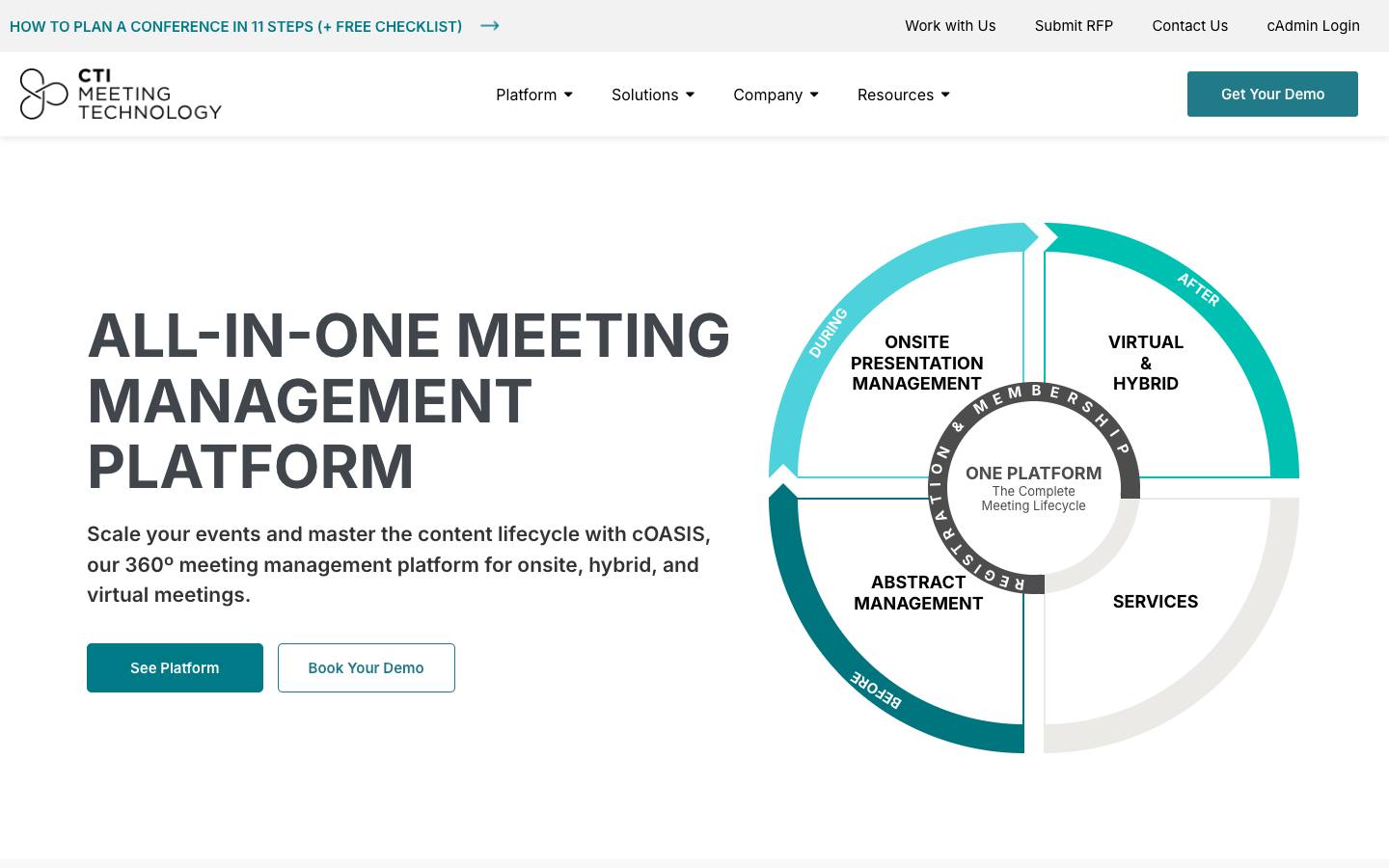
CTI Meeting Technology builds cOASIS, a cloud platform for scientific, technical and medical association meetings, from offices in Chicago and Vienna. The company was founded in 1982 and is privately owned. cOASIS handles abstract and session submission, peer review and scoring, invited faculty and speakers, slide and ePoster collection and the scientific program.
More on CTI Meeting TechnologyLess on CTI Meeting Technology
Founded: 1982 · HQ: Chicago, USA · Formats: In-person, Virtual, Hybrid, Webinar
It's built for very large congresses: named customers include the American College of Surgeons, the American College of Cardiology, the Society for Neuroscience, ESMO and EASD. Beyond review, cOASIS collects presentations and ePosters and delivers them to session rooms, publishes the program with personal itineraries, manages exhibitors and sponsors, and adds streaming, recordings, captions and attendance tracking by sessions attended and minutes viewed, which feeds continuing-education reporting. A mobile app is part of the platform, and training is included in every package.
Pricing isn't published; packages are configured per meeting, and demos and RFPs go through the website (checked October 2026). CTI notes that its registration and membership modules aren't offered in the US, so American societies will pair it with a separate registration provider. Integrations are listed only as part of the cOASIS Complete package without named systems, and security certifications aren't detailed publicly, so ask for both during procurement. It's built for scientific meetings rather than corporate B2B marketing events.
- Training included in every package
What stands out
- Proven at congresses such as ACC, ACS, SfN and ESMO
- Slide and ePoster collection delivered to session rooms
- Attendance tracking by sessions and minutes for CE
Worth checking
- Registration and membership modules aren't offered in the US
- Integrations and certifications not detailed publicly
Best suited for. CTI fits large scientific and medical societies whose congress depends on invited faculty, thousands of abstracts and ePosters. Smaller meetings, or US organizers who want registration in the same system, should compare Cadmium or X-CD.

7. Dryfta, best for research conferences that need triple-blind review, Salesforce sync or self-hosting
From $1,499/year
- Price
- From $1,499/year
- Try it
- Free trial
- Syncs with
- Salesforce
- Security
- SAML SSO, DPA
- Customers include
- Jhpiego, Johns Hopkins Center for Communication Programs, International Association of Applied Linguistics (AILA)
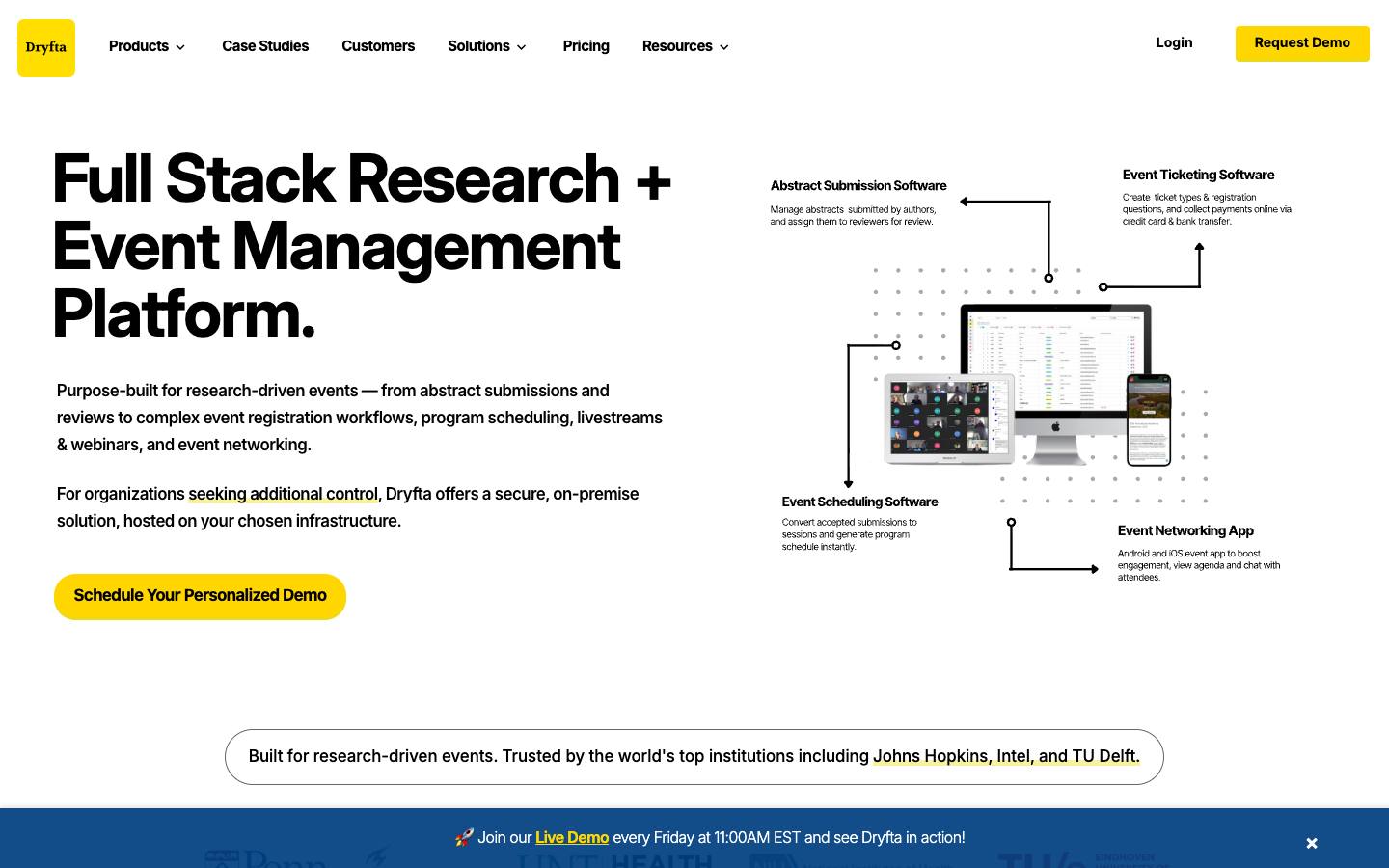
Dryfta is a conference platform for research-driven events run by universities, associations and nonprofits. It pairs abstract submission, single, double or triple-blind peer review and abstract book publishing with registration, a drag-and-drop schedule builder that converts accepted submissions into sessions, an event app and certificates with continuing-education credits.
More on DryftaLess on Dryfta
Formats: In-person, Virtual, Hybrid, Webinar
Pricing is published (checked October 2026). Small is $1,499 a year for 100 abstract submissions with unlimited reviews, 100 registrations, 25 in-person sessions and 3,000 emails. Medium is $14,999 a year for 1,000 submissions, 1,000 registrations, 150 sessions and 10,000 emails, with training sessions and 1,000 printed participation certificates. Large is quoted, and a pay-as-you-go option is priced through a calculator. Nonprofits can get a discount on annual plans, and a free trial is offered.
Reviewers can be assigned automatically or manually, and accepted work is published as an abstract book and searchable index. Dryfta syncs natively with Salesforce, connects other CRMs through a Zapier app, and lists Stripe, PayPal, Square, Mailchimp and Constant Contact. It also offers a self-hosted, on-premise deployment, which is unusual in this category. Named customers include the University of Pennsylvania, Johns Hopkins University, TU Delft, the University of Edinburgh, NIH and Intel. Leadership, headquarters and team size aren't disclosed on the website, which some procurement teams will ask about.
- Optional on-premise deployment
What stands out
- Single, double or triple-blind review
- Published plans: $1,499 and $14,999 a year
- Native Salesforce sync plus Zapier
Worth checking
- Big price step from Small to Medium
- Company leadership and location not disclosed on the site
Best suited for. Dryfta fits universities and research associations that need strict blind review, registration in the same system and, in some cases, self-hosting. Very small meetings will pay less with MeetingHand or Oxford Abstracts' free tier.

8. Converia, best for German-speaking societies and universities that need EU hosting and invoices finance accepts
From €49/month
- Price
- From €49/month
- Try it
- Free trial
- Languages
- German, English
- Security
- SAML SSO, DPA
- Customers include
- University of Cologne, FHNW, DECHEMA
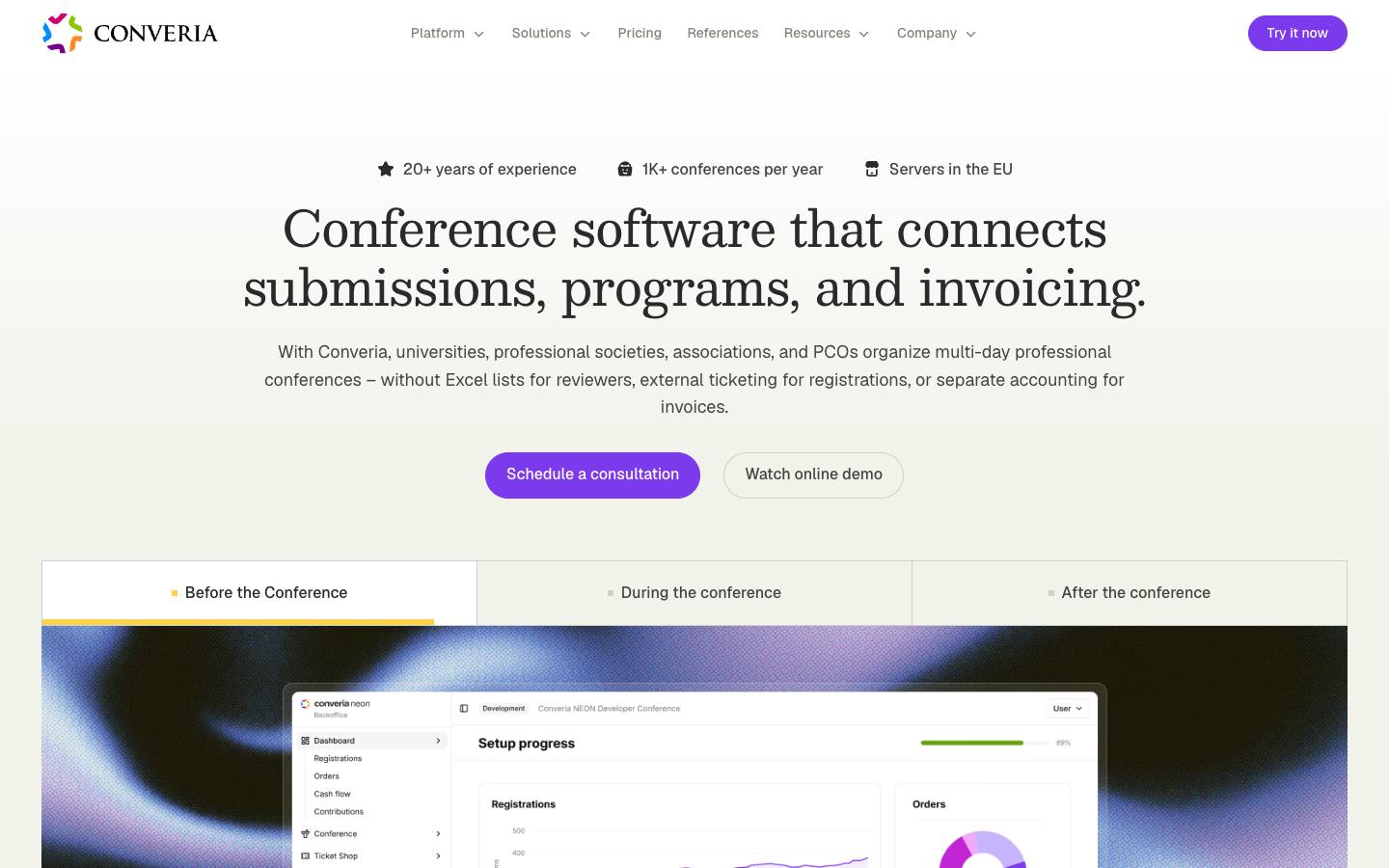
Converia is a conference management system from Weimar, Germany, founded in 2009, that runs abstract submission, peer review with conflict-of-interest rules, program planning with clash detection, registration and tax-compliant invoicing on one dataset. It's built for universities, scientific and medical societies and PCOs, mainly in German-speaking markets.
More on ConveriaLess on Converia
Founded: 2009 · HQ: Weimar, Germany · Formats: In-person, Virtual, Hybrid
Prices are published in euros, net (checked October 2026). Pro plans cover one recurring conference on a monthly fee within an annual contract: Starter is €49 a month for up to 150 participants and 50 talks, Plus is €149 for 300 participants and 150 talks, and Advanced is €349 for 750 participants and 500 talks. Each adds a 2.2% to 2.5% share of ticket revenue, capped at €15 a ticket, with nothing charged on free registrations. Flex plans from €129 a month share annual quotas across several events, and a demo account needs no payment details.
Reviewers are assigned with conflict-of-interest rules, and the program planner builds parallel tracks while flagging scheduling clashes. Converia connects to DATEV and SAP accounting, university single sign-on through Shibboleth, LDAP or OpenID Connect, several European payment providers and a REST API, and hosting is in an ISO 27001-certified data center in the EU. Named customers include RWTH Aachen University, TUM, Messe München, VDE and Volkswagen. Support and much of the documentation are German-first, which matters for English-only teams.
- EU hosting in an ISO 27001-certified data center
What stands out
- Pro plans from €49 a month
- Conflict-of-interest rules and clash detection
- DATEV, SAP and Shibboleth integrations
Worth checking
- Ticket revenue share on top of the subscription
- German-first support and documentation
Best suited for. Converia fits universities, societies and PCOs in Germany, Austria and Switzerland that need EU hosting and accounting exports their finance team accepts. English-first organizers elsewhere will find Oxford Abstracts, Fourwaves or Dryfta easier to work with.

9. EasyChair, best for program committees that want pay-per-submission review with a free tier for small workshops
From $4/submission
- Price
- From $4/submission
- Try it
- Free plan
- Languages
- English
- Customers include
- FLoC, IMDEA Software Institute, Max Planck Society
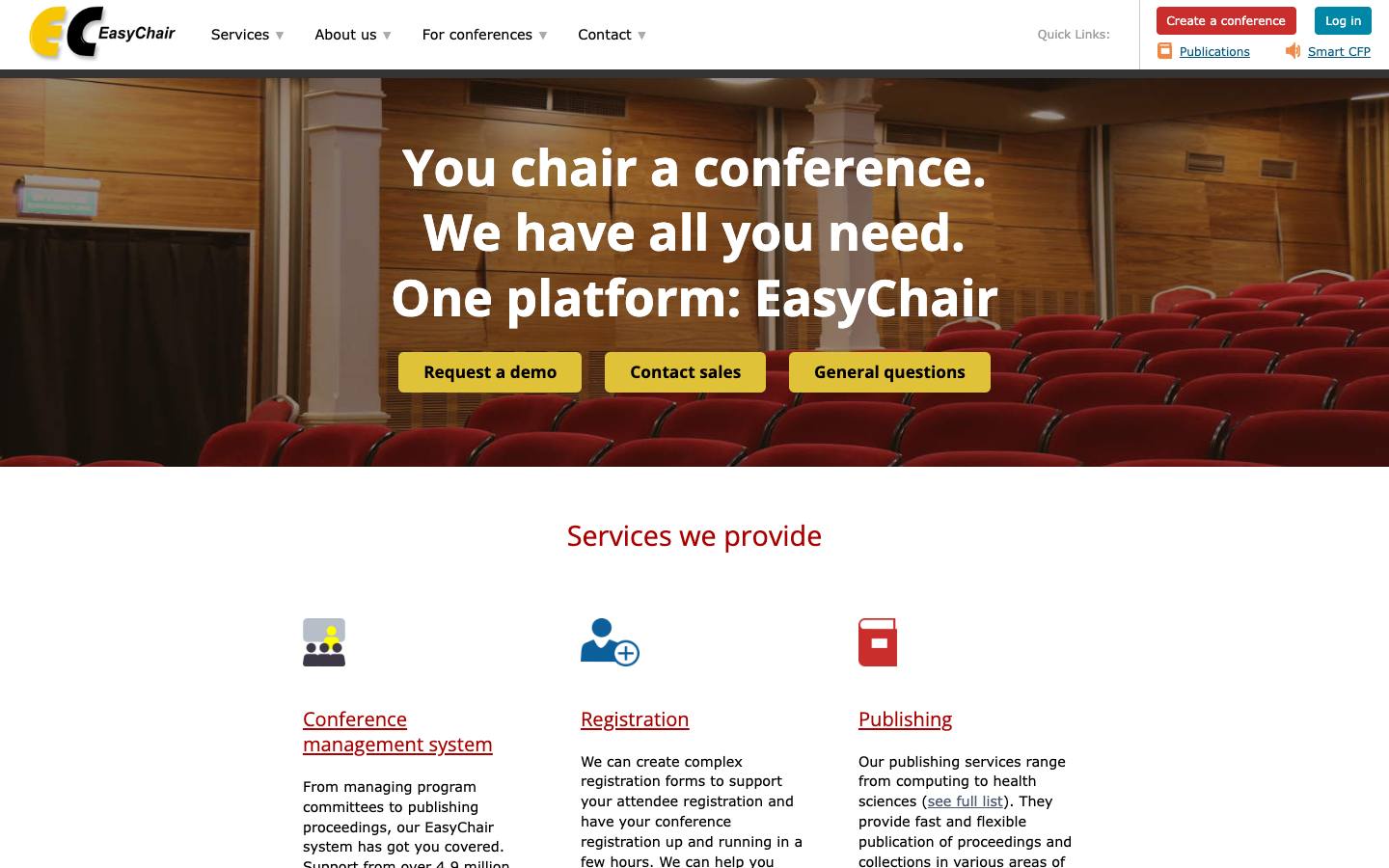
EasyChair is a UK-based conference management system, founded in 2002, used by academic and scientific organizers for calls for papers, submission handling, program committee peer review, registration and proceedings publishing. Authors, reviewers and chairs all work in one environment, which many researchers already know from other conferences.
More on EasyChairLess on EasyChair
Founded: 2002 · HQ: Manchester, UK · Team: 2-10 people · Formats: In-person
Licensing is per submission, published in USD (checked October 2026). The Free license covers up to 20 submissions. The Professional license is $4.00 a submission, pay as you go, up to 60 submissions. The Executive license runs from $6.20 a submission at a fixed price with no minimum down to $3.70 at a 1,000-submission minimum, and the VIP license adds a one-off setup fee from $1,370 plus $6.60 to $13.50 a submission depending on payment plan and volume. Larger minimums cut the rate by up to 40% but need a non-refundable deposit.
Inside EasyChair, authors submit, program committee members review, and chairs make decisions and notify authors, then registration with online payments and proceedings publishing follow on the same data. Smart CFP lists a call for papers publicly, and Smart Program publishes the schedule. EasyChair documents no third-party integrations, Zapier connector or API, and its interface is dated next to commercial event platforms. It isn't designed for marketing-led events, sponsors or lead capture, and costs rise with paper volume.
- Smart CFP public listing of calls
What stands out
- Free license for up to 20 submissions
- Per-submission pricing from $3.70 to $13.50
- Review, registration and proceedings in one environment
Worth checking
- No integrations, API or Zapier
- Dated interface
Best suited for. EasyChair fits academic workshops and conferences run by a volunteer program committee that wants familiar, low-cost review. Societies that need a branded attendee experience, posters or CE credits should look at Fourwaves, Oxford Abstracts or Cadmium.

10. OpenConf, best for technical conferences that want self-hosted peer review or low-cost hosting
From $400/one-time
- Price
- From $400/one-time
- Languages
- Over a dozen languages for author and reviewer interfaces (list not given on pages checked)
- Security
- SAML SSO
- Customers include
- California State University, eBay, Georgia Tech
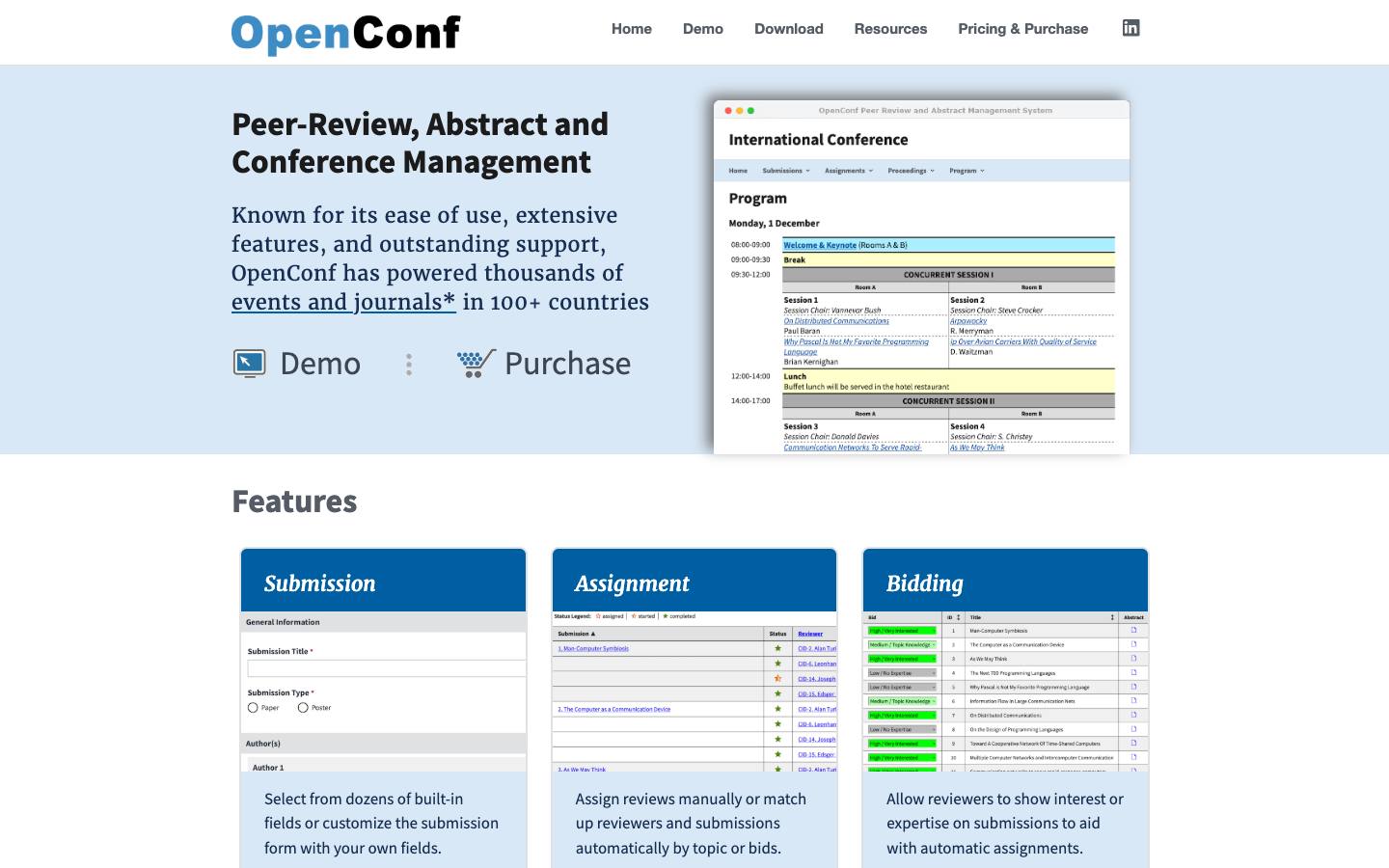
OpenConf, from Zakon Group in New Hampshire, handles calls for papers, reviewer assignment, scoring, acceptance decisions and program or proceedings output for conferences and journals. It's sold as a hosted service or as a licensed download you run on your own server, which suits institutions with strict data rules.
More on OpenConfLess on OpenConf
HQ: Mount Washington Valley, NH · Team: 2-10 people · Formats: In-person, Virtual, Hybrid
Prices are published (checked October 2026). Hosting costs $600 a year and includes the Professional Edition, 100 submissions, 10GB of storage and a year of support, with extra submissions at $200 per 100 at sign-up or $5 each afterward, and single sign-on at $300 a year. Self-hosted licenses cost $400 for the Plus Edition or $900 for the Professional Edition per installation, with unlimited submissions and a year of support, and each recurring annual event needs its own license.
Reviewers can be assigned manually or automatically by topic or bids, with custom review forms and conflict detection, and chairs send individual or bulk decisions with author notifications and rebuttals. Optional modules cover ORCID reviewer credit, ACM and IEEE copyright, iThenticate plagiarism checking and SAML or OIDC sign-on, and the program exports to a web or mobile schedule, a print booklet and online proceedings. Named customers include IEEE, NASA, Stanford University, the American Society of Civil Engineers and MITRE. It's a small team, there's no API or webhooks, and registration and marketing need other tools.
- Self-hosted option
What stands out
- Hosting from $600 a year, licenses from $400
- Automatic reviewer assignment by topic or bids
- ORCID, ACM, IEEE and plagiarism-check modules
Worth checking
- No registration module
- No API or webhooks
Best suited for. OpenConf fits engineering, computing and technical conferences that need rigorous paper review and want to self-host or pay little. Organizers who want registration and an attendee app in the same system should look at Fourwaves, Dryfta or MeetingHand.

11. ConfTool, best for international academic events that need a multilingual interface and German hosting
Quote only
- Price
- Quote only
- Try it
- Free plan
- Languages
- 10 languages
- Security
- DPA
- Customers include
- European Space Agency, University of Cambridge, World Bank Group
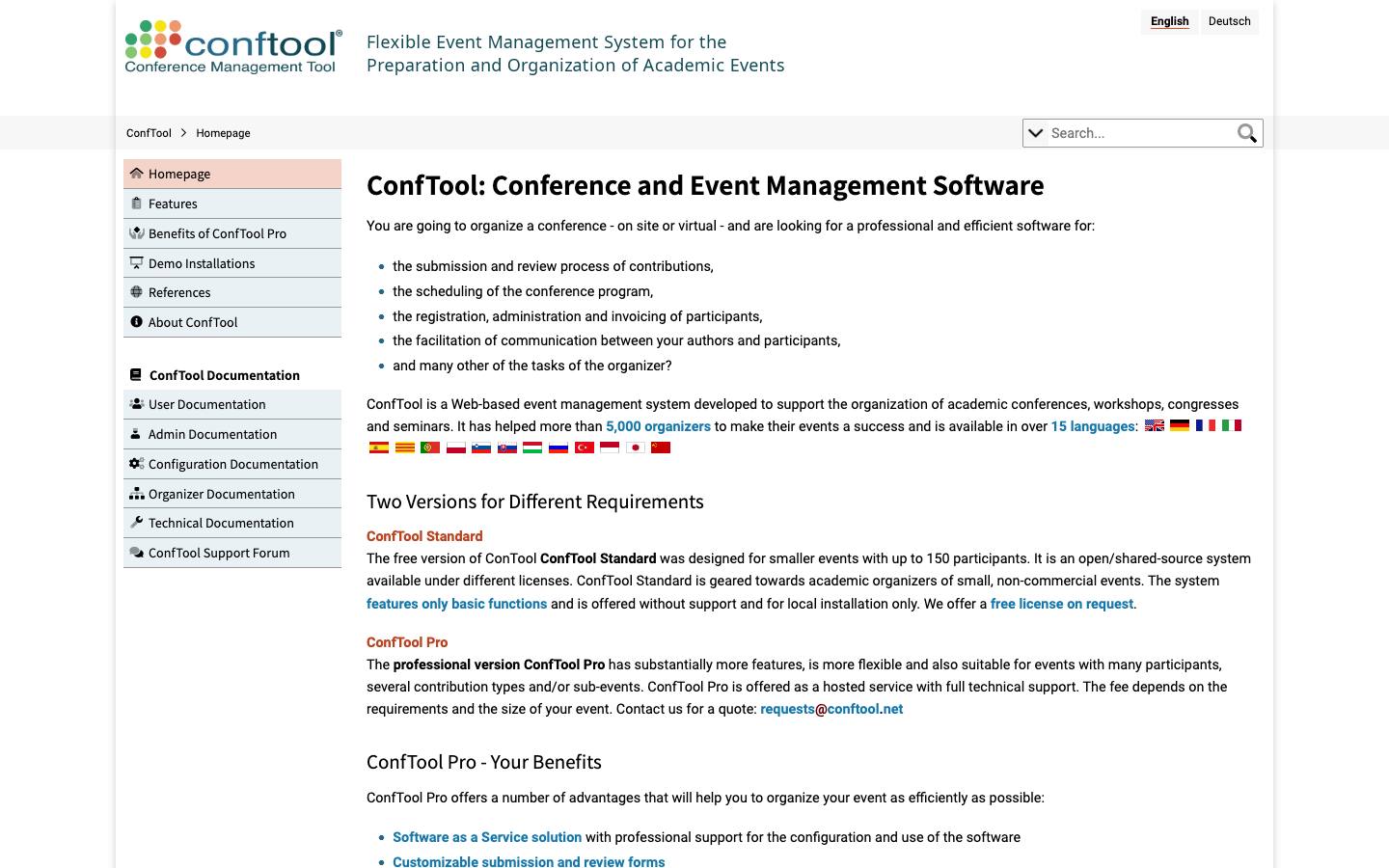
ConfTool is a conference management system from ConfTool GmbH in Hamburg, Germany, founded in 2010, for academic and scientific events. It handles paper and abstract submission, reviewing, program scheduling, participant registration and invoicing, and its site says more than 5,000 organizers have used it.
More on ConfToolLess on ConfTool
Founded: 2010 · HQ: Hamburg, Germany · Formats: In-person, Virtual, Hybrid
There are two editions (checked October 2026). ConfTool Standard is free for smaller events of up to 150 participants, with basic features, no support and local installation only. ConfTool Pro is a hosted service with full technical support, more features and support for many contribution types and sub-events, and its fee depends on the size and requirements of the event, quoted by email. Pro servers are hosted in Germany with a separate database for each conference.
The interface is available in more than 15 languages, including English, German, French, Spanish, Portuguese, Polish, Japanese and Chinese, which helps international societies whose authors and reviewers prefer their own language. Registration forms support conditions, dependencies and capacity limits, and payments run through PayPal, Stripe and optional gateway modules. Other tools such as Whova and Conference4Me are fed by file exports rather than live connectors. Named references include the University of Cambridge, Purdue University, Harvard Medical School, the European Space Agency and the World Bank Group. The form-driven interface looks dated next to newer tools.
- Registration with conditions and capacity limits
What stands out
- Free Standard edition for up to 150 participants
- Interface in more than 15 languages
- Pro hosted in Germany with a database per conference
Worth checking
- Pro pricing only by quote
- Integrations are file exports, not live connectors
Best suited for. ConfTool fits European and international academic conferences that want review and registration together with a multilingual interface and German hosting. Organizers who want a modern attendee-facing site and app should compare Fourwaves or Oxford Abstracts.

12. MeetingHand, best for small academic conferences that want abstracts and registration without an annual contract
From $4.90/registration
- Price
- From $4.90/registration
- Try it
- Free plan
- Languages
- English, Multi-language translations for event pages (languages not listed)
- Customers include
- IDA Desalination Academy, Mass Culture, SimGHOSTS
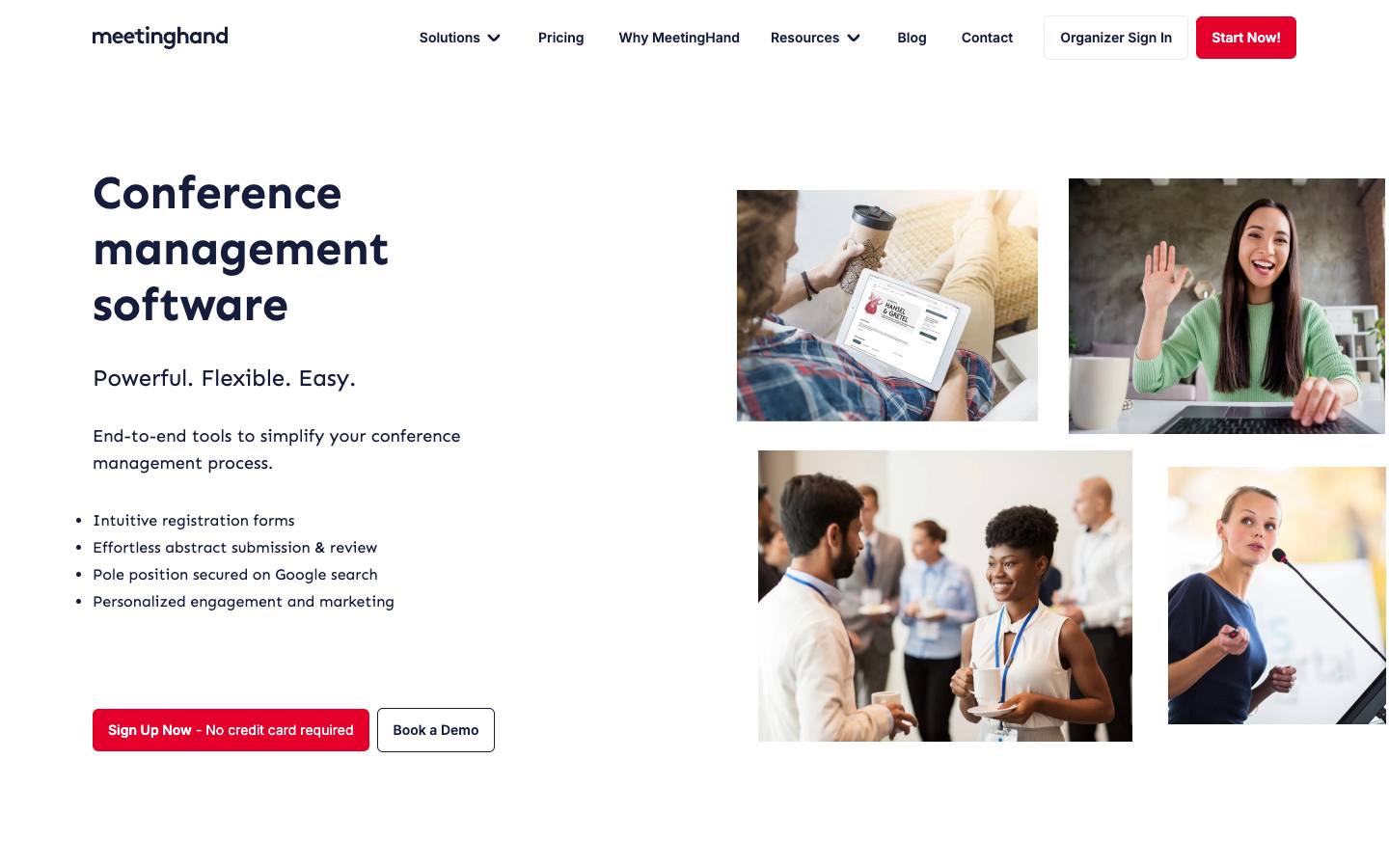
MeetingHand is self-service conference software that combines abstract submission and review with registration and payments, program building, branded websites, QR check-in and virtual sessions. Founded in 2016, it's used heavily by universities, medical schools and associations for academic and scientific conferences, and its pricing is published and usage-based.
More on MeetingHandLess on MeetingHand
Founded: 2016 · HQ: San Francisco, California · Team: 2-10 people · Formats: In-person, Virtual, Hybrid
It's free for up to 25 registrations or abstracts, then $4.90 per registration or abstract pay as you go, or prepaid bundles of $990 for up to 250 and $3,490 for up to 1,000 (checked October 2026). Bundles don't expire and work across events, every plan includes all features with unlimited events and users, and there are no cancellation fees and no card needed to start. Add-ons are a custom domain at $199 and streaming at $39 an hour.
Abstract features include evaluation and reviewer management, agenda scheduling, speaker management and book of abstracts exports, and registration covers workshops, social events and room booking. Support is 24/7 and live. Named customers include the University of Michigan, UCSF, the University of Pennsylvania, UCL, Honeywell and Dell Technologies. The company is small (2 to 10 employees on LinkedIn), lists no CRM or marketing integrations beyond Google Analytics, and publishes no security certifications, so it's best for events that don't go through a formal vendor security review.
- 24/7 live support
What stands out
- Free for up to 25 registrations or abstracts
- $4.90 each, or bundles from $990 that don't expire
- All features on every plan
Worth checking
- No CRM or marketing integrations
- No published security certifications
Best suited for. MeetingHand fits department-run symposia and small society conferences that want abstracts and registration on a pay-as-you-go basis. Larger associations with security reviews or AMS integration needs should look at Cadmium, X-CD or Dryfta.

13. Smart Abstract, best for scientific congresses in German-speaking markets that need conflict-checked program planning
Quote only
- Price
- Quote only
- Languages
- German, English
- Customers include
- München Klinik, Deutsche Gesellschaft für Pathologie, ECCO Congress
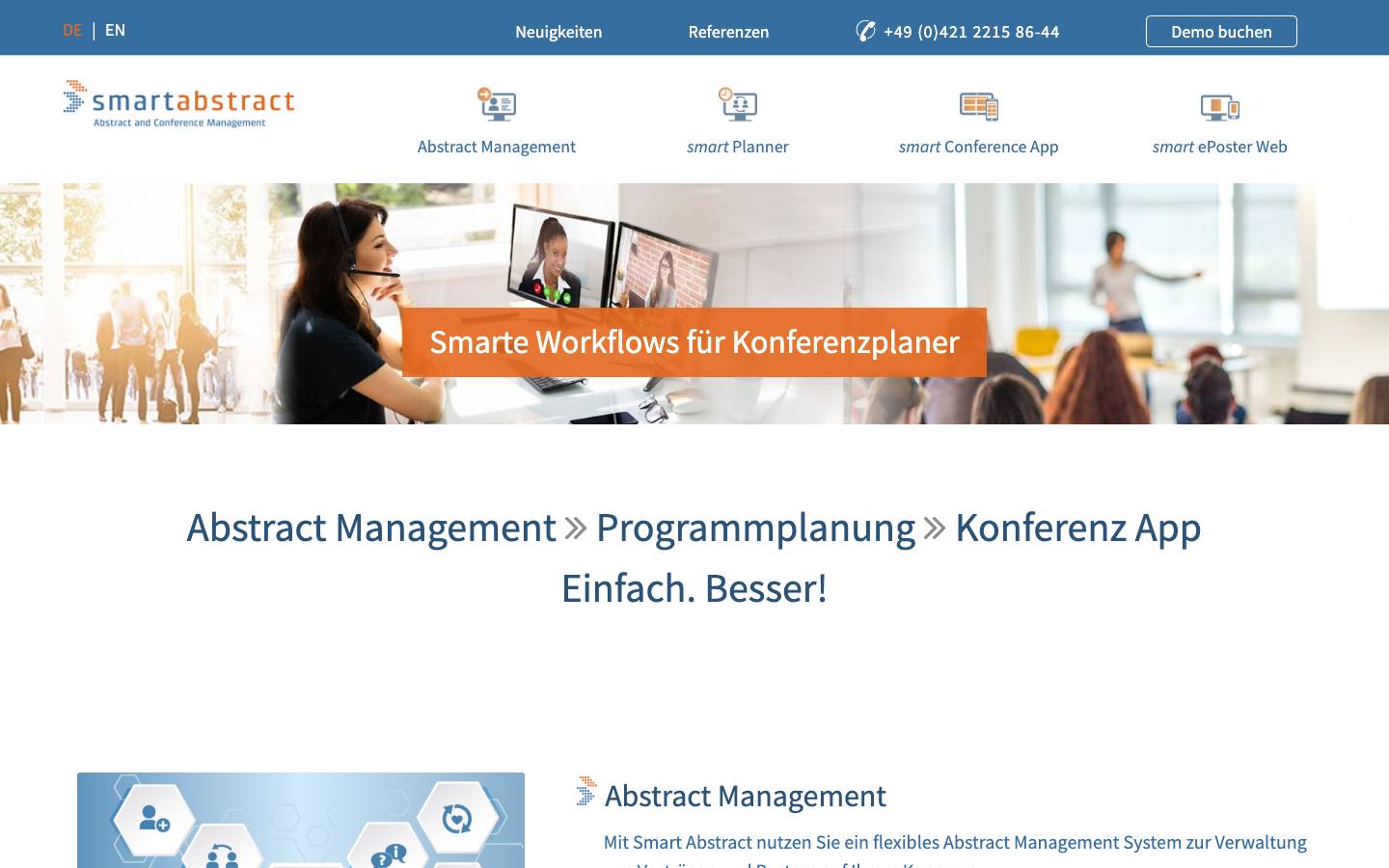
Smart Abstract is a Bremen, Germany conference software suite for associations, PCOs and academic organizers, specialized in the path from abstract to program. It handles abstract submission and review, session assignment and acceptance mailings, then drag-and-drop program planning that flags room and speaker conflicts.
More on Smart AbstractLess on Smart Abstract
HQ: Bremen, Germany · Formats: In-person, Virtual, Hybrid
The smart Planner lays out the program grid by room and time and warns about clashes, which is the step that usually breaks spreadsheets for multi-track scientific meetings. The smart Conference App publishes the live program with support for livestreams and on-demand talks, smart ePoster Web provides a virtual poster gallery during and after the congress, and the suite generates abstract books and post-event evaluation statistics. The site and support work in German and English, with phone and consultation support from the Bremen team and setup help tailored to each organizer's workflow.
Prices aren't published, and demos and consultations are offered (checked October 2026). Named customers include the DGP, ESCR, Messe Bremen, Universität Hohenheim, Universität Kiel, MARUM and SEMI. No registration or ticketing module is described, so pair it with a separate registration tool, and no third-party integrations, API, hosting or security details are published. It fits organizers whose main pain is review and program building rather than delegate registration, and who are comfortable working with a small, specialized vendor.
- German and English support from Bremen
What stands out
- Drag-and-drop planner with room and speaker conflict checks
- Virtual ePoster gallery and abstract books
- Conference app with livestream support
Worth checking
- No registration module described
- No published prices, integrations or security details
Best suited for. Smart Abstract fits German-speaking societies and PCOs whose congress program is complex and multi-track. Organizers who want registration and abstracts from one vendor should look at Converia, Dryfta or Fourwaves.
Picks 6 to 13 are folded to keep the list short. Open any of them, or compare them all in the table above.
Also worth considering
AbstractWiz, MiraSMART, Shocklogic, CYIM (Cyber Imagination), Indico, Whova, Cvent, EventsAir, Slayte, PheedLoop
The best abstract management software by use case
| If you need | Company size | Look at |
|---|---|---|
| Learned society trying a new conference on almost no budget | Startup | Oxford Abstractsfree Basic tier, then $890 an event |
| University research meeting with 300 abstracts and double-blind review | Startup, Mid-market | FourwavesAdvanced plan covers 300 abstracts with peer review |
| Medical association awarding CE credit and syncing with iMIS | Mid-market, Enterprise | Cadmium (Eventscribe)abstracts, posters, LMS and AMS connectors |
| Congress with thousands of abstracts, invited faculty and ePosters | Enterprise | CTI Meeting Technologybuilt for ACC, SfN and ESMO-scale meetings |
| Research institute that must keep submissions on its own servers | Mid-market, Enterprise | Dryftaon-premise option with triple-blind review |
| Computing workshop run by a volunteer program committee | Startup | EasyChairfree to 20 submissions, then per submission |
| German university congress needing DATEV invoices and EU hosting | Mid-market | Converiaaccounting exports and ISO 27001 data center |
| Department symposium with 150 delegates and abstracts, no contract | Startup | MeetingHand$4.90 per abstract or registration |
What results look like
Figures customers report in the vendors' own published case studies. They describe one customer each, not what every buyer should expect.
7-8
Events per year
Centre de recherche du CHU de Québec with Fourwaves · Case study
88%
Time saved on routine tasks
University of Cambridge with Ex Ordo · Case study
9
Speaker modules
American Psychological Association with X-CD Technologies · Case study
4,000+
Total attendees
ESMO with CTI Meeting Technology · Case study
2,722
Abstracts managed
Jhpiego with Dryfta · Case study
~50,000
Students
University of Cologne with Converia · Case study
How to choose
Background on what these tools do, how we ranked them and what to check before you buy. Open any topic.
What abstract management software actually is (and what it isn't)
Abstract management software handles the path from a call for abstracts to a finished scientific program. Authors submit abstracts, papers, posters or symposium proposals through a branded portal with custom fields, co-authors and file uploads. Organizers assign each submission to reviewers by topic or expertise, often blind, with conflict-of-interest rules. Reviewers score against a rubric, chairs make accept, revise or reject decisions, and the system emails authors. Accepted work then becomes sessions, poster boards, an abstract book or published proceedings.
It isn't the same as call for papers software for B2B and tech conferences, which collects session pitches from would-be speakers and helps a content team pick a lineup, usually without formal peer review. It isn't a full conference management platform either, although many tools here add registration, and it's narrower than an agenda builder, which publishes a schedule but doesn't run review. Awards and grants platforms use similar judging workflows for a different job.
For associations, medical societies, universities and research-led conference producers, it does four jobs: attract enough quality submissions, give volunteer reviewers a workspace they'll actually finish, make defensible decisions with an audit trail, and turn accepted work into a program and abstract book without spreadsheets and email chains.
How we ranked these abstract management software tools
We checked each product against the jobs a scientific or association program committee needs done, using vendor pricing and product pages, public documentation and our security research, checked in October 2026.
1. Review workflow
Blind review options, scoring rubrics, multi-stage review and decision handling, from vendor feature pages and documentation.
2. Reviewer assignment and conflicts
Whether reviewers can be matched by topic, bids or expertise, automatically or manually, with conflict-of-interest rules, from product pages.
3. Program and abstract book output
Whether accepted submissions move into sessions, posters, an abstract book or proceedings without re-keying, from feature pages.
4. Published pricing
Whether prices are published and what each plan includes, such as submission caps and per-submission fees, from vendor pricing pages.
5. Integrations and data
Named connections to association management systems, CRMs, payment gateways and APIs, plus hosting and security documents, from vendor pages and our procurement research.
More on our process in the methodology.
What abstract management software should do
At minimum it should handle the full review cycle: a branded submission portal with custom fields, co-authors and file uploads; reviewer assignment by topic or expertise, manual or automatic; blind review options; scoring rubrics; decisions with templated author notifications; and an export of accepted work as sessions, posters or an abstract book. Test it with your real submission form and a few volunteer reviewers before you commit, because reviewer experience decides whether scores arrive on time.
Then check what happens after acceptance. Oxford Abstracts' Conference plan, Fourwaves, Dryfta, Converia and MeetingHand carry accepted work into a program and registration, EasyChair also handles registration and proceedings, while OpenConf and Smart Abstract focus on review and program output and expect you to register delegates elsewhere.
What abstract management software costs
Published prices in our data fall into four models (checked October 2026). Per event: Oxford Abstracts is free, then $890 or $2,290 an event. Per submission: EasyChair is free to 20 submissions, then $4.00 to $13.50 each, and MeetingHand charges $4.90 per abstract or registration or $990 for 250. Annual by volume: Fourwaves is $999 a year for 100 abstracts and $2,599 for 300 with peer review, and Dryfta is $1,499 a year for 100 or $14,999 for 1,000. Hosting or license: OpenConf hosting is $600 a year for 100 submissions and licenses start at $400, and Converia starts at €49 a month plus a ticket revenue share.
Cadmium, X-CD, CTI, Ex Ordo and Smart Abstract quote after a demo, which is normal for platforms that add CE credits, ePosters and onsite services. Watch for caps that pause submissions, per-submission fees that grow with a bigger call, and card processing fees on registration.
Abstract management vs call for papers software
The two overlap, but they serve different programs. Abstract management software is built for peer review: blind review, conflict-of-interest rules, rubric scoring, revise-and-resubmit, posters, abstract books and proceedings, for academic, medical and association meetings where the committee is judging research. Call for papers software for B2B and tech conferences, covered in our call for papers software guide, collects session pitches from speakers, lets a content team vote, then manages speaker profiles, deadlines and agenda publishing, with less formal review and more speaker communication.
If your submissions are research abstracts, start with the tools in this guide. If they're talk proposals for a user conference or industry event, Sessionize, Sessionboard and pretalx are built for that job.
Questions to ask abstract management vendors
How are reviewers assigned, and can we enforce blind review and conflict-of-interest rules by institution or co-authorship? Can we run more than one review round, and can reviewers see each other's scores? What happens when we hit a submission cap mid-call? Can presenting authors register at the right rate from the same person record? How do accepted abstracts become sessions and posters, and what formats does the abstract book export in? Which association management system or CRM do you sync with natively? Where is data hosted, and can you share a SOC 2 report, an ISO 27001 certificate or an accessibility statement?
Getting volunteer reviewers to finish
Most review delays come from reviewers, not software, so pick a tool that reduces their effort. Look for a workspace that saves automatically, shows only assigned submissions, and sends scheduled reminders, as Oxford Abstracts does. Keep the rubric short, with anchored scores, and assign each reviewer a manageable load. Tools with automatic assignment by topic or bids, such as OpenConf and Dryfta, save chairs hours on large calls, and X-CD's suggested scores and thematic clustering can help a committee triage thousands of abstracts. Our free CFP review scorer skill can draft an anchored rubric to start from.
Where this fits in your event tech stack
Abstract management sits at the start of a conference's content workflow. Upstream, it pulls member status and rates from an association management system such as iMIS, Fonteva or Nimble AMS (Cadmium lists all three), or from a CRM such as Salesforce (Dryfta). Downstream, accepted abstracts become sessions in the program, posters in an ePoster gallery and pages in an abstract book or proceedings, then flow to the event app, the registration system for presenting authors, and the LMS or CE tracking after the meeting. If your abstract tool doesn't include registration, decide early which system owns the presenter record so badges, rates and session assignments match.
FAQ
What is abstract management software?
How much does abstract management software cost?
Is there free abstract management software?
How do you review abstracts for a conference?
What's the difference between abstract management and call for papers software?
What is double-blind review in abstract management?
Does Cvent have abstract management?
How does abstract management software connect to registration?
Shortlist by your submission volume and review rules
Count last year's submissions and reviewers.
Write down your blind review and conflict rules.
Decide whether registration must sit in the same system.
Price two or three tools at your real volume.
Then run a test call with a few volunteer reviewers.
Ready? Build your shortlist in two minutes, or try the free cFP review scorer skill.
Get a free shortlistKeep reading
Ratings link to their source and are shown as published on the date of our last check. Read our methodology.