 vs

Fourwaves vs SpeakerStacks
Both are in our Agenda & speaker management category. Fourwaves is best for University departments and scientific societies running research days and conferences; SpeakerStacks is best for B2B marketers and executives who speak at conferences and need to attribute pipeline to talks.
The short answer: Fourwaves and SpeakerStacks solve different problems. Fourwaves is conference management for academic events, with abstract submission, peer review, registration and a conference app, and a free Starter plan. SpeakerStacks is QR-code lead capture for conference speakers, with a free plan, $49/month Professional and organizer plans from $1,249/year. Use Fourwaves to run a research conference and SpeakerStacks to measure leads from talks.
Built from each vendor's own website and our research profiles. How we research
Side by side
“Not published” means we couldn't find it on the vendor's own pages.
FourwavesSpeakerStacksStrengths and considerations
Fourwaves
What stands out
- Purpose-built for academic conferences with native abstracts and peer review
- Free tier and transparent annual pricing
- Conference app included at no extra cost
Worth checking
- Not aimed at corporate marketing events or lead generation
- No formal security certifications named
- Few named third-party integrations
SpeakerStacks
What stands out
- Focused specifically on speaker-driven lead capture, a gap most event platforms leave open
- Organizer plan lets an event offer lead capture to every speaker as a value-add
- Low entry price with a free tier
Worth checking
- Native CRM sync is limited to HubSpot; other CRMs need Zapier or the API
- Early-stage company with organizer pricing marked as early access
- No named customers or security certifications on the site
Notable customers
Organizations each vendor names on its own website: customer stories first, then testimonials and logos.
Fourwaves
- Centre de recherche du CHU de Québec
- CHU Sainte-Justine
- Northern Ontario School of Medicine
- Université Laval
- University of Oxford (ASAP Team Cragg)
- UT Austin College of Natural Sciences
- Virginia Tech
- CHUM Research Center
- McGill CRBS
- McMaster Online CBT Training
- Research Institute of the McGill University Health Centre
- Université de Montréal Department of Biological Sciences
SpeakerStacks
The main difference between Fourwaves and SpeakerStacks
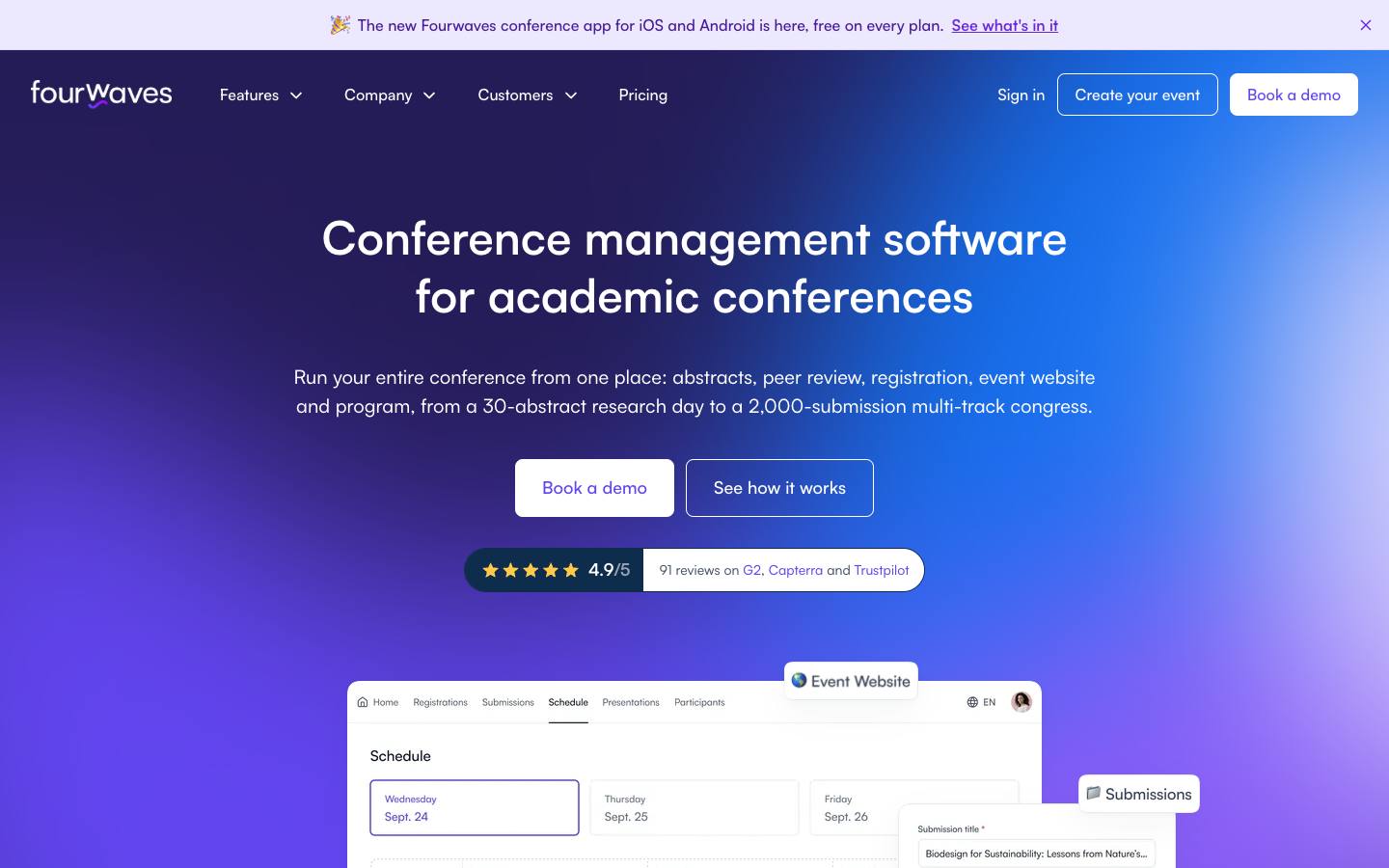
Fourwaves runs an academic or scientific event from call for abstracts to programme. It combines configurable submission forms, single- or double-blind peer review with conflict-of-interest detection, registration and multi-currency payments, a no-code event website, badges, certificates and a conference app included with every event. It was founded in 2012 in Quebec City, and its listed customers are largely universities and research hospitals, such as Université Laval, Virginia Tech and the University of Oxford.
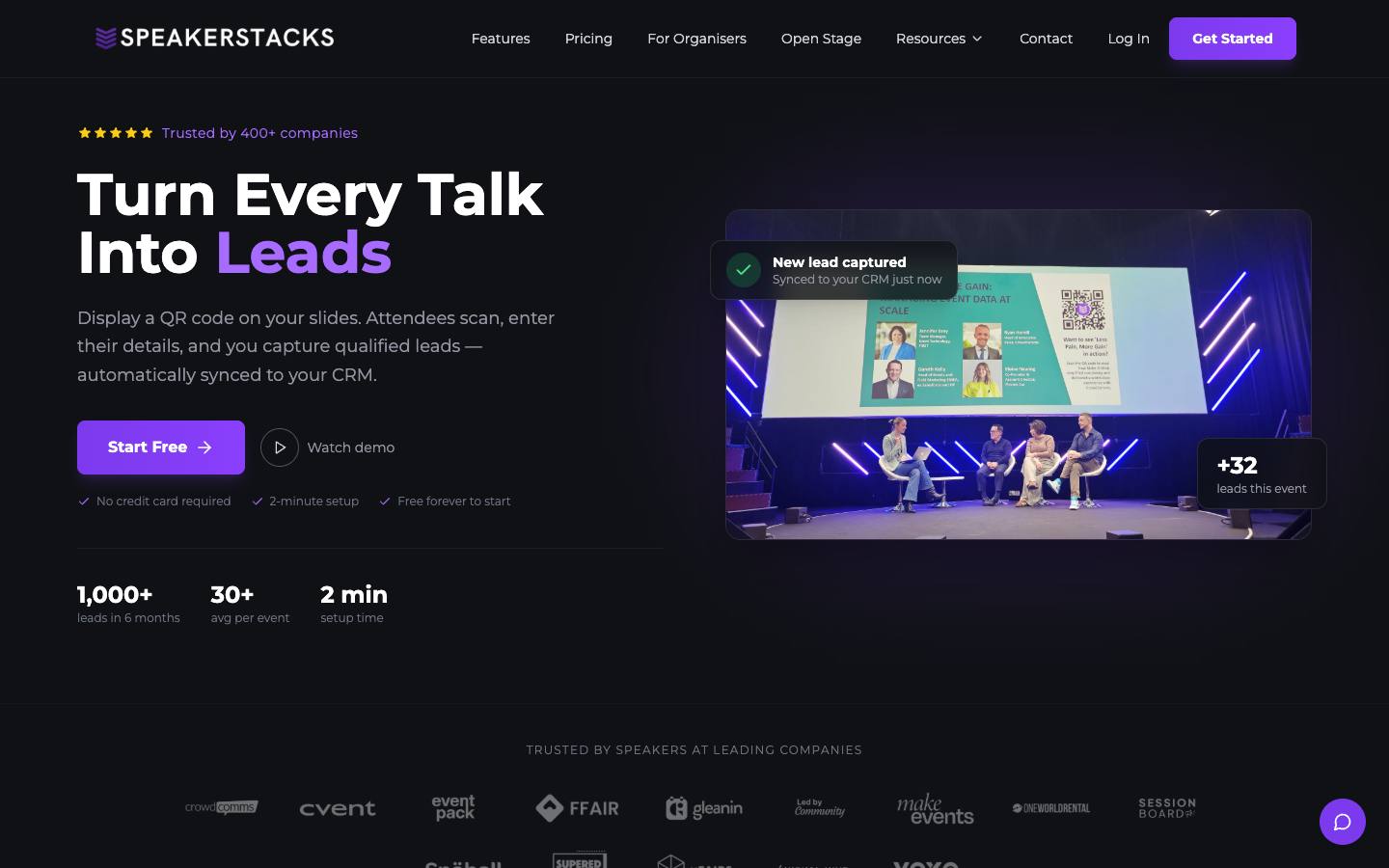
SpeakerStacks turns a speaking slot into a lead source. A speaker puts a QR code on a slide, attendees opt in on a branded landing page with consent captured, and leads sync to the CRM with ROI reporting by session. An organizer plan lets event teams invite all speakers, auto-generate speaker pages and report leads by speaker or session. It was founded by Adam Parry, co-founder of Event Industry News and creator of Event Tech Live.
One manages submissions, review and registration; the other measures what talks produce. An academic organizer wouldn't swap one for the other, and a B2B conference could use SpeakerStacks beside its own registration platform.
Fourwaves vs SpeakerStacks pricing
Fourwaves prices annually by abstract volume, checked October 2026. Starter is $0/year with unlimited registrations and events, 25 abstract submissions, a branded site and the conference app. Essential is $999/year ($899/year on a multi-year term) with 100 abstracts, a badge generator and email communications. Advanced is $2,599/year ($2,339/year multi-year) with 300 abstracts, peer review, a certificates generator and an onboarding call. Pro is custom, with white label and a dedicated account manager. A 3% service fee applies on Starter, Essential and Advanced.
SpeakerStacks has a free plan with one live session and three visible leads, and leads from a session can be unlocked for a one-time $49. Professional/Teams is $49/month, billed monthly, with unlimited live sessions and leads, CRM integrations, ROI analytics and up to 5 users. Event Organisers plans start from $1,249/year, marked as early access pricing, with an organizer dashboard, bulk speaker invites, REST API, webhooks and up to 5 admins. Prices show in local currency where available, and neither offers a free trial. Prices checked October 2026.
Features and integrations
Fourwaves lists 6 integrations: Stripe and PayPal gateways, Zoom, a public API with keys on every plan and SAML2 or Shibboleth SSO. We didn't find a CRM connector. It documents a public DPA, a subprocessor list and a status page.
SpeakerStacks lists 7: native HubSpot and Google Sheets sync, Zapier, Lineup Ninja, Sessionboard, a REST API and webhooks on organizer plans. Its trust page covers data protection, encryption and access controls, with a published DPA and a subprocessor list of 15 providers. We didn't find a SOC 2 report or ISO 27001 certificate for either.
Which should you choose?
Choose Fourwaves if you're a university department, society or research network running a conference that needs abstract submission, peer review, registration and a programme in one tool, with a free tier for small events. Choose SpeakerStacks if you're a B2B marketer or executive who speaks at conferences, or an organizer who wants to give speakers and sponsors measurable session leads, and you use HubSpot or Zapier.