 vs

Ex Ordo vs Shocklogic
Both are in our Agenda & speaker management category. Ex Ordo is best for Scholarly societies and academic conference committees; Shocklogic is best for associations and PCOs running scientific or medical congresses with abstracts and CPD tracking.
The short answer: Ex Ordo is a Galway-based platform built around the call for papers: abstract submission, peer review and programme building, bought per conference. Shocklogic, a London supplier founded in 1997, covers a wider association suite (membership, registration, scanning, CPD tracking and event apps) and publishes an event-app price from £1,995. Choose Ex Ordo for review-led academic meetings, Shocklogic for one vendor across members and events.
Built from each vendor's own website and our research profiles. How we research
Side by side
“Not published” means we couldn't find it on the vendor's own pages.
Ex OrdoShocklogicStrengths and considerations
Ex Ordo
What stands out
- Purpose-built around abstract and peer-review workflows
- Per-conference buying model suited to volunteer-run committees
- Long specialisation in scholarly and research events
Worth checking
- Not designed for B2B marketing or demand-gen events
- Pricing only on request
- Security certifications aren't published
Shocklogic
What stands out
- Long track record with scientific congresses: abstracts, ePosters and CPD tracking built in
- Membership and event modules from the same vendor
- Merger with Eventboost adds corporate-event tools such as seating and voting
Worth checking
- Core software prices aren't published
- Integrations with CRMs or AMSs aren't documented on the site
- Post-merger product roadmap between Shocklogic and Eventboost platforms is still evolving
Notable customers
Organizations each vendor names on its own website: customer stories first, then testimonials and logos.
Ex Ordo
- University of Cambridge
- Trinity College Dublin School of Nursing & Midwifery
- American Marketing Association
- Wildlife Disease Association
- Institute of Obstetricians & Gynaecologists, RCPI
- International Pragmatics Association
- Society of Engineering Science
- American Society for Engineering Management
- C19: The Society of Nineteenth-Century Americanists
- American Association of Swine Veterinarians
- CUA Research Symposium
- Texas A&M University
The main difference between Ex Ordo and Shocklogic
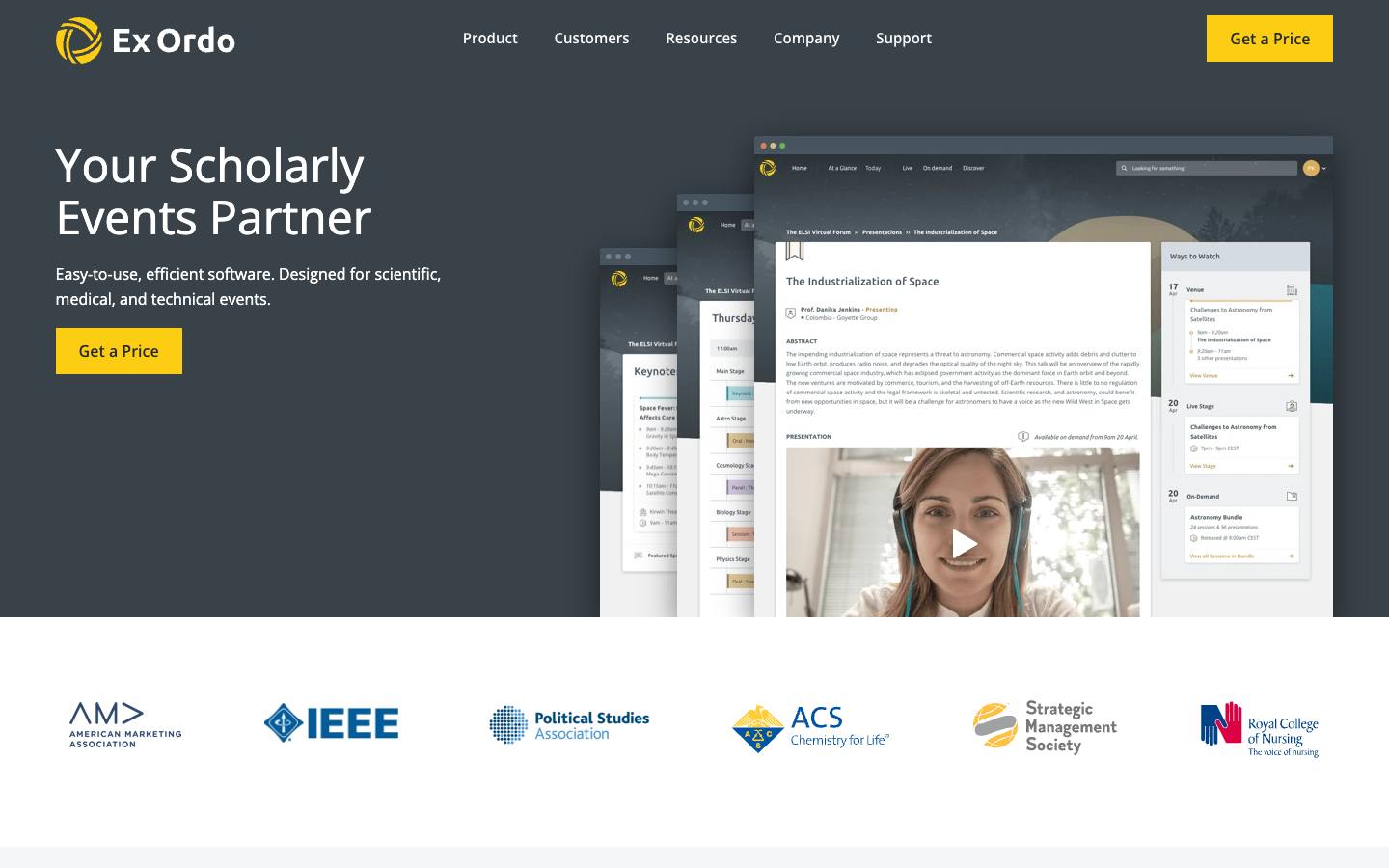
Ex Ordo starts from the abstract. Its forms handle abstracts, papers, panels and symposia, reviewers are matched and tracked, and accepted submissions are scheduled straight into the programme. Registration, payments and a virtual event space sit around that workflow. Shocklogic also does abstracts, peer review, scoring and ePosters, but it adds membership records and renewals, hotel booking, onsite check-in and badge printing, exhibition management and scanning that tracks session attendance for CME/CPD credits.
So the question is how much of your organization the software has to cover. A committee running one annual scientific meeting around peer review fits Ex Ordo's narrower scope. An association or professional conference organizer that wants members, registrations, exhibitors and credits in one place fits Shocklogic. Both target SMB and mid-market teams and run in-person, virtual and hybrid events; Shocklogic also lists webinars.
Ex Ordo vs Shocklogic pricing
Neither vendor publishes a full price list, checked October 2026. Ex Ordo sells per conference: a 'Get a Price' form returns a quote based on your expected number of submissions, in USD, GBP or EUR. It doesn't publish a starting price, and we didn't find a free plan or trial.
Shocklogic licenses registration software annually by number of events, with prices on request: Registration Essential covers up to 3 events a year with 10 support hours, Professional up to 7 events with onsite check-in and badge printing, Advanced up to 10 events with scanning, surveys and certificates, and Enterprise unlimited events. The one published figure is the mobile app at £1,995 per event, with app add-on modules from £375 each. It also sells single-event licenses (prices checked October 2026), and it has no free plan or trial.
In practice both are quote exercises. Give each the same brief (events per year, expected submissions or registrants, apps) so the quotes are comparable.
Features and integrations
Ex Ordo lists 6 integrations: Guidebook (which powers its mobile app add-on), Naylor AMS and Novi AMS lookups that pull member tags and contact details by email, Stripe and PayPal. Virtual sessions stay available for 60 days after the event, and a book of proceedings is an add-on. We didn't find a CRM, marketing automation or Zapier connector on its public pages.
Shocklogic lists 1 integration, Stripe, and we didn't find CRM or AMS connectors documented; its membership module is the way it keeps member data alongside event data. It adds exhibition tools (booth sales, 3D floor plans, lead retrieval) and a per-event app with optional networking, gamification and live polling modules. Its 2025 merger with Eventboost adds corporate-event tools such as seating and voting, though the combined product roadmap is still settling.
On security, Ex Ordo documents that servers are in Germany with failover in Dublin, subprocessors in an annex to its Terms (last updated Oct 2019) and GDPR processor terms inside those Terms rather than a standalone DPA. We didn't find SOC 2 or ISO 27001 reports for either vendor, and we didn't find a security or privacy document on Shocklogic's public pages.
Which should you choose?
Choose Ex Ordo if your meeting lives or dies by the call for papers, you want an onboarding team assigned per conference, and a volunteer-run committee buys one event at a time. Its customers include the University of Cambridge, the American Marketing Association and the Wildlife Disease Association. Support is by email and phone from teams based in Ireland and the UK.
Choose Shocklogic if you also manage members, need CPD tracking at the door, run exhibitions with lead retrieval, or want one supplier for registration, abstracts and the app. Customers include ISAPS, ISUOG and PCMA, and licenses bundle support hours with onsite support teams available. If you need CRM connectors, confirm them with either vendor first, because neither documents one.