 vs

Ex Ordo vs Indico
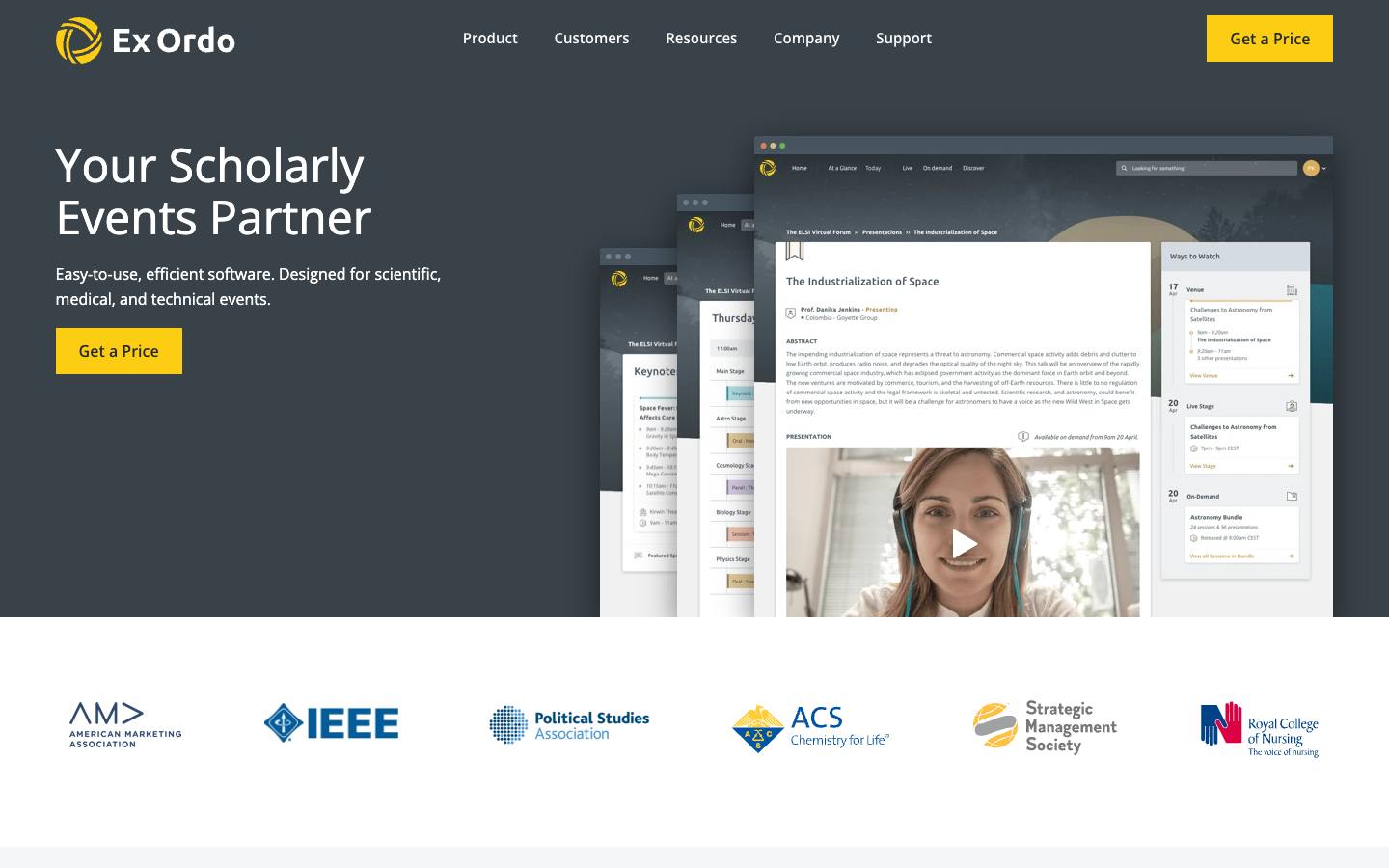
Both are in our Agenda & speaker management category. Ex Ordo is best for Scholarly societies and academic conference committees; Indico is best for Research institutions, universities and international organisations running scientific meetings and conferences.
The short answer: Ex Ordo is a hosted conference platform from Galway, Ireland, sold per event with a price quote, built around abstract review, registration and a programme builder. Indico is free, open-source software developed at CERN that your own IT team installs and maintains. Choose Ex Ordo for a volunteer-run society wanting onboarding and phone support, and Indico if you have in-house IT and want no license cost.
Built from each vendor's own website and our research profiles. How we research
Side by side
“Not published” means we couldn't find it on the vendor's own pages.
Ex OrdoIndicoStrengths and considerations
Ex Ordo
What stands out
- Purpose-built around abstract and peer-review workflows
- Per-conference buying model suited to volunteer-run committees
- Long specialisation in scholarly and research events
Worth checking
- Not designed for B2B marketing or demand-gen events
- Pricing only on request
- Security certifications aren't published
Indico
What stands out
- Fully open source with a long track record at CERN (over 900,000 events there)
- Strong support for scientific workflows such as abstract review and material archiving
- Includes room booking, which most event platforms do not
Worth checking
- Self-hosting and maintenance require in-house IT resources
- Not built for marketing use cases such as lead capture, CRM sync or sponsor monetisation
- Not to be confused with unrelated companies named Indico (e.g. Indico Data, Indico Capital Partners)
Notable customers
Organizations each vendor names on its own website: customer stories first, then testimonials and logos.
Ex Ordo
- University of Cambridge
- Trinity College Dublin School of Nursing & Midwifery
- American Marketing Association
- Wildlife Disease Association
- Institute of Obstetricians & Gynaecologists, RCPI
- International Pragmatics Association
- Society of Engineering Science
- American Society for Engineering Management
- C19: The Society of Nineteenth-Century Americanists
- American Association of Swine Veterinarians
- CUA Research Symposium
- Texas A&M University
Indico
The main difference between Ex Ordo and Indico
The main difference is who runs the software. Ex Ordo is a hosted service: the company assigns an onboarding team, sets up each conference, and offers human support by email and phone from Ireland and the UK. Indico is open source and self-hosted, so your own IT team follows the production installation guide, and support comes from documentation, a forum and GitHub issues. No paid support is listed.
Both target scholarly and scientific meetings built around abstract review rather than marketing-led events. Ex Ordo adds a virtual event space that keeps sessions available for 60 days after the event, a communications dashboard for authors, reviewers and delegates, and add-ons such as a book of proceedings and a mobile app. Indico adds archiving of presentations and papers, tree-based permissions across categories and events, and room booking with delegated approval and AV equipment tracking.
Ex Ordo's page names customers including the University of Cambridge, Texas A&M University and the American Marketing Association. Indico's page names CERN, the United Nations and ENEA. Ex Ordo fits small and mid-sized organizers, while Indico targets mid-market and enterprise institutions.
Ex Ordo vs Indico pricing
Indico costs nothing to license, while Ex Ordo doesn't publish a starting price (checked October 2026). Indico is open source and downloadable for self-hosting, and no commercial plans are listed on the project site. The real cost is the server, the IT time to install and update it, and the work of keeping it running.
Ex Ordo prices per conference. A 'Get a Price' form on its pricing page returns a quote based on expected submissions, in USD, GBP or EUR, and the contract is per conference with no standing commitment. That suits a committee that runs one annual meeting and doesn't want a subscription. Neither product publishes a free trial.
Features and integrations
Both cover the core academic workflow. Ex Ordo handles custom submission forms for abstracts, papers, panels and symposia, reviewer matching with progress tracking, card or bank-transfer registration payments, and a programme builder that schedules accepted submissions. Indico handles registration, a call for abstracts, peer review of scientific contributions, a timetable and an event website.
Integrations are short on both sides, and neither lists a CRM, marketing automation or Zapier connector. Ex Ordo lists 6 integrations: Guidebook, which powers its mobile app, Naylor AMS and Novi AMS lookups that pull member tags and details by email, plus Stripe and PayPal. Indico lists 4: Zoom, SAML, Shibboleth and LDAP login, a Python plugin system for payments, chat and search, and an HTTP export API with OAuth. We didn't find SAML single sign-on or a public API on Ex Ordo's public pages, so a university needing campus login leans toward Indico.
On security, Ex Ordo documents EU hosting in Germany with failover in Dublin and lists subprocessors in its Terms. We didn't find a SOC 2 or ISO 27001 report for either product.
Which should you choose?
Choose Ex Ordo if a volunteer committee runs the conference and nobody on the team wants to maintain servers. The per-conference quote, assigned onboarding team and phone support suit a society that runs one meeting a year, and the AMS lookups help when member discounts depend on a Naylor or Novi database.
Choose Indico if your institution already has IT staff and wants a free, self-hosted system with SAML or LDAP login, a documented API, permanent archiving and room booking. Expect to handle upgrades and troubleshooting yourself. Neither product is built for lead capture, sponsor monetization or CRM sync, so corporate marketing events should look elsewhere.