 vs

EasyWebinar vs eWebinar
Both are in our Virtual, webinar & streaming category. EasyWebinar is best for SMB marketing and sales teams running recurring demo or lead-gen webinars; eWebinar is best for SaaS marketing and sales teams running evergreen demo or product webinars.
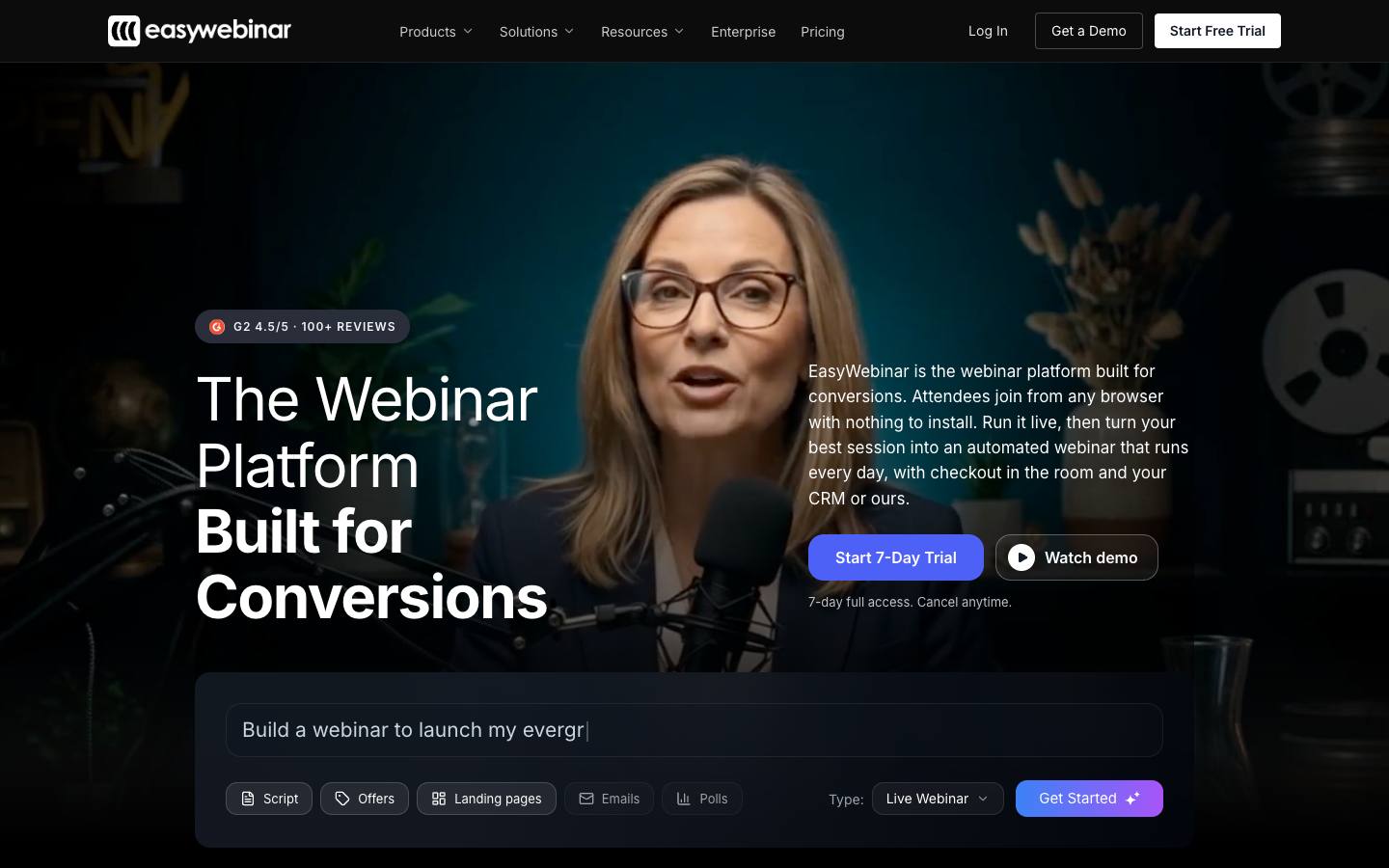
The short answer: EasyWebinar runs live webinars and converts them into automated, simulive or evergreen sessions, with built-in checkout and a lightweight CRM, from $44 a month. eWebinar is built only around pre-recorded, on-demand webinars, from $99 a month, and lets small teams answer chat asynchronously. Pick EasyWebinar if you also present live; pick eWebinar if every session is automated.
Built from each vendor's own website and our research profiles. How we research

Side by side
“Not published” means we couldn't find it on the vendor's own pages.
EasyWebinareWebinarStrengths and considerations
EasyWebinar
What stands out
- One subscription covers both live and automated/evergreen webinar formats
- Selling tools (offers, checkout) built into the webinar room
- Published, tiered pricing with overage instead of hard attendee cut-offs
Worth checking
- Customer base skews toward creators and small businesses rather than enterprise event programs
- No free plan; trial requires a card
- SSO/SAML is limited to the top Scale plan
eWebinar
What stands out
- Built specifically for automated, pre-recorded webinars rather than live broadcasting
- Asynchronous chat lets small teams handle questions without being online
- Broad marketing-automation and CRM integration list
Worth checking
- Not designed for live webinars or in-person events
- Plans are capped by active webinars and monthly registrants
Notable customers
Organizations each vendor names on its own website: customer stories first, then testimonials and logos.
The main difference between EasyWebinar and eWebinar
The main difference is whether you ever present live. EasyWebinar, founded in 2014 and based in Las Vegas, runs live sessions in the browser with polls, chat, CTAs and screen sharing, then clones a live session into scheduled, just-in-time, simulive or on-demand versions. It also multistreams to YouTube, LinkedIn, Facebook, Instagram or a custom RTMP target, and adds in-session offers with Stripe and PayPal checkout.
eWebinar, founded in 2019 and based in Vancouver, is designed for automated webinars made from pre-recorded video. Its signature feature is chat that hosts can answer in real time or later by email, so a small team doesn't have to be online when a session runs. Interactions such as polls, quizzes and offers sit on the video timeline. It fits demos, onboarding, training and recruiting, and it isn't designed for live webinars. Both target SMB and mid-market teams.
EasyWebinar vs eWebinar pricing
EasyWebinar publishes five tiers, checked October 2026: Launch at $44 a month (50 live attendees), Growth at $116, Pro at $198 and Scale at $349, all billed monthly, with annual billing saving two months. Enterprise is contact-sales and goes up to 100,000 live attendees. Plans scale by live and automated attendee caps, and attendees over a plan's limit are billed as overage. There's no free plan, and the 7-day trial requires a card.
eWebinar publishes three tiers, checked October 2026: Level 1 at $99 a month (1 active eWebinar, 1,000 registrants a month), Level 2 at $199 (5 active eWebinars, 3,000 registrants) and Level 3 at $299 (15 active eWebinars, 5,000 registrants, plus $15 a month for each additional). Annual billing is $1,010, $2,030 and $3,050 respectively, and the level adjusts automatically with the number of active eWebinars. Enterprise is custom. There's no free plan, and the trial runs 14 days.
The limits are measured differently. EasyWebinar caps live and automated attendees, so a large single webinar pushes you up a tier. eWebinar caps active webinars and monthly registrants, so a big library of evergreen sessions does.
Features and integrations
Both support automated and replayed webinars with registration pages and engagement analytics, and both offer AI help with setup: EasyWebinar's AI builder drafts a script, registration pages, emails and polls, and eWebinar has an AI script generator. EasyWebinar adds an AI Moderator that answers chat from uploaded documents on Pro and above, a built-in EasyCRM with lead scoring on Growth, and timed offers inside the room.
On integrations, EasyWebinar lists 26 and eWebinar lists 28. Both list HubSpot. For Salesforce, eWebinar names Salesforce itself, while EasyWebinar lists Salesforce Account Engagement (Pardot) and doesn't list a native Sales Cloud connector. EasyWebinar's native HubSpot and Pardot sync is on Pro, while Launch lists ActiveCampaign, Kit and Zapier. eWebinar adds Marketo (as an add-on), Kajabi (through Zapier), Thinkific, Intercom, Drift, Zendesk, Slack and Zoom, and offers a REST API v2 and webhooks. EasyWebinar's full API, webhooks and SSO/SAML are on Scale.
On security, EasyWebinar says it holds SOC 2 Type II, with the report shared under NDA through sales. We didn't find a SOC 2 Type II report for eWebinar, though it documents a SOC 2 Type 1 attestation dated 26 Feb 2024 and a trust center. Both publish a GDPR data processing addendum.
Which should you choose?
Choose EasyWebinar if you run live demos or launches and want to reuse them as evergreen sessions, sell from inside the webinar, or stream to social channels. It also fits teams that want lead scoring in one subscription, or that need SSO/SAML (Scale) or Pardot sync (Pro). Its customer base skews toward creators and small businesses, and the page shows Bureau Veritas, Cato Networks, Foundr, The Hacker News and XM Cyber.
Choose eWebinar if every session will be pre-recorded and you want a small team to handle questions by email rather than staff a live room. Its registrant-based caps suit a steady program of onboarding or product demos, and its integration list leans toward CRM and marketing automation, including Salesforce and Marketo. Its page shows customers such as eXp Realty, TED-Ed, Proposify, VideaHealth, SuperOffice and RealScout.