 vs

Dryfta vs EventAct
Both are in our Abstract & conference management category. Dryfta is best for universities and scholarly associations running research conferences with calls for papers; EventAct is best for professional conference organisers and associations running scientific congresses with abstracts.
The short answer: Dryfta and EventAct both pair registration with abstract management for scientific conferences. Dryfta publishes annual plans from $1,499/yr (Small) to $14,999/yr (Medium) and adds blind peer review, abstract-book publishing and an on-premise option. EventAct starts at $210/month, offers single-event packages from $550, and syncs two-way with HubSpot and Salesforce. Dryfta suits research-driven conferences, EventAct suits teams that mix B2B and scientific programs.
Built from each vendor's own website and our research profiles. How we research
Side by side
“Not published” means we couldn't find it on the vendor's own pages.
DryftaEventActStrengths and considerations
Dryfta
What stands out
- Abstract submission, peer review and abstract-book publishing are core, not bolt-ons
- Optional on-premise, self-hosted deployment for institutions with strict data rules
- Published annual pricing tiers with stated capacity limits
Worth checking
- Best suited to academic and research conferences; corporate marketing teams may find CRM and pipeline features thin
- Several capabilities (virtual sessions, event app, white-label, SSO) cost extra on top of annual plans
- Company leadership, headquarters and size aren't disclosed on the website
EventAct
What stands out
- Covers scientific (abstracts, e-posters) and commercial (exhibitor leads, B2B meetings) needs in one system
- Transparent published pricing including single-event options
- Multilingual event support
Worth checking
- Company leadership, location and size aren't disclosed on the website
- Only a handful of integrations are named
- Customer logos and case studies aren't shown on the site
Notable customers
Organizations each vendor names on its own website: customer stories first, then testimonials and logos.
Dryfta
EventAct
None found on its website.
The main difference between Dryfta and EventAct
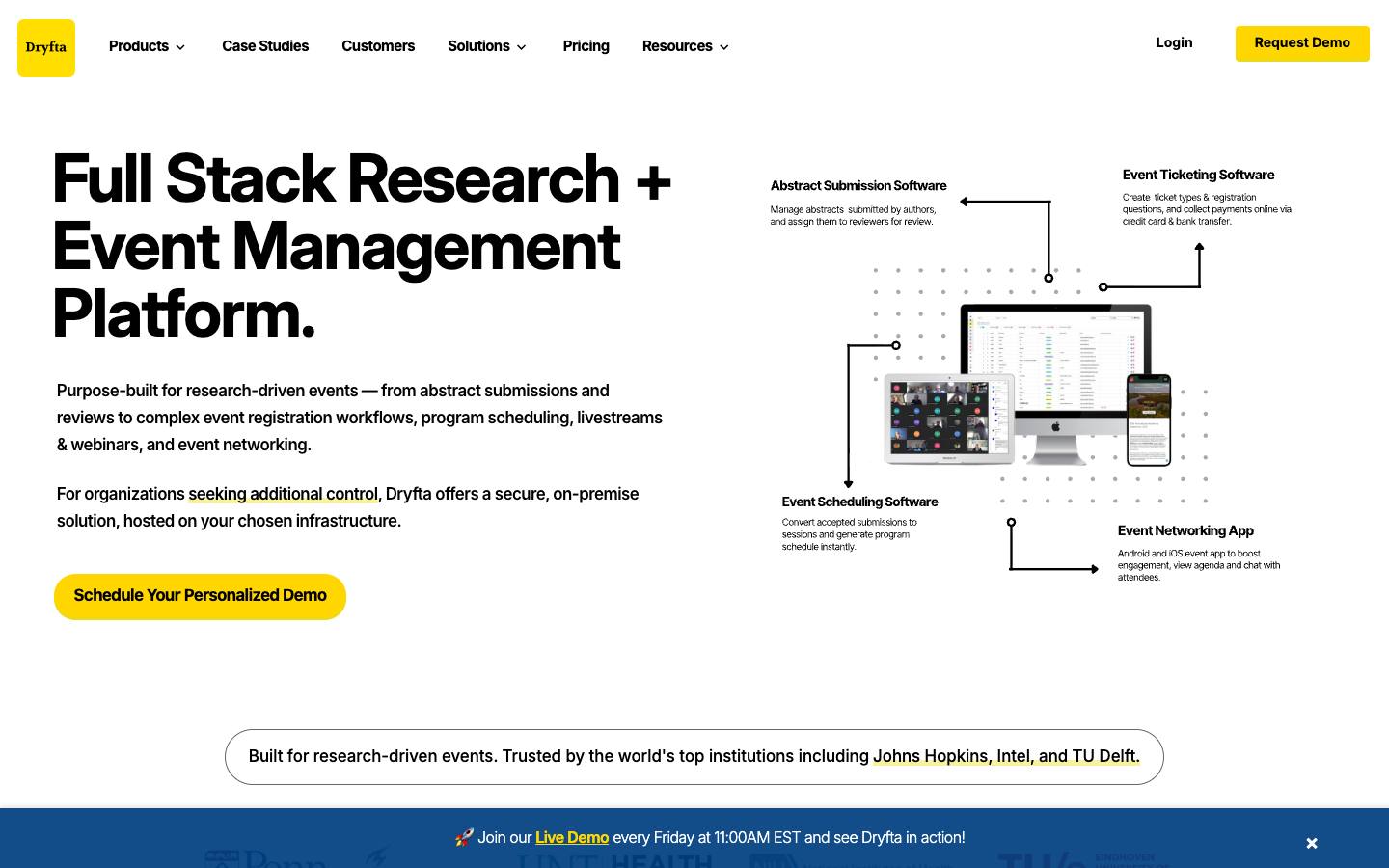
Dryfta puts the academic workflow first. Abstract submission, single-, double- or triple-blind review, automatic or manual reviewer assignment and abstract-book publishing are core, along with continuing-education credits and a schedule builder that turns accepted submissions into sessions. It also offers a self-hosted, on-premise deployment, which suits institutions with strict data rules. Its customers include the University of Pennsylvania, TU Delft, NIH and Intel.
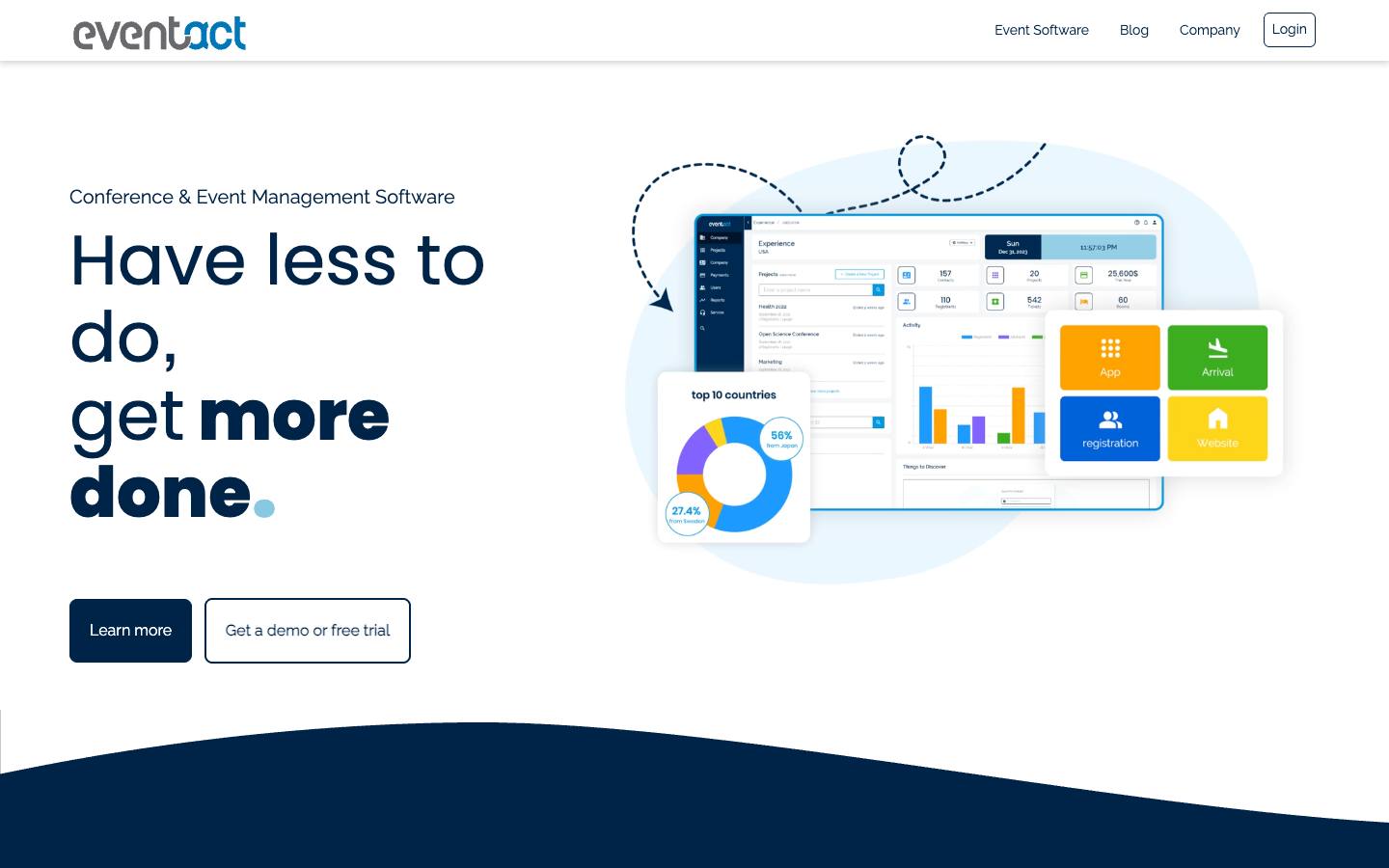
EventAct, developed since 2000, covers scientific needs (abstracts, e-posters, program building) and commercial ones in the same system: exhibitor lead retrieval, B2B meeting scheduling, an Arrival check-in app with badge printing, accommodation booking and a native two-way sync with HubSpot and Salesforce. It targets professional conference organizers and B2B teams, and shows no customer logos on its site.
Dryfta vs EventAct pricing
Dryfta sells annual plans (checked October 2026). Small is $1,499/yr for 100 abstract submissions, 100 attendee registrations and 25 in-person sessions. Medium is $14,999/yr for 1,000 submissions, 1,000 registrations and 150 virtual or in-person sessions, with a native iOS and Android app, white-label with custom domain and SSO. Large is quote-based. Every plan allows unlimited events and includes free setup and data migration, and a free trial is offered.
EventAct publishes monthly subscriptions by module bundle for under 2,000 attendees a year (checked October 2026): $210/month for registration and website, $330/month adding the event app, and $415/month adding abstracts. Single events start at $550 for under 400 attendees. Its Arrival check-in app is $49 per event for up to 200 registrants, or $1,199/yr for unlimited events up to 5,000 registrants. A free trial is available.
Features and integrations
Dryfta lists 20 integrations, among them native Salesforce sync, Zapier, Stripe, PayPal, Mailchimp and Constant Contact; other CRMs connect through a Zapier app built on its public API. It documents SAML SSO, a Section 508 VPAT, a subprocessor list with selectable data region and a status page. EventAct lists 5, including HubSpot, Salesforce, Stripe, PayPal and WhatsApp Business, plus signed webhooks, a REST API and a WCAG 2.1 AA accessibility statement.
Beyond in-person events, Dryfta also runs webinars, and both handle virtual and hybrid formats. Dryfta fits small, mid-market and enterprise teams, and EventAct fits small and mid-market.
Which should you choose?
Choose Dryfta if you run a call for papers with blind review, need an abstract book, CE credits or an on-premise deployment, and want annual pricing with stated capacity limits. Its published tiers jump from Small to Medium, so check which one fits your volume.
Choose EventAct if you run both scientific and customer conferences, want HubSpot or Salesforce two-way sync, need a monthly or single-event price for a smaller event, or want a separately priced check-in app.