Best Event Intelligence Platforms in 2027: The Buyer's Shortlist
By EventMarketingSoftware.com · Published October 18, 2026 · 11 tools compared
The best event intelligence platforms for B2B teams are Vendelux for choosing events by which target accounts will attend and then booking meetings and tracking pipeline, Sproxxy for planning and budgeting a conference portfolio, Lensmor for prospecting exhibitors and visitors at global trade shows, and Luminik for turning a show's attendees into scored outreach lists.
Our top picks
- 1
 VendeluxBest for B2B teams choosing events by where their target accounts will be, then booking meetings and measuring pipelineQuote only
- 2
 SproxxyBest for marketing, PR and sponsorship teams planning and budgeting a conference portfolioQuote only
- 3
 LensmorBest for sales teams prospecting exhibitors and visitors at trade shows worldwide, including AsiaFrom $499/month
Key takeaways
- Event intelligence answers three questions: which third-party events are worth the budget, who'll be there, and what each event produced. Vendelux and Mobly cover all three, while list services such as WhoGoes, ExhibitorLens and PullAList only answer who'll be there.
- Prices run from $29 to enterprise contracts. WhoGoes credit packs start at $29, ExhibitorLens all-access is $79 one-time, PullAList is $299 per list, Luminik starts at $249 a month billed annually and Lensmor Basic is $499 a month (all checked October 2026), while Vendelux, Mobly, Sproxxy, Plain Sight, ZoomInfo and Demandbase are quoted.
- Coverage claims vary by two orders of magnitude. Vendelux cites more than 250,000 B2B events, Lensmor 160,000+, ExhibitorLens 2,882 events with exhibitor lists and WhoGoes 1,200+ events with attendee lists, so check coverage for your own industries and regions before you buy.
- Where attendee data comes from matters more than how much there is. WhoGoes builds lists from public LinkedIn posts, ExhibitorLens from organizers' exhibitor directories and Luminik from event platforms, speaker lists and exhibitor directories, while PullAList doesn't say how its lists are sourced.
- CRM attribution is what turns event intelligence into next year's budget. Vendelux, Luminik and Mobly write event pipeline back to Salesforce or HubSpot, the list services only export CSVs or spreadsheets, and Sproxxy lists no integrations at all.
Free tool: Cost per lead, meeting and opportunity calculator. Turn event cost and results into cost per lead, meeting and opportunity, pipeline, expected revenue, ROI and break-even meetings.
Side-by-side comparison
The same criteria for every pick: published event coverage, attendee data source disclosed, target account matching, native salesforce or hubspot sync, published entry price, security documentation. A dash means the vendor doesn't publish it.
| Tool | Starting price | Free plan / trial | CRM | Capterra | App Store | Security |
|---|---|---|---|---|---|---|
| Vendelux | Quote only | Free plan | Salesforce, HubSpot | ★ 5.0 (4) | ★ 4.6 (10) | SOC 2 Type II, SAML SSO, DPA |
| Sproxxy | Quote only | – | – | – | – | – |
| Lensmor | From $499/month | Free trial | HubSpot | – | – | – |
| Luminik | From $249/month | – | Salesforce, HubSpot | – | – | SAML SSO |
| Mobly | Quote only | – | Salesforce, HubSpot, Marketo | – | ★ 4.8 (20) | SOC 2 Type II |
| WhoGoes | From $29/one-time | Free plan | – | – | – | – |
| Plain Sight | Quote only | – | – | – | – | – |
| ExhibitorLens | From $79/one-time | – | – | – | – | – |
| PullAList | From $299/list | – | – | – | – | – |
| ZoomInfo | Quote only | Free trial | Salesforce, HubSpot, Dynamics, Marketo | – | – | SOC 2 Type II, ISO 27001, SAML SSO |
| Demandbase | Quote only | – | – | – | – | SOC 2 Type II, ISO 27001, DPA |
Event intelligence, in the B2B marketing sense, is data that helps you decide which conferences and trade shows to attend or sponsor, who'll be there, how to reach them before the event and what the event produced afterwards. The term is also used for IT operations and security monitoring tools that correlate system events; those are a different category and aren't covered here. This guide is only about business events.
We compare 11 products, from full platforms that cover discovery, outreach and attribution to low-cost attendee and exhibitor list services you can buy one event at a time. Every product detail comes from our vendor profiles and each vendor's own pages, checked in October 2026. Use it to match the tool to the question you're trying to answer: where to go, who to meet, or what it was worth.
Who this guide is for. This guide is for B2B field marketers, demand generation and event marketing leads, sponsorship managers and sales leaders who attend or sponsor other organizers' conferences and trade shows and have to defend that budget. It's most useful for teams with a calendar of 5 to 50 third-party events a year, target account lists in Salesforce or HubSpot, and pressure to show pipeline. Teams that mainly host their own events need registration or event management software instead.
Not sure which one fits your team?
Answer a few questions about your events, team and CRM and get a free shortlist of tools that fit, with pricing and security details side by side.
Get a free shortlistThe best event intelligence platforms in 2027
We list 11 event intelligence platforms, ordered by how fully each one handles the main job: choosing third-party events and turning them into meetings and pipeline. Full platforms covering discovery, outreach and attribution come first, followed by single-job tools for portfolio planning, prospecting and buying lists, then the account data platforms many teams pair with them. For each pick, look at event coverage, where its attendee data comes from and whether results reach your CRM.
1. Vendelux, best for B2B teams choosing events by where their target accounts will be, then booking meetings and measuring pipeline
- Price
- Quote only
- Try it
- Free plan
- Capterra
- 5.0/5 from 4 reviews
- App Store
- 4.6/5 from 10 ratings
- Languages
- English
- Syncs with
- Salesforce, HubSpot
- Security
- SOC 2 Type II, SAML SSO, DPA
- Customers include
- TELUS Digital, Superhuman, Pecan AI
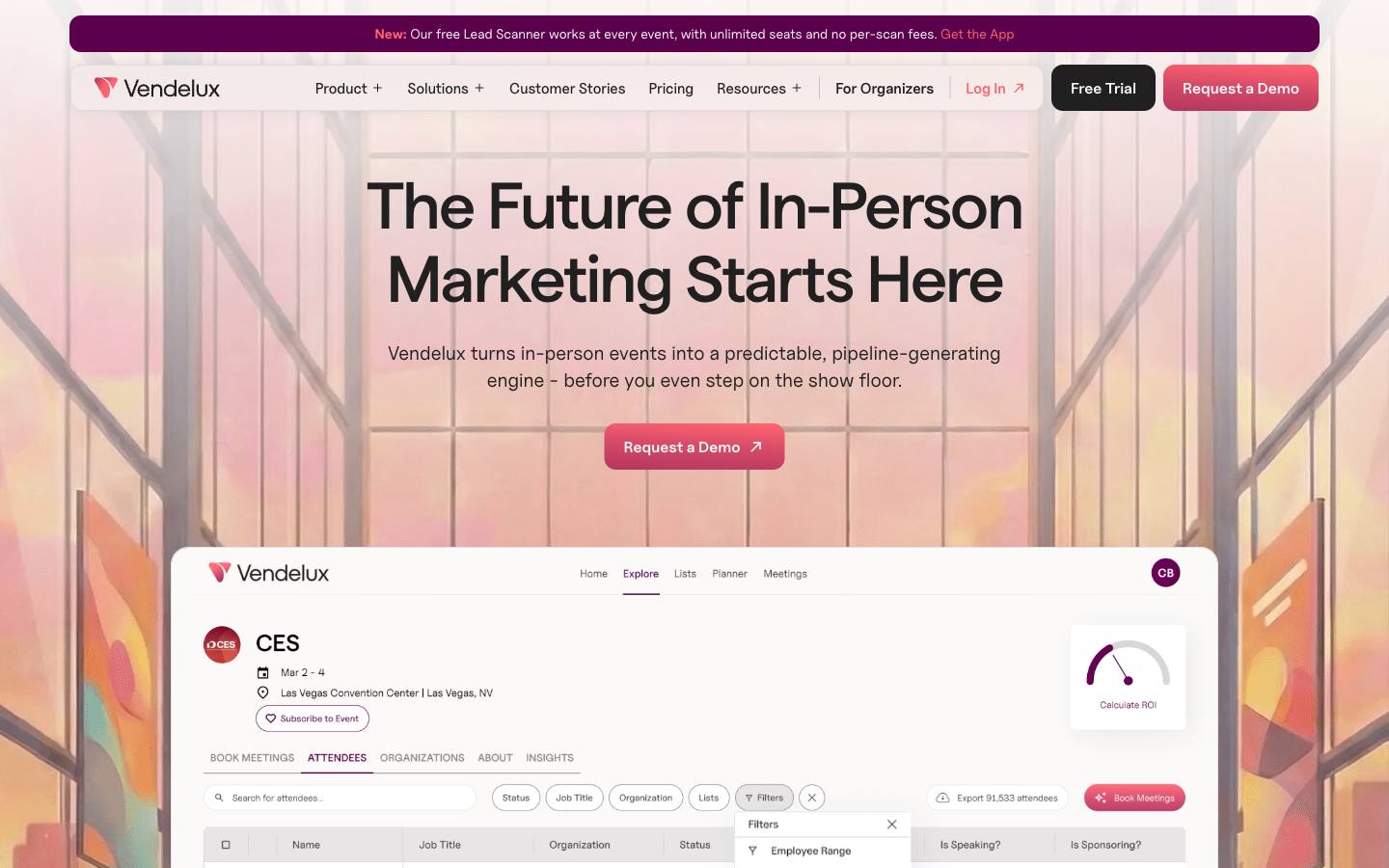
Vendelux is an event intelligence and pipeline platform for teams that attend or sponsor third-party events. It searches more than 250,000 B2B events to show where your customers, prospects, partners and competitors will be attending, speaking or sponsoring, builds role-filtered lists for each event, runs pre-event meeting outreach with AI and human campaign managers, and ties attendance back to pipeline in the CRM.
More on VendeluxLess on Vendelux
Founded: 2021 · HQ: New York, US · Team: 51–200 people · Formats: In-person
Vendelux was founded in 2021 and is based in New York. In July 2026 it raised a $50 million Series B led by Tribeca Venture Partners, bringing total funding to $71 million by its own count, with HubSpot Ventures, FirstMark and S3 Ventures among its investors. Plans come in three tiers, Starter, Plus and Enterprise, that differ by lead credits, campaign credits and seats. Prices aren't published, and pilots are offered to qualified buyers. Capterra shows a 5.0 rating from 4 reviews.
Customers named on its site include Ramp, Glean, Coupa, AdRoll, TELUS Digital and Superhuman. Native integrations cover Salesforce, HubSpot and Zoho; CRM sync is view-only on Starter, and Plus pushes contacts to lists and campaigns. Its trust center lists a 2025 SOC 2 Type II report, GDPR and CCPA compliance and a subprocessor list, and Enterprise adds Okta single sign-on. The free Lead Scanner app, rated 4.6 from 10 App Store ratings, reads badges and business cards and syncs enriched contacts to HubSpot, and RSVP pages cover hosted side events such as dinners.
- Free Lead Scanner app for badge and business card capture at the event
What stands out
- Database of 250,000+ B2B events with account-level matching against your CRM or uploaded lists
- Meeting campaigns combining AI-timed outreach with a dedicated outreach manager on Plus and Enterprise
- CRM overlay and attribution with Salesforce and HubSpot, with push to lists and campaigns on Plus
Worth checking
- Prices aren't published, and usage runs on lead and campaign credits
- Not a registration or event hosting platform, and the Starter plan's CRM sync is view-only
Best suited for. Vendelux fits mid-market and enterprise B2B teams with a calendar of third-party conferences, target accounts in Salesforce or HubSpot and pressure to show event pipeline. If you only need a one-off attendee list, or you mainly host your own events, a list service or a registration platform will cost less.
2. Sproxxy, best for marketing, PR and sponsorship teams planning and budgeting a conference portfolio
- Price
- Quote only
- Languages
- English
Sproxxy is a conference intelligence workspace for deciding which external events to attend, speak at or sponsor. It combines filtered event search and KPI-driven recommendations with plans, budgets, tasks and dashboards, and tracks spend per event against outcomes, including social share of voice. It's built for the portfolio decision rather than for prospecting individual attendees.
More on SproxxyLess on Sproxxy
Founded: 2022 · HQ: New York, USA · Team: 1-10 people · Formats: In-person
Sproxxy was founded in 2022 in New York and went through Techstars, with a seed round of about $1.1 million led by Ivy Ventures and total funding of $1.37 million according to CB Insights. TechCrunch covered it in February 2024 as a way to measure the return on conference spending. The team is small, at 1 to 10 people, and pricing isn't published, so access starts with a demo request.
The workspace starts with filtered event search, then suggests events based on the goals and KPIs you upload. Once events are on the calendar, teams track dollar spend per event, assign tasks with stored workflows and review results in personalized dashboards, including impressions and share of voice on social channels around each event. It's built for in-person events and English-language teams. No integrations are listed anywhere on its site, so CRM attribution and contact lists have to come from other tools, and its site footer still showed a 2024 copyright at our last check, which is worth raising in a demo.
- Social share of voice and impressions around events
What stands out
- Event recommendations driven by the goals and KPIs you upload
- Dollar spend and ROI tracking per event
- Team task delegation and stored workflows for a shared event calendar
Worth checking
- No integrations are listed, so CRM attribution may be manual
- Early-stage, seed-funded company with no published pricing
Best suited for. Sproxxy fits marketing, PR and sponsorship teams that need one shared place to choose, budget and review a portfolio of external events and speaking slots. Teams that need attendee lists, meeting outreach or CRM pipeline reporting should look at Vendelux, Luminik or Lensmor instead.
3. Lensmor, best for sales teams prospecting exhibitors and visitors at trade shows worldwide, including Asia
- Price
- From $499/month
- Try it
- Free trial
- Languages
- English
- Syncs with
- HubSpot
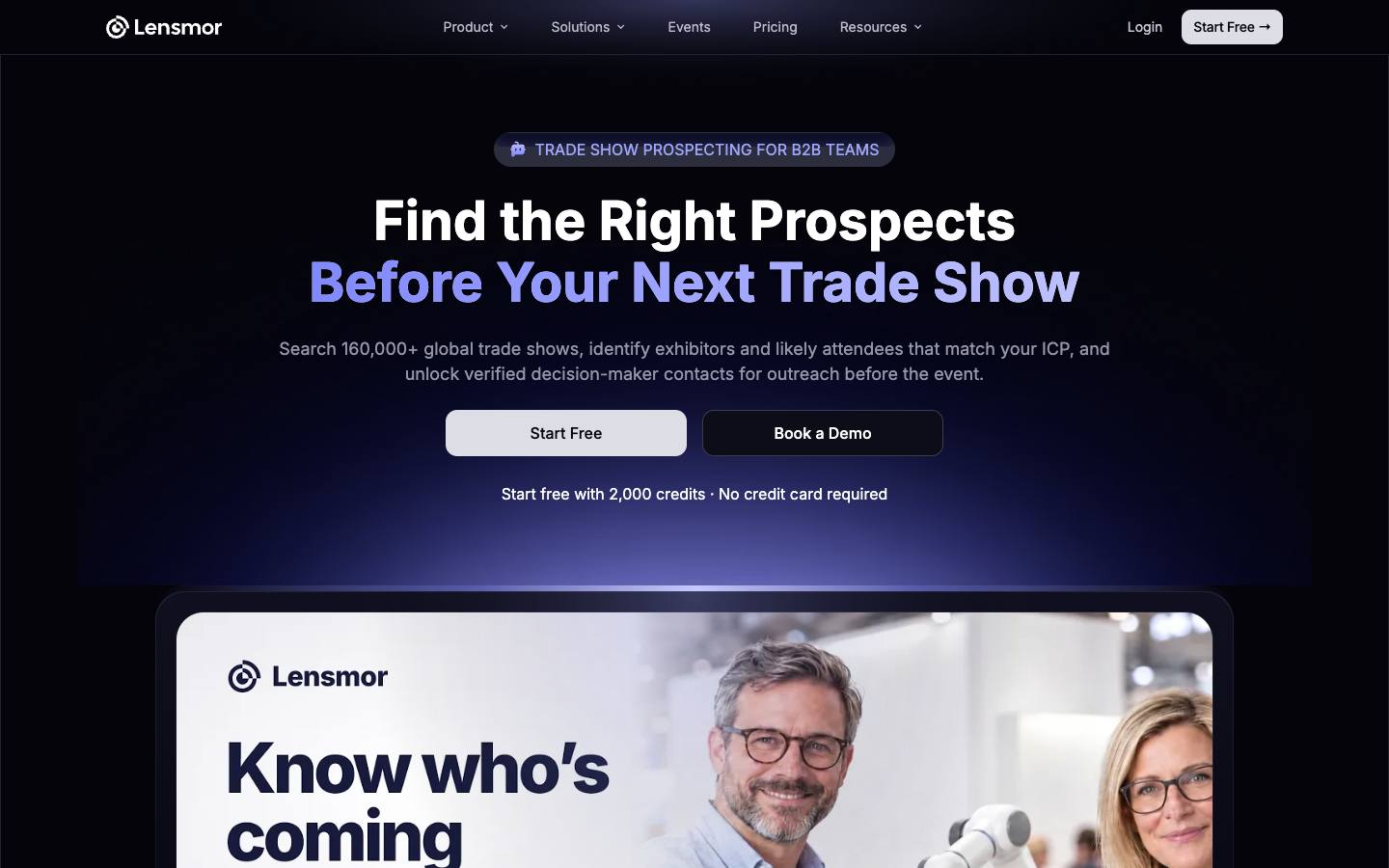
Lensmor indexes 160,000+ global events and shows which companies exhibit at or attend each one, ranks them against your ideal customer profile and reveals work emails and phone numbers for outreach. An AI agent turns a plain-language brief into shortlists of events, accounts and contacts. It's sold on credit-based plans with published prices.
More on LensmorLess on Lensmor
Founded: 2025 · HQ: Singapore · Team: 2-10 people · Formats: In-person
Lensmor was founded in 2025 and is run from Singapore by Ecocreate Technology Pte. Ltd., with a team of 2 to 10 people. It publishes its prices: Basic is $499 a month or $4,990 a year for 35,000 credits a month, roughly 7 event unlocks and up to 5 seats. Growth is $14,900 a year for 1,500,000 credits, about 300 event unlocks and up to 10 seats with priority email and WhatsApp support, and Enterprise is custom with API access (pricing page, checked October 2026). New accounts get 2,000 free credits without a card, and event search is free.
Beyond the event index, its footprint search shows every show a given company exhibits at or attends, which helps with competitor research as well as prospecting. Contacts can be filtered by role and seniority before you spend credits on a reveal. Data leaves through CSV or Excel, direct exports to HubSpot, Salesforge and Instantly, webhooks into Zapier, Make, n8n and Pipedream, a documented public API and an MCP server. It calls itself GDPR-ready but doesn't publish a DPA, and it says data coverage varies by event.
- HubSpot export, webhooks, an API and an MCP server
What stands out
- Event footprint search showing which shows a given company exhibits at or attends
- Published plans: Basic at $499 a month or $4,990 a year and Growth at $14,900 a year (pricing page, checked October 2026)
- 2,000 free credits on signup with no card, and free event search
Worth checking
- Visitor data exists only for some events, and phone reveals use credits quickly
- Founded in 2025 with a small team
Best suited for. Lensmor fits sales teams, agencies and booth builders who prospect exhibitors and visitors at trade shows worldwide and want published, self-serve pricing. If you need managed meeting outreach or pipeline attribution in Salesforce, a fuller platform such as Vendelux or Luminik is the better fit.

4. Luminik, best for growth-stage B2B teams that want attendee lists scored and pushed to their sequencer before each show
- Price
- From $249/month
- Syncs with
- Salesforce, HubSpot
- Security
- SAML SSO
Luminik sources a third-party event's likely attendees weeks ahead from event platforms, speaker lists and exhibitor directories, enriches them through your own Apollo or ZoomInfo contract and scores them against your ICP. Priority contacts go to your sequencer with event-specific messaging, booth conversations are captured on mobile, and sourced and influenced pipeline is written back to Salesforce or HubSpot.
More on LuminikLess on Luminik
Formats: In-person
Luminik publishes three tiers. Starter is $249 a month billed annually ($2,988 a year) or $299 month to month, for up to 6 events, 15,000 enriched ICP matches and 3,000 gap-fill records a year, with Salesforce, HubSpot and Apollo and unlimited booth reps. Growth is $665 a month billed annually for up to 12 events and 30,000 matches, with a report after each event and SSO as a $199 monthly add-on. Scale starts at $1,665 a month for up to 30 events and 100,000 matches, with SSO, directory sync and a dedicated CSM (pricing page, checked October 2026).
Its booth app is offline-first on iOS and Android and captures badges, business cards, QR codes and voice notes, syncing to the CRM the same day. AI features score attendee lists, draft event-specific outreach angles and pull next steps from booth notes, and an MCP interface lets you check pipeline status from Claude or ChatGPT. Single sign-on works with Okta, Microsoft Entra ID and Google Workspace. The company is founder-led under CEO Prasad Subrahmanya, its case studies are anonymized, and a SOC 2 report is offered on request on the top tier.
- Pipeline written back to CRM opportunities per event, rep and account
What stands out
- Pre-event attendee sourcing and ICP scoring for each show
- Handoff to Apollo, Salesloft, Amplemarket or Lemlist
- Published pricing from $249 a month billed annually for up to six events a year (checked October 2026)
Worth checking
- Relies on your existing enrichment and sequencer contracts
- Early-stage company with anonymized case studies; SOC 2 report on request on the top tier
Best suited for. Luminik fits Series A to C B2B teams that sponsor several conferences a year and already pay for Apollo or ZoomInfo plus a sequencer. If you don't have those contracts, or you want the vendor to book meetings for you, compare Vendelux or Lensmor.

5. Mobly, best for teams that want event selection, booth capture and pipeline reporting in one product
- Price
- Quote only
- App Store
- 4.8/5 from 20 ratings
- Syncs with
- Salesforce, HubSpot, Marketo
- Security
- SOC 2 Type II
- Customers include
- Insperity, JLL, Pattern
Mobly is a field and event marketing platform for B2B sponsors and exhibitors. Its Scout module suggests events that match your ICP and in-person strategy, Capture handles badge and card scanning with enrichment and ICP scoring, Pulse starts follow-up from the show floor, and Insights reports on pipeline, lead quality and which events produced revenue.
More on MoblyLess on Mobly
Founded: 2023 · HQ: Lehi, Utah · Team: 11-50 people · Formats: In-person
Mobly was founded in 2023 and is based in Lehi, Utah, with 11 to 50 employees. It raised a $4.3 million seed round in January 2025 led by Jump Capital and Eniac Ventures after a $2.5 million pre-seed, and CB Insights puts total funding at $7.24 million. In April 2026 it expanded from a capture app into a wider in-person revenue platform, adding Host for branded registration pages and email templates for side events. Pricing isn't published; access is through a demo.
Capture reads QR codes, badges, business cards and even handwritten name tags, works offline, scores every lead against your ICP and runs waterfall enrichment across data providers. Integrations include Salesforce, HubSpot, Marketo, Pardot, Pipedrive, Zoho CRM, Calendly, Chili Piper and webhooks. The iOS app holds a 4.8 rating from 20 App Store ratings, its site shows a SOC 2 Type II badge, and customers named on its site include Ramp, JLL, Wistia, Insperity, Paddle and Nearmap.
- SOC 2 Type II compliant
What stands out
- Scout recommends events matched to your ICP
- Lead capture, follow-up and pipeline reporting in the same product
- Integrations with Salesforce, HubSpot, Marketo and Pardot
Worth checking
- No published pricing
- Its site doesn't describe pre-event attendee lists or target account identification for a given show
Best suited for. Mobly fits B2B sponsors and exhibitors that want event selection, booth capture, instant follow-up and pipeline reporting from one vendor. Its site doesn't describe pre-event attendee lists for a given show, so teams whose main question is who'll be there should also look at Vendelux or Lensmor.

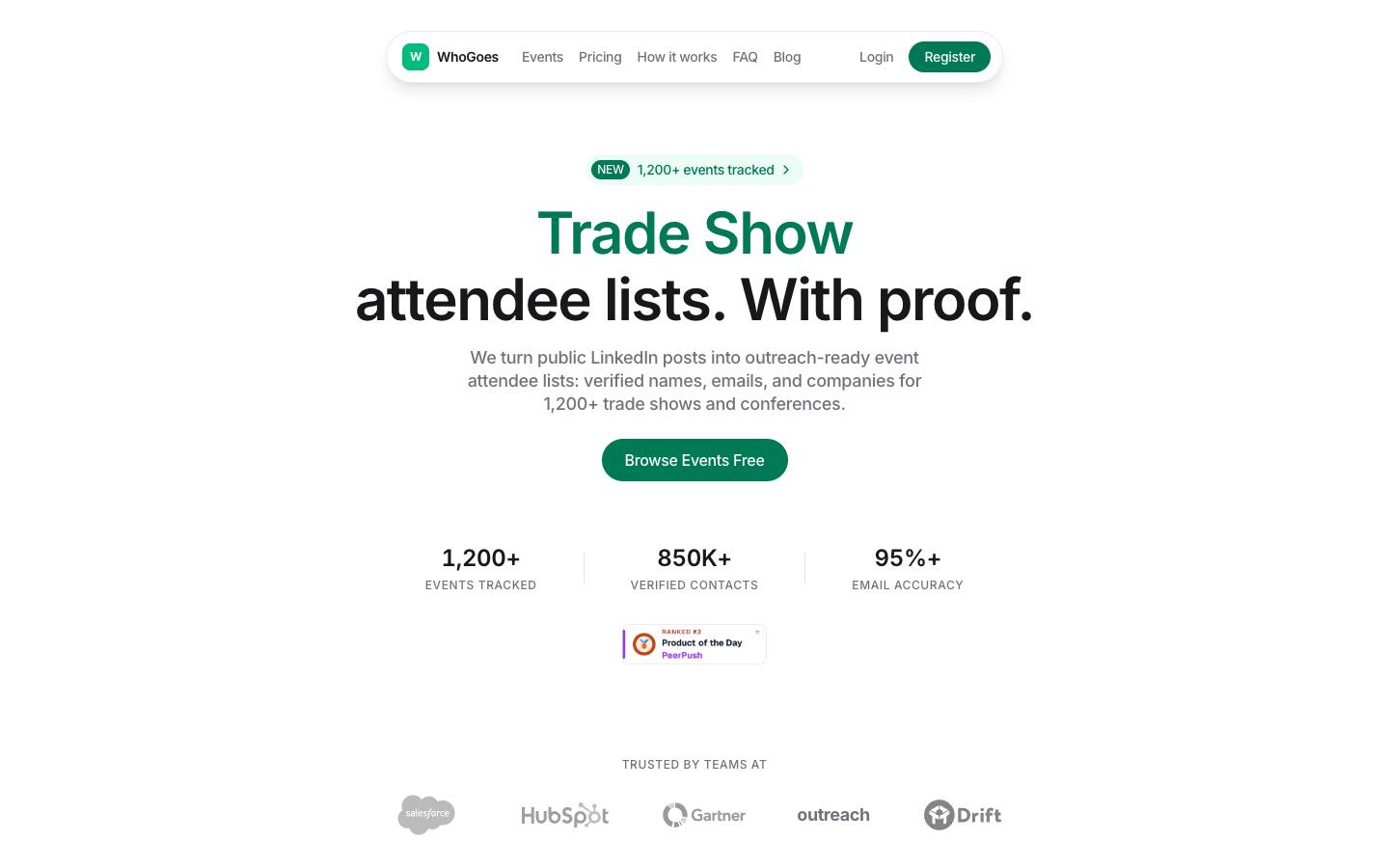
6. WhoGoes, best for small teams that want low-cost trade show attendee lists with no contract
From $29/one-time
- Price
- From $29/one-time
- Try it
- Free plan
- Languages
- English
WhoGoes builds attendee lists for 1,200+ trade shows and conferences from public LinkedIn posts in which people say they're going. Each contact links to the post, which can double as an outreach opener, and you can filter by seniority, function, industry, company size, country and event role before spending credits. Contacts export as CSV.
More on WhoGoesLess on WhoGoes
Founded: 2026 · HQ: San Francisco, US · Team: 2-10 people · Formats: In-person
WhoGoes was founded in 2026 and is based in San Francisco with a team of 2 to 10. Pricing is pay as you go: 20 free credits on signup, then packs of 200 credits for $29, 750 for $79 and 2,000 for $149, which works out to between 14.5 and 7.5 cents a contact because one credit unlocks one contact (checked October 2026). Credits don't expire and there's no contract. You can browse events and preview five contacts per event before signing up.
Records include names, companies and emails, and you can filter by speakers, sponsors, exhibitors and attendees as well as by seniority and function. There are no named integrations, Zapier connection or API, so contacts move into a CRM or sequencer by CSV. Its GDPR page names legitimate interest as the legal basis and lists data subject rights and standard contractual clauses for transfers outside the EEA, and its FAQ says it complies with GDPR and CCPA. Coverage is limited to people who posted publicly, so expect partial lists rather than full registrations.
- Filters for speakers, sponsors, exhibitors and attendees
What stands out
- Every contact backed by a public post about attending
- Credit packs from $29 for 200 credits, with credits that don't expire (checked October 2026)
- 20 free credits on signup and a free five-contact preview per event
Worth checking
- Covers only people who posted publicly, so lists are partial
- No CRM integration, and the company was founded in 2026; check your own GDPR position on LinkedIn-sourced data
Best suited for. WhoGoes fits small sales and event teams that want a cheap, contract-free attendee list before a show they're exhibiting at or visiting. If you need full coverage, account matching or CRM attribution, a platform such as Vendelux or Lensmor will serve you better.

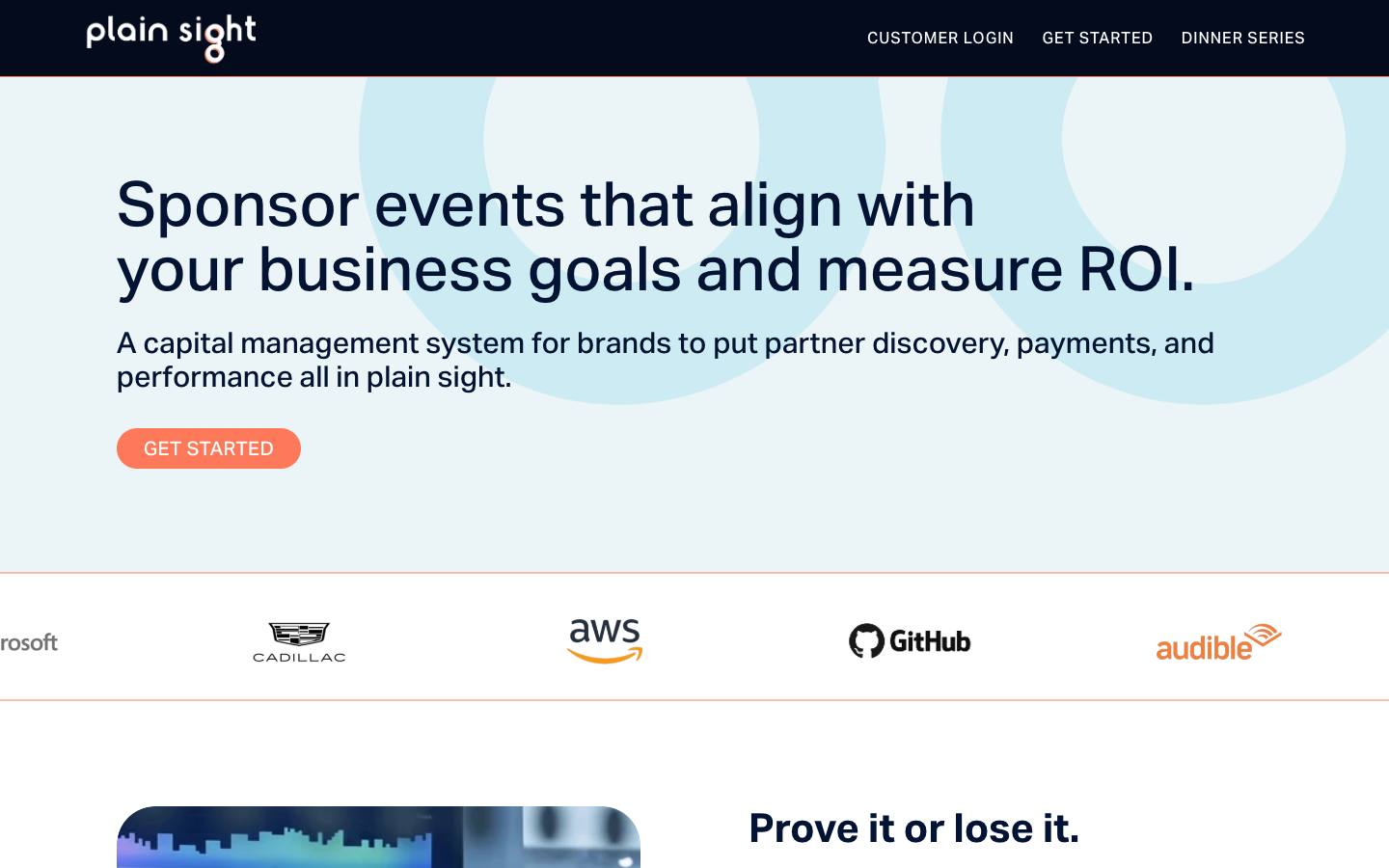
7. Plain Sight, best for brands that fund many community and grassroots events and need to manage the sponsorship portfolio
Quote only
- Price
- Quote only
- Languages
- English
- Customers include
- Microsoft
Plain Sight is a sponsorship portfolio system for brands that fund events run by outside organizers, such as developer meetups and community events. It recommends organizers that fit your goals, routes sponsorship requests for approval, handles payouts with budget rollover and collects post-event reports and guest lists so leadership can see performance across the portfolio.
More on Plain SightLess on Plain Sight
Founded: 2019 · HQ: Atlanta, Georgia · Team: 2-10 people · Formats: In-person
Plain Sight was founded in 2019 and is based in Atlanta, Georgia, with a team of 2 to 10 led by CEO James Chapman. CB Insights records $580,000 in funding through a convertible note, with Republic, Dan Gilbert and Capital Q Ventures among its investors. Microsoft is the customer named on its site. Pricing isn't published.
The workflow runs from discovery to reporting. Predictive modeling recommends organizers likely to fit your objectives and informs how budget is split. A triage dashboard lets you approve, decline or ask for more information on sponsorship requests, with automatic notifications to organizers. Capital deployment handles payouts and lets unspent annual budget roll over, and organizers submit post-event reports and guest lists that roll up into portfolio analytics for leadership, keeping history intact when team members change. No customer-facing integrations are listed, and while its privacy policy covers European and California data rights, no security certifications are published.
- Used by Microsoft for community programs, per its site
What stands out
- AI recommendations of event organizers that match your objectives
- Approvals, payouts and post-event reporting in one place
- Unspent sponsorship budget rolls over to the next period
Worth checking
- Aimed at sponsorship programs, not at choosing large trade shows to exhibit at
- No published pricing, integrations or security documentation
Best suited for. Plain Sight fits brand and community marketing teams that fund many small, outside-organized events and need approvals, payouts and reporting in one system. If you're choosing large trade shows to exhibit at or need attendee lists, look at Vendelux, Sproxxy or Lensmor instead.

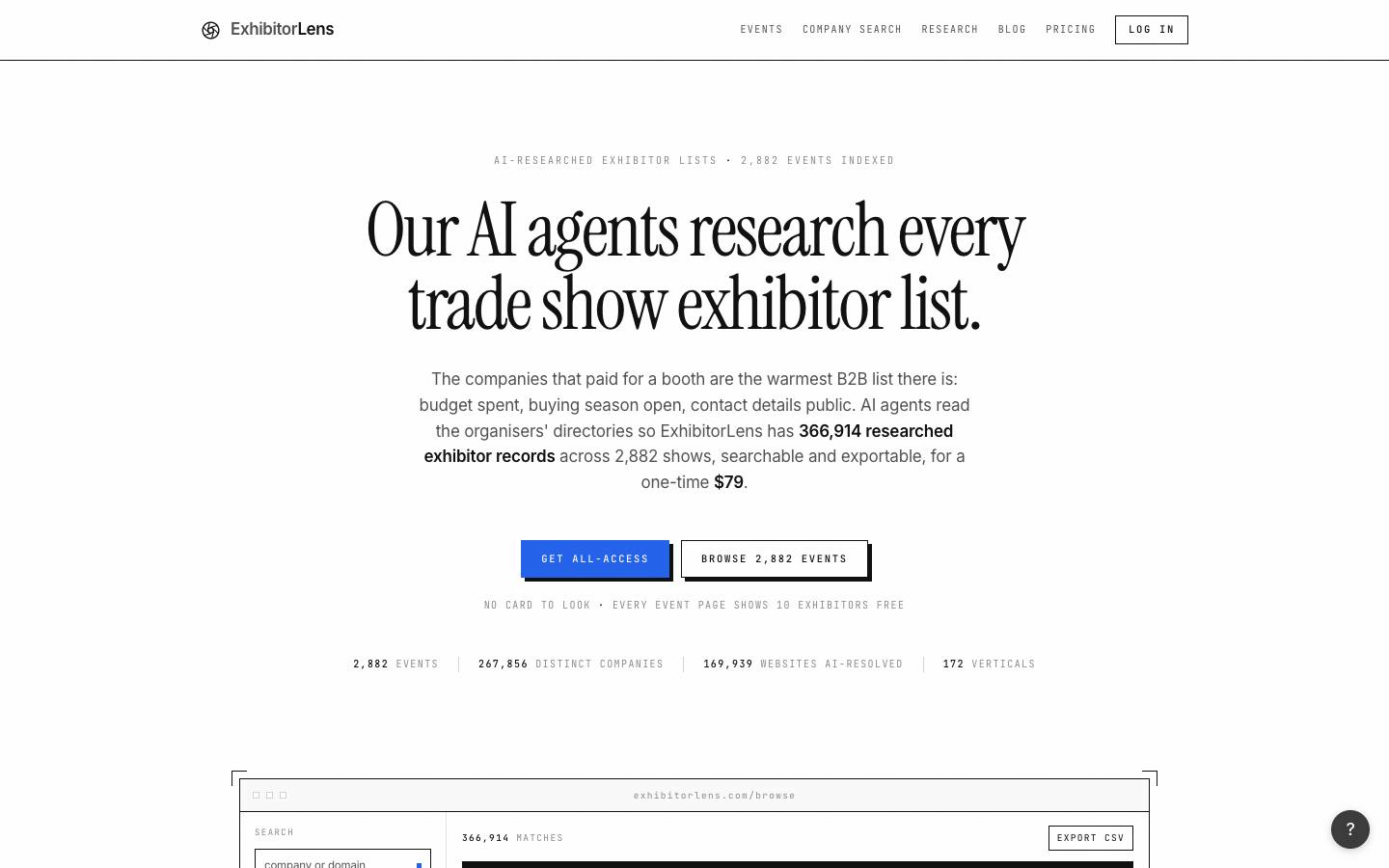
8. ExhibitorLens, best for researching which companies exhibit at which shows for a one-time fee
From $79/one-time
- Price
- From $79/one-time
- Languages
- English
ExhibitorLens uses AI agents to compile exhibitor lists from event directories into a searchable database of 2,882 events and 366,914 exhibitor records. You can search by event, company, vertical or country and see where a company exhibits across shows. All-access is a single payment, with attendee and exhibitor contact lists sold per event.
More on ExhibitorLensLess on ExhibitorLens
Formats: In-person
Pricing is published and simple. All-access costs $79 once and covers every exhibitor list in the database, cross-event company search, CSV export and new events at no extra charge. Per-event add-ons are built on request and arrive as a CSV by email within 24 hours: an attendee list is $99 per event, and an exhibitor contact list, with one decision-maker per exhibitor including name, title, business email and LinkedIn, is $79 per event (pricing page, checked October 2026). There's a 14-day refund window if the data doesn't match the vendor's claims.
AI agents read organizers' exhibitor directories and archived snapshots to build and refresh lists, resolve company websites and write event overviews, and booth numbers and sponsor tiers are included where shows publish them. You can preview the first 10 exhibitors for any event without an account. The company publishes little about itself beyond its founder, Markus Wagner, and its privacy page names Stripe, SendGrid and Render as processors. There are no named CRM integrations.
- Free preview of the first 10 exhibitors per event
What stands out
- All-access to every exhibitor list for $79 one-time (pricing page, checked October 2026)
- Cross-event search showing every show a company exhibits at
- Per-event attendee lists for $99 and exhibitor contact lists for $79, delivered within 24 hours
Worth checking
- All-access data is company-level, without contacts
- No integrations; data leaves as CSV, and little company information is published
Best suited for. ExhibitorLens fits SDR teams and marketers who want to know which companies exhibit at which shows, including competitors, for a one-time fee. If you need attendee-level contacts across many events or CRM sync, Lensmor or Vendelux will fit better.

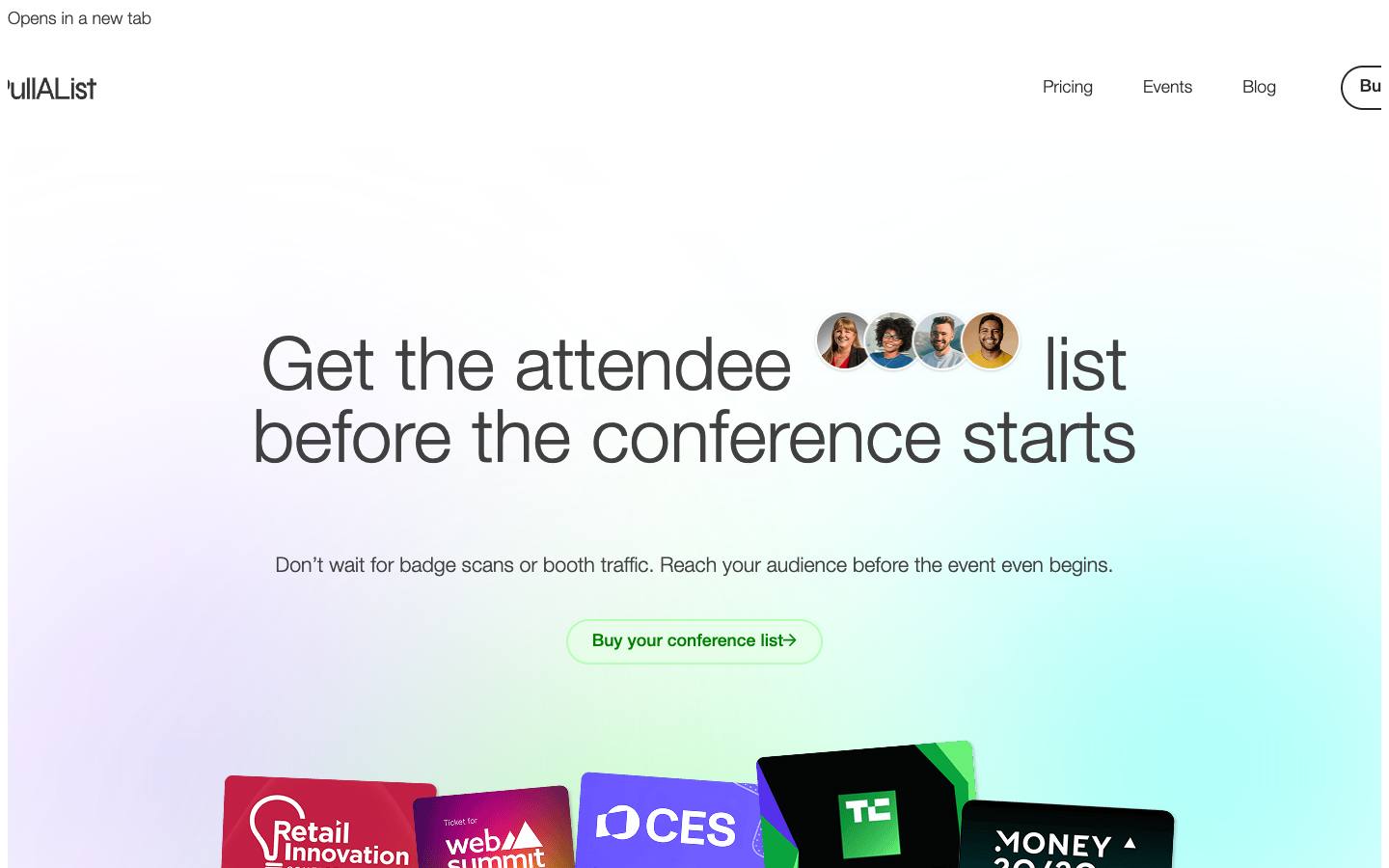
9. PullAList, best for prospecting attendees at one large tech, fintech or retail conference
From $299/list
- Price
- From $299/list
- Languages
- English
PullAList sells attendee lists for individual conferences, delivered as a Google Sheet. Its catalog leans toward large events such as Dreamforce, SXSW, Collision, NRF's Big Show and Shoptalk, and it'll source lists for events not yet listed. Add-ons enrich contacts or send newly registered attendees each week.
More on PullAListLess on PullAList
Formats: In-person
PullAList prices per list. Standard delivery is $299 for a list within 3 to 5 business days, rush delivery is $499 within 48 hours, and a $299 enrichment add-on adds verified emails and LinkedIn profiles to either order (checked October 2026). Lists from previous editions of a conference cost $199, and a weekly refresh add-on sends newly registered attendees for the same event. If a standard list arrives late, it offers a refund, and there's no subscription.
Each list arrives as a Google Sheet that can be downloaded as CSV, XLSX or PDF, with name, title and company plus email and LinkedIn where provided. Its catalog leans toward large technology, fintech and retail events such as Dreamforce, SXSW, Collision, NRF's Big Show and Shoptalk, and it'll source lists for events not yet listed. The site doesn't say how attendee data is collected, doesn't address GDPR or consent, and doesn't disclose its operator, location or leadership. There are no CRM integrations.
- Sources lists on request for events outside its catalog
What stands out
- $299 per list with 3 to 5 business day delivery, or $499 for delivery within 48 hours (checked October 2026)
- Enrichment and weekly refresh add-ons
- Full refund if a standard list arrives late
Worth checking
- The site doesn't explain how attendee data is obtained or address consent, so check legal exposure before emailing
- No CRM integration, and the operator isn't disclosed
Best suited for. PullAList fits business development teams that want a ready-made list for one big tech, fintech or retail conference without a subscription. If you need to know where the data came from, or want lists matched to your accounts across many events, choose WhoGoes, Lensmor or Vendelux instead.

10. ZoomInfo, best for enterprises that want to enrich event lists and prioritize accounts with intent data they already own
Quote only
- Price
- Quote only
- Try it
- Free trial
- Languages
- English
- Syncs with
- Salesforce, HubSpot, Dynamics, Marketo
- Security
- SOC 2 Type II, ISO 27001, SAML SSO
- Customers include
- Zoom, Seismic, monday.com
ZoomInfo is a go-to-market data platform with B2B contact and company data, buyer intent signals and AI agents. It doesn't tell you which events to attend, but event teams use it to enrich attendee and badge-scan lists, build target-account invite lists and prioritize who to meet and follow up with. Many of the tools above can plug into an existing ZoomInfo contract.
More on ZoomInfoLess on ZoomInfo
Founded: 2007 · HQ: Vancouver, Washington · Team: 1,001-5,000 people · Formats: In-person
ZoomInfo is a public company headquartered in Vancouver, Washington, with 1,001 to 5,000 employees under founder and CEO Henry Schuck. Pricing isn't published: Professional, Copilot Advanced and Copilot Enterprise packages are priced by seats, export credits and add-ons, and some sales packages offer a trial, typically 7 days. Copilot Advanced adds buyer intent signals, website visitors and account fit scores. Named customers include Adobe, Microsoft, Google, Snowflake, Figma and Zoom.
For event teams, the value is enrichment and prioritization around events found elsewhere. Native integrations include Salesforce, HubSpot, Microsoft Dynamics 365, Marketo, Outreach, Salesloft and Snowflake, and an MCP server connects Claude, ChatGPT and other assistants to its data. In October 2026 it launched Agent Teams, built on its September 2026 acquisition of DoubleO.ai, plus a native n8n integration. Its security page lists SOC 2 Type II, ISO 27001 and ISO 27701, with SAML SSO and SCIM through Okta, and its status page logged 8 incidents in the 90 days to October 18, 2026. Luminik can use an existing ZoomInfo contract for attendee enrichment.
- SOC 2 Type II, ISO 27001 and ISO 27701
What stands out
- Large B2B contact and company dataset for enriching event lists
- Buyer intent signals to prioritize accounts before a show
- Native Salesforce, HubSpot, Dynamics 365 and Marketo integrations
Worth checking
- Not an event product; it needs pairing with event discovery and capture tools
- Quote-only, credit-based pricing that can be costly for small teams
Best suited for. ZoomInfo fits mid-market and enterprise teams that already own it and want to enrich event lists and rank accounts by intent before a show. It doesn't tell you which events to attend or who'll be there, so pair it with an event intelligence platform rather than buying it for events alone.

11. Demandbase, best for enterprise ABM teams that want events tied into intent and buying-group data
Quote only
- Price
- Quote only
- Languages
- English
- Security
- SOC 2 Type II, ISO 27001, DPA
- Customers include
- Palo Alto Networks, SAP Concur, Thales
Demandbase is an account-based go-to-market platform with account identification, intent and buying-group data, B2B advertising and sales intelligence. Event marketers use it to decide which accounts to invite or target around a show, promote events to those accounts and prioritize follow-up by engagement. It doesn't discover events or provide attendee lists.
More on DemandbaseLess on Demandbase
Founded: 2006 · HQ: San Francisco, US · Team: 501-1,000 people · Formats: In-person
Demandbase was founded in 2005 and is based in San Francisco, with 501 to 1,000 employees and $330 million raised according to CB Insights, including financing from Vista Credit Partners. Pricing isn't published; contracts combine a platform fee with a flat per-user fee for marketing and sales seats, and advertising and data products can be bought separately. Named customers include Adobe, SAP Concur, Thermo Fisher Scientific, Visa, IBM, DocuSign and Salesforce.
Its buying-group intelligence maps engagement across the people at an account, which helps decide who to invite to a dinner or meet at a booth, and its account-targeted advertising can drive registrations or booth visits from target accounts. Demandbase AI and the Mojo marketing agent prioritize opportunities, and connectors cover Claude, Copilot and Gemini. Its SafeBase trust site offers a SOC 2 Type 2 report on request, ISO 27001 certification, a DPA, a subprocessor list and pentest reports. No event platform integrations appear in its partner directory, and it doesn't index events or supply attendee lists.
- Connectors for AI assistants including Claude, Copilot and Gemini
What stands out
- Intent and buying-group signals to choose which accounts to focus on at an event
- Account-targeted advertising to drive registrations or booth visits
- SOC 2 Type 2 reporting and ISO 27001 certification
Worth checking
- No event discovery, attendee data or event platform integrations
- Enterprise contracts with no published prices
Best suited for. Demandbase fits enterprise B2B teams already running account-based programs that want field events and conferences tied into intent and buying-group data. If you need to discover events or see who'll attend, pair it with Vendelux, Lensmor or another event intelligence tool.
Picks 6 to 11 are folded to keep the list short. Open any of them, or compare them all in the table above.
Also worth considering
10times, ExhibitorsData, BizProspex, Target Response, Articuler, momencio, HelloSponsor, Evenda (sponsorship exchange), Mingloft
The best event intelligence platforms by use case
| If you need | Company size | Look at |
|---|---|---|
| Team choosing 10 to 50 sponsorships a year by where target accounts will be | Mid-market, Enterprise | Vendeluxmatches 250,000+ events to CRM accounts and books meetings |
| Growth-stage team that already pays for Apollo and a sequencer | Startup, Mid-market | Luminikscores each show's attendees and pushes them to outreach from $249 a month |
| Sales team prospecting exhibitors at trade shows worldwide, including Asia | Startup, Mid-market, Enterprise | Lensmor160,000+ events with published self-serve plans |
| Field team that wants booth capture and event selection from one vendor | Startup, Mid-market | MoblyScout, Capture and Insights share one product |
| PR and sponsorship team budgeting a portfolio of conferences and speaking slots | Startup, Mid-market, Enterprise | Sproxxytracks spend, tasks and share of voice per event |
| Brand funding dozens of community meetups run by outside organizers | Mid-market, Enterprise | Plain Sighthandles approvals, payouts and post-event reports |
| Startup that needs an attendee list for one show this month | Startup | WhoGoescredit packs from $29 with no contract |
| SDR team researching where competitors exhibit | Startup, Mid-market | ExhibitorLens$79 one-time for every exhibitor list |
What results look like
Figures customers report in the vendors' own published case studies. They describe one customer each, not what every buyer should expect.
300%
Revenue growth
Zoom with ZoomInfo · Case study
17%
Closed-won rate lift with buying groups
Palo Alto Networks with Demandbase · Case study
How to choose
Background on what these tools do, how we ranked them and what to check before you buy. Open any topic.
What event intelligence platforms actually are (and what they aren't)
Event intelligence platforms help B2B teams decide which conferences and trade shows to attend, sponsor or exhibit at, and then get more out of each one. They index upcoming events, show which companies and people are likely to attend, speak, sponsor or exhibit, match that against your target accounts and open deals, and help you reach the right people before the show. The fuller platforms also connect to Salesforce or HubSpot so each event's sourced and influenced pipeline is recorded where finance can see it.
It isn't event management or event registration software, which run the events you host yourself, and it isn't event analytics software, which measures attendee behavior at your own events. It isn't a lead retrieval app either, although several platforms here include one for scanning badges at the booth. Event matchmaking software schedules meetings inside one event's attendee base on the organizer's side; event intelligence works from the outside, across many events, for sponsors and exhibitors. Searches for the term also return IT and security monitoring products that correlate system events, which are unrelated.
For a B2B event team, the jobs are concrete: rank next year's calendar by how many target accounts each show draws, build attendee and exhibitor lists by role, book meetings before the doors open, and prove afterwards which shows created pipeline so the budget conversation starts from data rather than habit.
How we ranked these event intelligence platforms
We ranked these products by how fully they handle the main job of choosing third-party events and turning them into meetings and pipeline. Every criterion below can be checked on the vendor's own pages or in our research files.
1. Published event coverage
We recorded the number of events or event lists each vendor states on its own site, checked in October 2026.
2. Attendee data source disclosed
We checked whether the vendor's pages say where attendee, sponsor or exhibitor data comes from, such as directories, speaker lists, public posts or registration data.
3. Target account matching
We checked product pages for matching events against CRM accounts, open deals or an uploaded ideal customer profile.
4. Native Salesforce or HubSpot sync
We checked integration pages and our vendor profiles for a native CRM connection rather than CSV export only.
5. Published entry price
We recorded the lowest published price from each vendor's pricing page and marked the rest as quote-only.
6. Security documentation
We checked trust centers and security pages for SOC 2, ISO 27001 and a data processing addendum, as recorded in our procurement research.
More on our process in the methodology.
What event intelligence means for B2B teams
For a B2B marketer, event intelligence answers three questions: which conferences and trade shows are worth our budget, who will be there that we want to meet, and what did each event produce? Tools differ in which question they answer. Vendelux and Mobly span all three. Sproxxy and Plain Sight focus on choosing and managing a portfolio of events. Lensmor, WhoGoes, ExhibitorLens and PullAList answer the who: exhibitor and attendee data for a given show. Luminik focuses on the run-up to and follow-through after each show. ZoomInfo and Demandbase add account data and intent but don't tell you about events. Searches for event intelligence also return IT and security monitoring software, which is unrelated to business events.
What to look for in an event intelligence platform
Start with coverage: how many events are indexed, how far ahead, and whether the regions and industries you sell into are well covered (Vendelux cites 250,000+ B2B events, Lensmor 160,000+, ExhibitorLens 2,882 events with exhibitor lists, WhoGoes 1,200+ with attendee lists). Then check how it knows who's attending: registration or sponsor data, exhibitor directories, speaker lists, public social posts or predictions. Next, look at matching against your own accounts, either by CRM connection or list upload, and what happens after you find the right people: export to CSV, push to a sequencer, or managed meeting outreach. Finally, check whether it records which events created pipeline in Salesforce or HubSpot, because that's what the next budget decision depends on.
Trade show attendee lists: what you're actually buying
Organizers rarely sell full attendee lists, so most attendee data comes from somewhere else, and the source shapes its quality. WhoGoes uses public LinkedIn posts about attending, so every contact is backed by a post but coverage is partial. ExhibitorLens builds exhibitor lists from organizers' directories, which is reliable for companies but company-level unless you buy contacts per event. PullAList says its lists contain what the conference makes available but doesn't explain how it gets them. Platforms such as Vendelux, Lensmor and Luminik combine several sources and match them to your accounts. Before emailing anyone, ask where each record came from and check your own consent position, especially for attendees in the EU.
Questions to ask vendors
Ask each vendor: how many events do you cover in our industries and regions, and how early before an event is attendee or sponsor data available? Where does attendee data come from, and how accurate was it at a past event we attended? Can you match against our Salesforce or HubSpot accounts and open deals? Do you book meetings, or do we run outreach ourselves? How do you attribute pipeline to an event, and can we see it on CRM opportunities? How are credits used, and what happens to unused ones? Is there a pilot or trial on one of our upcoming shows?
How much event intelligence costs
Prices range from a few dollars to tens of thousands a year, depending on how much of the job the tool does. List and data tools are cheapest: WhoGoes credit packs start at $29 for 200 credits, ExhibitorLens all-access is $79 one-time, and PullAList charges $299 per list (all checked October 2026). Self-serve platforms come next: Luminik starts at $249 a month billed annually for up to six events a year, and Lensmor Basic is $499 a month or $4,990 a year, with Growth at $14,900 a year. Full platforms with managed outreach and attribution are quoted; Vendelux doesn't publish prices. ZoomInfo and Demandbase are quoted enterprise contracts.
Event intelligence vs. event attribution and ABM tools
Event intelligence is mostly about decisions made before the event: where to go, who'll be there and who to meet. Event attribution software measures what events produced after the fact, and ABM platforms such as Demandbase and data providers such as ZoomInfo track accounts across every channel, not just events. The categories overlap at the edges, since Vendelux, Mobly and Luminik all write pipeline back to the CRM. If your main problem is proving return on events you already run, compare dedicated attribution tools too; if it's choosing where to spend next year's event budget, start here.
Where this fits in your event tech stack
Event intelligence sits at the start of the third-party event workflow and feeds the rest of the stack. It reads from the CRM (target accounts, open deals and customers) to decide which shows matter, pushes target contacts to a sales engagement tool or managed outreach before the event, and hands off to lead capture at the booth. Afterwards, the CRM is where attendance, meetings and opportunities are tied back to each event. Vendelux, Luminik and Mobly connect to Salesforce and HubSpot; Lensmor exports to HubSpot and sequencers via webhooks and an API; WhoGoes, ExhibitorLens and PullAList deliver CSVs or spreadsheets. ZoomInfo and Demandbase usually sit alongside as the account and intent layer.
FAQ
What is event intelligence?
What does an event intelligence platform do?
How do I decide which trade shows to attend?
How can I get a trade show attendee list?
How much does event intelligence software cost?
What's the difference between event intelligence and event attribution?
How do I plan event ROI before committing to a show?
How can I get a list of exhibitors at a trade show?
Get a free event intelligence platforms shortlist
Reading reviews only gets you so far. The right pick depends on your events, your team and the systems it has to sync with.
Our shortlist finder asks a few questions and matches you with tools that fit, using the same verified data as this guide.
You'll see published prices, security documents and CRM integrations side by side, and you can save tools to compare later.
It's free, there's no sign-up, and no vendor gets your details.
Ready? Build your shortlist in two minutes, or try the free cost per lead, meeting and opportunity calculator.
Get a free shortlistKeep reading
Ratings link to their source and are shown as published on the date of our last check. Read our methodology.