Best Event Analytics Software in 2027: The Buyer's Shortlist
By EventMarketingSoftware.com · Published October 18, 2026 · 13 tools compared
The best event analytics software for B2B marketers ties event activity to CRM pipeline. Vendelux measures pipeline from third-party conferences you sponsor or attend. RainFocus and Certain turn engagement at your own events into CRM signals. Vivastream unifies data from any platform, hapily and Blackthorn keep event data native in HubSpot or Salesforce, and Bear Analytics serves organizers.
Our top picks
- 1
 VendeluxBest for B2B teams measuring pipeline and revenue from the third-party conferences they sponsor or attendQuote only
- 2
 RainFocusBest for enterprise teams that host flagship conferences and want portfolio reporting tied to Salesforce pipelineQuote only
- 3
 CertainBest for enterprise marketers who want session, booth and content engagement scored and routed to CRM during the eventQuote only
Key takeaways
- Event analytics only pays off once event data reaches the CRM. CRM-native tools avoid sync entirely (hapily stores records in HubSpot and Blackthorn in Salesforce), while RainFocus, Certain, Cvent and Bizzabo push data to Salesforce, HubSpot or Marketo.
- Five of the 13 picks publish prices, checked October 2026. Luminik starts at $249 a month billed annually, hapily at $600 a month, Bear Analytics at $900 a month, Bizzabo at $499 per user a month with a 3-user minimum, and Crowd Connected at $10 per delegate plus a $6,000 activation charge in the US.
- Whose event it is changes what you can measure. At events you host, platforms like RainFocus, Certain and Cvent see sessions, app activity and meetings, while at other organizers' shows Vendelux and Luminik measure which target accounts were there and what pipeline followed.
- Passive measurement closes the badge-scan gap. Crowd Connected uses wearable tags and beacons, Bizzabo's Klik SmartBadge records onsite interactions, and Zenus measures dwell time and sentiment with cameras that don't store identifiable data.
- Surveys and benchmarks answer what behavior data can't. Explori benchmarks results against more than 10,000 measured events, and Bear Analytics gives organizers registration pacing and exhibitor ROI through connectors for association and trade show systems.
Free tool: Cost per lead, meeting and opportunity calculator. Turn event cost and results into cost per lead, meeting and opportunity, pipeline, expected revenue, ROI and break-even meetings.
Side-by-side comparison
The same criteria for every pick: native crm connection, pipeline attribution, engagement data captured, cross-event reporting, published pricing, security documentation. A dash means the vendor doesn't publish it.
| Tool | Starting price | Free plan / trial | CRM | Capterra | App Store | Security |
|---|---|---|---|---|---|---|
| Vendelux | Quote only | Free plan | Salesforce, HubSpot | ★ 5.0 (4) | ★ 4.6 (10) | SOC 2 Type II, SAML SSO, DPA |
| RainFocus | Quote only | – | Salesforce, HubSpot, Marketo | ★ 4.0 (1) | ★ 5.0 (5) | SOC 2 Type II, ISO 27001 |
| Certain | Quote only | Free plan | Salesforce, HubSpot, Marketo | ★ 4.3 (6) | ★ 4.8 (8) | SOC 2 Type II |
| Vivastream | Quote only | – | Salesforce | – | – | – |
| hapily | From $417/month | – | HubSpot | – | – | SOC 2 Type II, DPA |
| Blackthorn | Quote only | – | Salesforce | – | ★ 5.0 (16) | SOC 2 Type II, DPA |
| Luminik | From $249/month | – | Salesforce, HubSpot | – | – | SAML SSO |
| Bizzabo | From $499/user | – | Salesforce, HubSpot, Marketo | ★ 4.4 (171) | ★ 4.6 (14) | SOC 2 Type II, ISO 27001 |
| Cvent | Quote only | – | Salesforce, HubSpot, Dynamics, Marketo | ★ 4.5 (1099) | ★ 4.8 (40,670) | SOC 2 Type II, ISO 27001, DPA |
| Bear Analytics | From $900/month | – | Salesforce, HubSpot | – | – | – |
| Explori | Quote only | – | – | – | – | – |
| Zenus | Quote only | – | – | – | – | – |
| Crowd Connected | From £8/attendee | Free plan, Free trial | – | – | – | – |
Event analytics, in the sense this guide uses it, means measuring what in-person and hybrid events do for the business: who came, which accounts engaged, what they did at sessions and booths, and how much pipeline and revenue followed. It's different from the product analytics meaning of the same phrase (tracking clicks and events in Google Analytics or Mixpanel), and narrower than general marketing attribution, which weighs every channel at once. This guide compares 13 products in four groups: event intelligence for sponsored and attended events, event platforms with built-in engagement and pipeline reporting, CRM-native tools, and dedicated measurement layers such as unified dashboards, surveys and onsite sensors. Every detail comes from our vendor profiles and the vendors' own pages, checked in October 2026.
Who this guide is for. This guide is for B2B event marketers, field and demand generation teams, marketing operations and event program owners who have to show what events contribute to pipeline. It's most useful if you run or sponsor several events a year, collect data in different tools (registration, app, lead scanning, surveys) and need one view by event, account and opportunity in Salesforce or HubSpot. Trade show and association organizers proving value to exhibitors will find relevant picks too, though the ordering favors teams measuring their own pipeline.
Not sure which one fits your team?
Answer a few questions about your events, team and CRM and get a free shortlist of tools that fit, with pricing and security details side by side.
Get a free shortlistThe best event analytics software in 2027
We compare 13 event analytics tools, ordered by fit for the job most B2B teams have: tying event activity to CRM pipeline. Sponsor-side attribution and enterprise platforms that score engagement come first, then unified data layers, CRM-native tools and platform reporting, followed by measurement tools built mostly for organizers: dashboards, surveys and onsite sensors. For each pick, check which data it captures, how it reaches your CRM and whether pricing is published.
1. Vendelux, best for B2B teams measuring pipeline and revenue from the third-party conferences they sponsor or attend
- Price
- Quote only
- Try it
- Free plan
- Capterra
- 5.0/5 from 4 reviews
- App Store
- 4.6/5 from 10 ratings
- Languages
- English
- Syncs with
- Salesforce, HubSpot
- Security
- SOC 2 Type II, SAML SSO, DPA
- Customers include
- TELUS Digital, Superhuman, Pecan AI
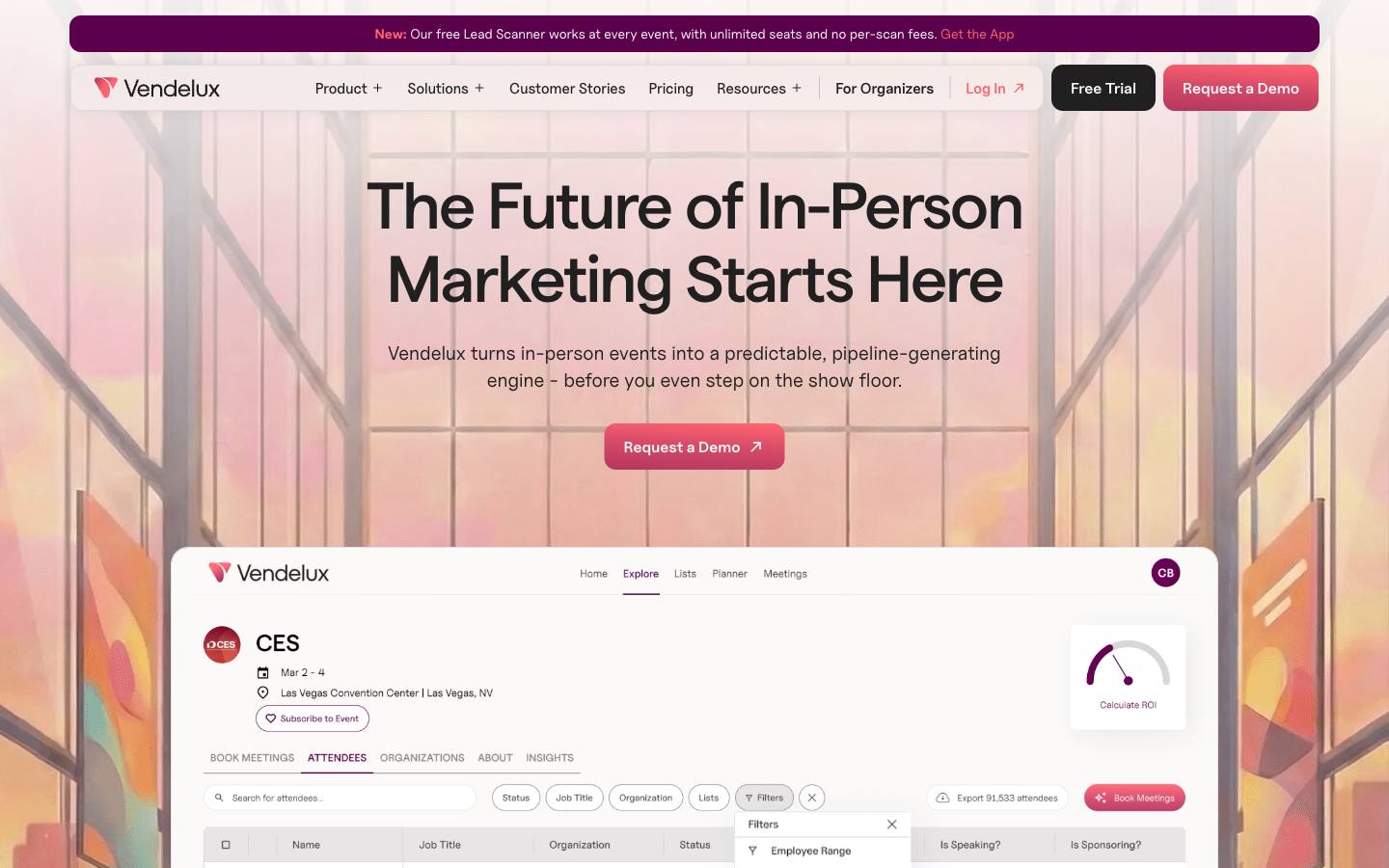
Vendelux is an event intelligence platform built on a database of more than 250,000 B2B events. It overlays your CRM accounts and open deals on upcoming events to show where target accounts will be, then attributes pipeline and closed revenue back to the events you attended or sponsored. A free lead scanner app captures and enriches booth contacts.
More on VendeluxLess on Vendelux
Founded: 2021 · HQ: New York, US · Team: 51–200 people · Formats: In-person
Vendelux was founded in 2021 in New York and raised a $50 million Series B in July 2026, bringing total funding to $71 million by its own count. For measurement, its CRM overlay maps Salesforce or HubSpot accounts and open deals onto upcoming events, and after each show it attributes pipeline and closed revenue to the events you attended or sponsored. CRM sync is view-only on the Starter plan and pushes to lists and campaigns on Plus, and Zoho is also supported.
Plans (Starter, Plus and Enterprise) differ by lead credits, campaign credits and seats. Prices aren't published. It holds a 5.0 rating from 4 reviews on Capterra. Plus adds a dedicated client success manager and quarterly on-site visits. Customers named on its site include Ramp, Glean, Coupa and AdRoll, and its trust center lists a 2025 SOC 2 Type II report and GDPR and CCPA compliance. It doesn't measure engagement inside events you host, such as sessions or app activity.
- Free iOS and Android lead scanner that enriches contacts captured at the booth
What stands out
- CRM overlay maps your accounts and open deals onto upcoming events before you commit budget
- Attributes pipeline and revenue back to individual events through Salesforce or HubSpot
- Event database of 250,000+ events for comparing where to spend next year
Worth checking
- Built for events run by other organizers; it doesn't report on registration or sessions at events you host
- Pricing isn't published and is based on lead and campaign credits; native CRM integrations are Salesforce, HubSpot and Zoho
Best suited for. Vendelux fits B2B teams whose biggest event spend goes to sponsoring and exhibiting at other organizers' conferences and who need that spend tied to Salesforce or HubSpot pipeline. For engagement analytics at events you host yourself, add or choose RainFocus, Certain or hapily.
2. RainFocus, best for enterprise teams that host flagship conferences and want portfolio reporting tied to Salesforce pipeline
- Price
- Quote only
- Capterra
- 4.0/5 from 1 reviews
- App Store
- 5.0/5 from 5 ratings
- Syncs with
- Salesforce, HubSpot, Marketo
- Security
- SOC 2 Type II, ISO 27001
- Customers include
- Autodesk, Trimble, Ellucian
RainFocus is an enterprise event marketing platform built around one attendee data model across a whole portfolio of events. Registration, sessions, meetings, sponsor activity and app engagement feed cross-event performance reporting and marketing data views. A dedicated Salesforce app supports pipeline attribution, and a sales module gives reps event-driven account activity.
More on RainFocusLess on RainFocus
Founded: 2013 · HQ: Lindon, Utah · Team: 201–500 people · Formats: In-person, Virtual, Hybrid, Webinar
RainFocus was founded in 2013 in Lehi, Utah, has 201 to 500 employees and has raised $104 million, with JMI Equity and KKR as backers. Customers named on its site include Adobe, Cisco, Oracle, Red Hat, ServiceNow and Zscaler, and it runs some of the largest tech user conferences, including Cisco Live. Forrester named it a Leader in its 2026 evaluation of virtual event management platforms. Pricing isn't published and is aimed at enterprise budgets.
Its RainFocus for Salesforce app handles pipeline attribution, and named connectors include Marketo Engage, Oracle Eloqua and HubSpot, though the vendor cites 40+ connectors without naming the rest. In July 2026 it added a sales module that gives reps event-driven account activity, plus MCP Profiles for AI agent connectivity, after launching its Nexus AI agents in January 2026. A Base module for small, repeatable events arrived in December 2025. Security documentation includes ISO 27001:2022, a SOC 2 Type 2 report on request and PCI DSS, and its status page showed no incidents in the 90 days to October 18, 2026.
- SOC 2 and ISO 27001:2022 listed on its security page
What stands out
- Portfolio-level performance reporting across conferences, roadshows, field events and webinars
- Salesforce app for pipeline attribution, plus Marketo Engage, Eloqua and HubSpot integrations
- Sales module that surfaces event activity on target accounts for reps
Worth checking
- Only worth it if RainFocus also runs your events; it isn't a standalone analytics layer
- Pricing isn't published and is aimed at enterprise budgets
Best suited for. RainFocus fits enterprise marketing teams running a portfolio of large user conferences and field events that want one attendee data model and Salesforce attribution. Teams running a handful of simpler events will likely find hapily, Blackthorn or Bizzabo easier to buy and run.
3. Certain, best for enterprise marketers who want session, booth and content engagement scored and routed to CRM during the event
- Price
- Quote only
- Try it
- Free plan
- Capterra
- 4.3/5 from 6 reviews
- App Store
- 4.8/5 from 8 ratings
- Syncs with
- Salesforce, HubSpot, Marketo
- Security
- SOC 2 Type II
- Customers include
- Analog Devices, Deloitte, National Instruments
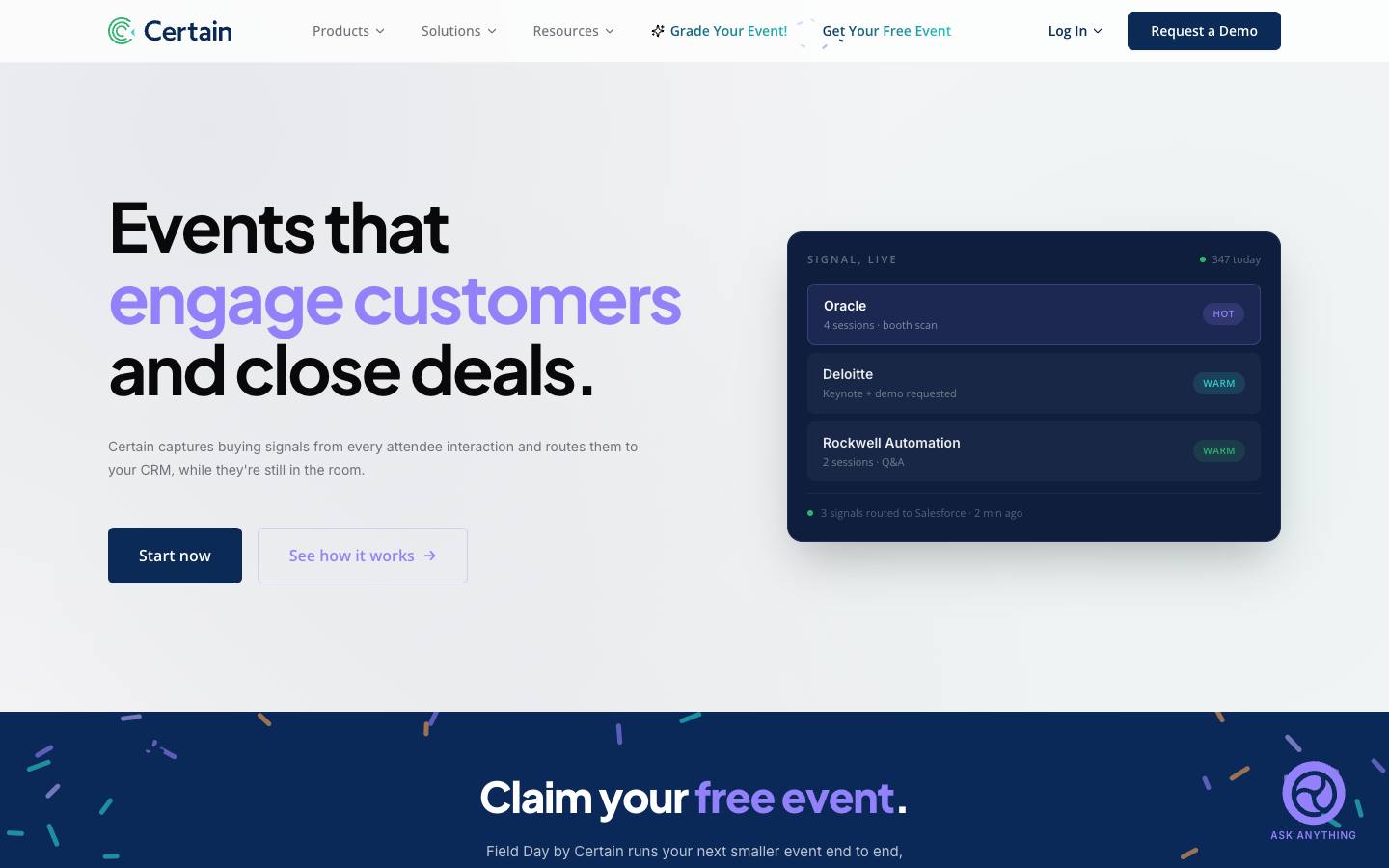
Certain is a long-running enterprise event management platform now positioned as an event intelligence system. It tracks session, booth and content interactions, scores attendee intent with AI and routes those signals to Salesforce, HubSpot or Marketo while the event is still running. A live dashboard shows attendees, captured signals, hot leads synced and pipeline influenced.
More on CertainLess on Certain
Founded: 1994 · HQ: San Francisco, United States · Formats: In-person, Virtual, Hybrid
Certain was founded in 1994 and is privately held, with $38.64 million raised according to CB Insights and a fully remote team. Pricing is custom and set by event portfolio size and modules (event management, intelligence and signals, and the Touchpoint mobile app), and a free Field Day offer covers smaller events from registration through badge printing and data sync. Capterra shows 4.33 from 6 reviews. Named customers include Oracle, Thomson Reuters, Deloitte, Rockwell Automation and Analog Devices.
Its AI engine scores and weights attendee intent signals, and behavior-based follow-up sends messages based on which sessions and content each person engaged with. An AI Event Advisor recommends sessions and networking to attendees. Direct connections cover Salesforce, HubSpot and Marketo through no-code data flows, plus a Public API 2.0. Its security page names SOC 2 Type II and PCI compliance and claims GDPR compliance, and its status page showed no incidents in the 90 days to October 18, 2026, with the last one in March 2025.
- SOC 2 Type II and PCI DSS listed
What stands out
- AI scoring of attendee intent from session, booth and content behavior
- Real-time routing of buying signals to CRM, not just a post-event export
- Live dashboard of signals captured and pipeline influenced
Worth checking
- Pricing is fully custom and not published
- Short published integration list (Salesforce, HubSpot, Marketo and a public API)
Best suited for. Certain fits enterprise teams that host many branded events and want in-event engagement turned into scored intent in Salesforce, HubSpot or Marketo while the event is still running. If your events run on several platforms, a platform-agnostic layer such as Vivastream may fit better.

4. Vivastream, best for enterprise B2B teams that run events on several platforms and need one account-level view
- Price
- Quote only
- Languages
- English
- Syncs with
- Salesforce
- Customers include
- AT&T, Atlassian, Citrix
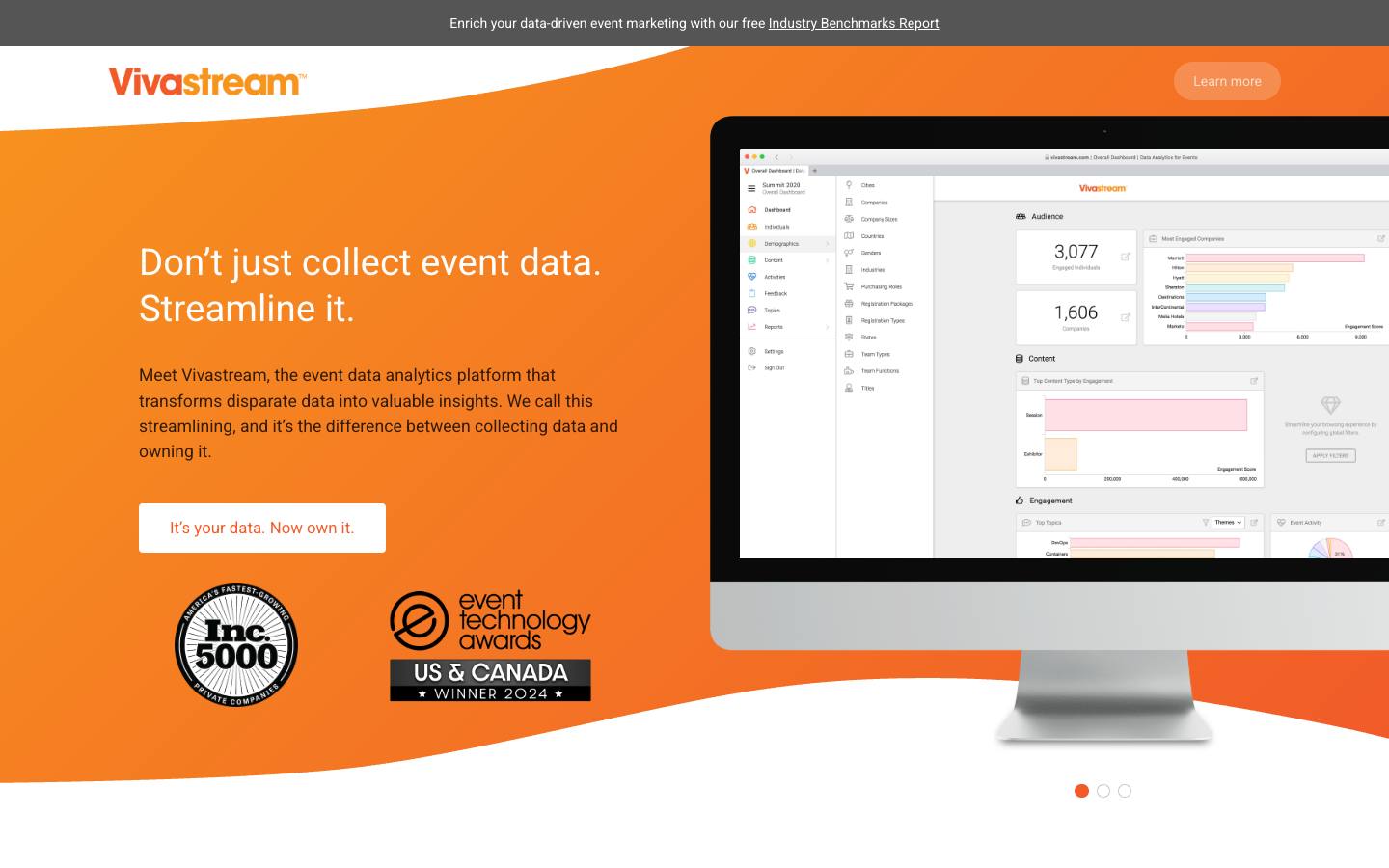
Vivastream is an event data analytics platform that ingests registration, lead scan, app, session, survey, webinar and other data, from your own events or other organizers', through an API or plain files. It cleans and joins the data without manual dedupe and presents dashboards at individual, account and event level. Results can be pushed into the CRM, marketing systems, warehouses and BI tools.
More on VivastreamLess on Vivastream
HQ: New York, USA · Formats: In-person, Virtual, Webinar
Vivastream is a New York company with $1.81 million raised according to CB Insights, and it won an Event Technology Awards US and Canada prize in 2024. Customers named on its site include Atlassian, AT&T, Citrix, Fiserv, Red Hat, Synopsys and VMware, which reflects its focus on large tech marketing teams. Pricing isn't published, and its public site is a single page with limited product detail.
Custom reports compare events year over year and break results down by country, industry, company and title, and Trip Reports summarize each attendee's activity after an event, which sales teams can use for follow-up. Implementation is handled by Vivastream: you supply API access or raw Excel, CSV or JSON files and its team does the processing, though no timeline is stated. It's an analytics layer only and doesn't run registration or the event itself. The site says results can be pushed into CRM and marketing systems, warehouses and BI tools, and a product screenshot is labeled Salesforce Integration, but no other connectors are named, so confirm your CRM in a demo.
- Per-attendee trip reports summarizing each person's event activity
What stands out
- Platform-agnostic: works on top of whichever registration and lead scanning tools you use
- Dashboards by individual, account and event, suited to account-based programs
- Custom reports such as year-over-year and by country, industry, company or title
Worth checking
- Analytics only; you still need tools to run the events and capture the data
- No published pricing, and the website gives limited product detail
Best suited for. Vivastream fits enterprise teams whose event data is spread across several registration, lead scan and app vendors and who want one account-level view of owned and third-party events. If one platform runs all your events, its built-in reporting or a CRM-native tool like hapily may be enough.

5. hapily, best for HubSpot teams that want event registrations, scans and deal attribution as native CRM records
- Price
- From $417/month
- Languages
- English
- Syncs with
- HubSpot
- Security
- SOC 2 Type II, DPA
- Customers include
- Duke Corporate Education, Imperial PFS, Pearagon
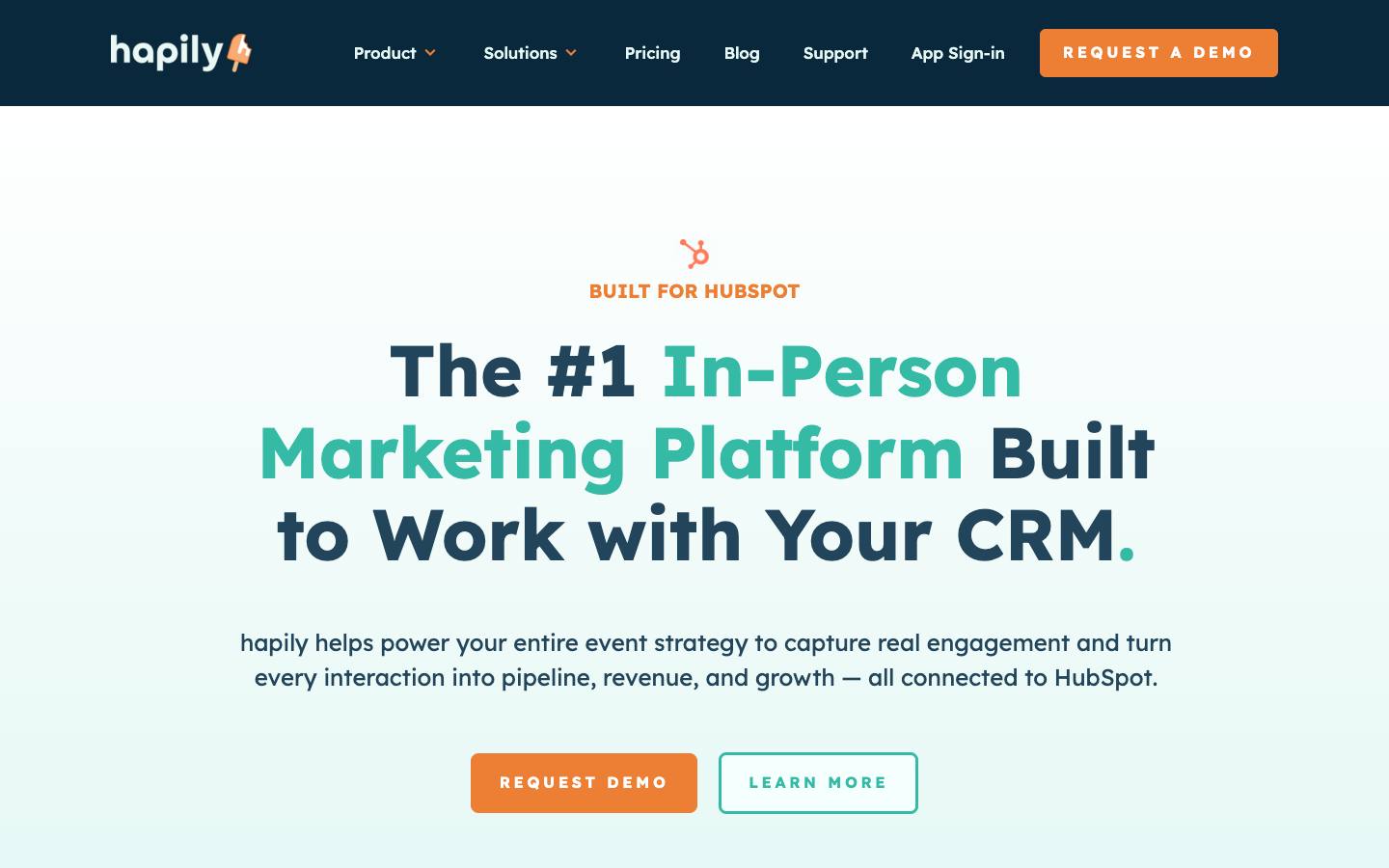
hapily runs event registration, check-in, mobile lead capture and meetings inside HubSpot, storing every registration and scan as a native record. Because the data already lives in the CRM, deal attribution and ROI reports are built in HubSpot dashboards. It covers events you host and events you attend.
More on hapilyLess on hapily
Founded: 2025 · HQ: New York, NY · Team: 11-50 people · Formats: In-person, Virtual, Hybrid, Webinar
hapily was founded in 2025 in New York and has 11 to 50 employees. It publishes prices: Hosted Events and Lead Capture each cost $600 a month billed annually with 1,000 credits, the Core Bundle with both is $833 a month with 2,000 credits and unlimited seats and events, and the Event Meetings and Paid Events and Sessions add-ons are $417 a month each (pricing page, checked October 2026). One registration or lead scan uses one credit, and 4,000 extra credits cost $2,500. Billing is annual, with no free plan or trial.
Because records are native HubSpot objects, attribution and ROI reports run in HubSpot dashboards with no sync to maintain. Hosted events get registration pages, QR check-in and badge printing, and the mobile lead capture app adds AI enrichment, voice notes and AI-drafted follow-up for third-party shows. Named customers include Arizona State University, OUTFRONT Media, Duke Corporate Education, Edelman and SignalFire. Its trust center offers a SOC 2 Type II report dated April 2, 2026 on request, plus SOC 3, a DPA and a subprocessor list. No other CRMs are supported.
- SOC 2 Type II and SOC 3 listed
What stands out
- Event data model lives natively in HubSpot, with no sync to reconcile
- Reporting, ROI and deal attribution included in both Hosted Events and Lead Capture plans
- Published pricing: $600 a month billed annually for either core plan, or $833 a month for both (pricing page, checked October 2026)
Worth checking
- Only useful if your CRM is HubSpot
- Credit-based: each registration or lead scan uses a credit, and annual billing is required
Best suited for. hapily fits SMB and mid-market HubSpot customers who want hosted and attended events measured in the same CRM at a published price. If you run Salesforce, Blackthorn is the native equivalent, and large enterprise portfolios may need RainFocus or Certain.

6. Blackthorn, best for Salesforce-centric organizations that want event attendance and ROI reported from native CRM records
Quote only
- Price
- Quote only
- App Store
- 5.0/5 from 16 ratings
- Languages
- English
- Syncs with
- Salesforce
- Security
- SOC 2 Type II, DPA
- Customers include
- University of Wisconsin-Madison Division of Continuing Studies, Utah State University, Colorado State University
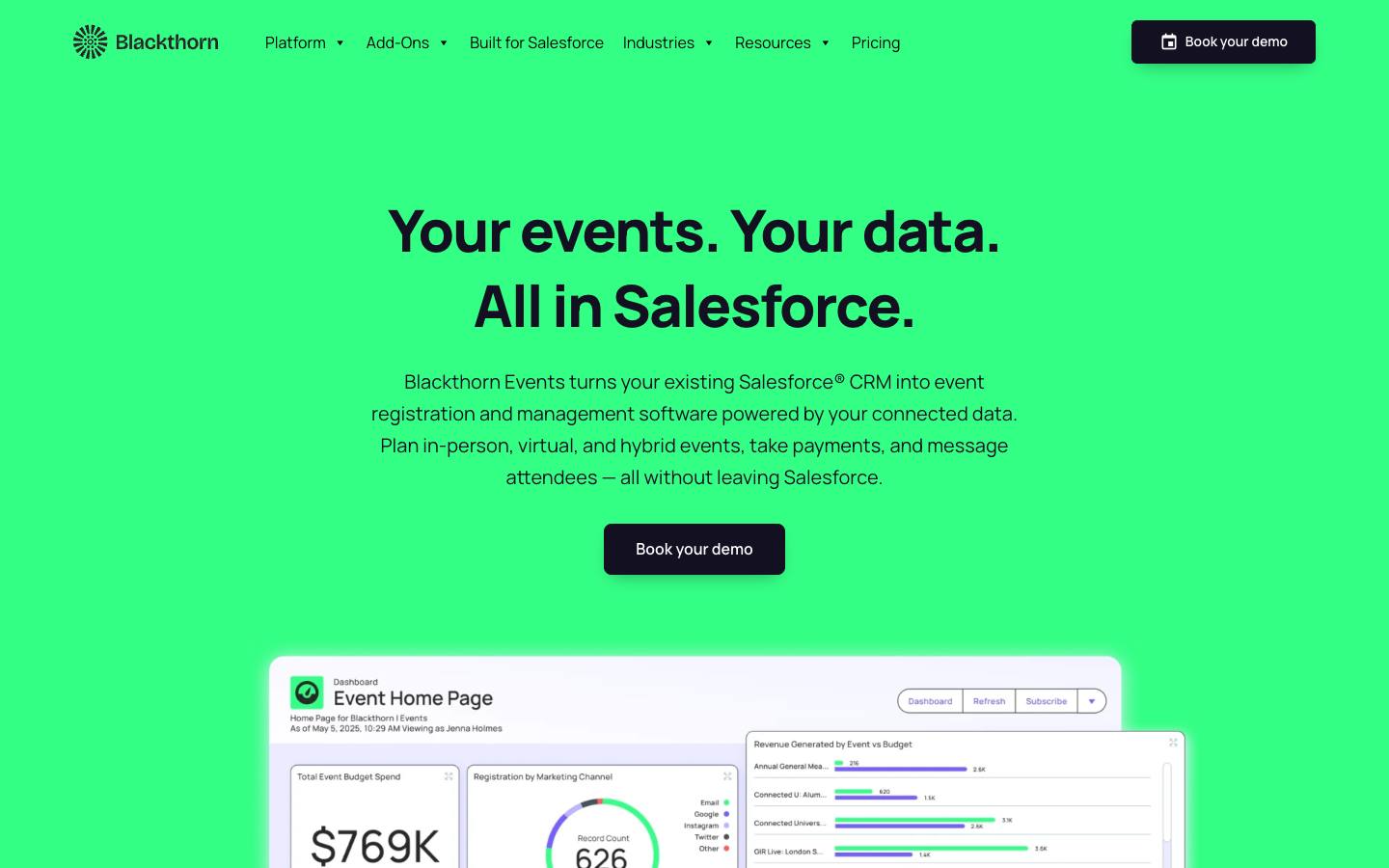
Blackthorn Events is an event management app built natively on Salesforce, so registrations, attendance, payments and engagement are stored as Salesforce records. Reporting uses Salesforce dashboards for attendance, budget, sponsors and ROI, with feedback surveys alongside. Agentforce support adds insights from past event performance.
More on BlackthornLess on Blackthorn
Founded: 2015 · HQ: New York, NY · Formats: In-person, Virtual, Hybrid, Webinar
Blackthorn was founded in 2015, is backed by Level Equity with $16 million raised according to CB Insights, and describes itself as employee-majority owned with a fully remote team of more than 100. Prices aren't published, and Payments, Messaging, Event Navigator, Smart Capture, Compliance and Badges are sold as separate add-ons, with discounts for nonprofits and community colleges. Named customers include Audi, Canon, Poshmark, Southern New Hampshire University and USC Marshall School of Business.
Agentforce support builds guest lists and surfaces insights from past event performance. The Smart Capture lead app holds a 5.0 rating from 16 App Store ratings, and payments run through 120+ gateways with reconciliation in Salesforce. In October 2026 it launched Forge, a web workspace for running Salesforce-native events without admin skills. Its trust center lists a 2025 SOC 2 Type 2 report, SOC 3 and PCI DSS SAQ D documentation, and a WCAG 2.1 conformance report is available. Customer data stays in your own Salesforce org, which simplifies HIPAA and FERPA reviews.
- SOC 2 and PCI DSS (SAQ D) listed
What stands out
- No sync layer: event data sits on standard and custom Salesforce objects
- Salesforce dashboards for attendance, budget, sponsors and ROI
- Smart Capture ties leads and interactions at events to CRM records
Worth checking
- Requires Salesforce
- Pricing isn't published, and payments, SMS, the app and badges are separate add-ons
Best suited for. Blackthorn fits organizations that run on Salesforce, including associations, universities and enterprise teams, and want attendance, payments and engagement reported in standard Salesforce dashboards. If you're on HubSpot or another CRM, choose hapily or a platform with a sync connector instead.

7. Luminik, best for growth-stage B2B teams that need sourced and influenced pipeline written back to CRM after each sponsored event
From $249/month
- Price
- From $249/month
- Syncs with
- Salesforce, HubSpot
- Security
- SAML SSO
Luminik covers the sponsor-side event workflow for Series A to C B2B teams: it scores third-party attendee lists against your ICP, pushes priority contacts into your sequencer, captures booth conversations on mobile and writes sourced and influenced pipeline per event, rep and account back to Salesforce or HubSpot. It uses your existing enrichment and sequencing contracts.
More on LuminikLess on Luminik
Formats: In-person
Luminik publishes event-based pricing. Starter is $249 a month billed annually, or $299 month to month, for up to 6 events, 15,000 enriched ICP matches and 3,000 gap-fill records a year with unlimited booth reps. Growth is $665 a month billed annually for 12 events and adds a report after each event, and Scale starts at $1,665 a month for up to 30 events with SSO, directory sync and a dedicated CSM (pricing page, checked October 2026). Overage rates are published too.
For measurement, the key piece is the writeback: after each event, Luminik records sourced and influenced pipeline per event, rep and account on Salesforce or HubSpot opportunities, so reporting lives in the CRM rather than in a separate dashboard. Its offline-first booth app syncs badges, business cards, QR codes and voice notes the same day, and AI pulls next steps from booth notes. An MCP interface lets you ask about pipeline status from Claude or ChatGPT. Case studies are anonymized, and a SOC 2 report is offered on request on the top tier.
- MCP interface for asking Claude or ChatGPT about pipeline status
What stands out
- CRM writeback of sourced and influenced pipeline by event, rep and account
- Published pricing from $249 a month billed annually (per our profile, checked October 2026)
- Works with tools you already pay for, such as Apollo, ZoomInfo, Salesloft and Lemlist
Worth checking
- For events you attend or sponsor, not events you host
- Early-stage company with anonymized case studies and no named customers
Best suited for. Luminik fits growth-stage B2B teams that sponsor 6 to 30 third-party events a year and want per-event pipeline in their CRM at a published price. It doesn't measure events you host, so teams running their own conferences should look at hapily, Blackthorn or RainFocus.
8. Bizzabo, best for in-person event teams that want wearable-badge engagement data alongside platform reporting
From $499/user
- Price
- From $499/user
- Capterra
- 4.4/5 from 171 reviews
- App Store
- 4.6/5 from 14 ratings
- Languages
- English
- Syncs with
- Salesforce, HubSpot, Marketo
- Security
- SOC 2 Type II, ISO 27001
- Customers include
- Compass, DJI, HubSpot
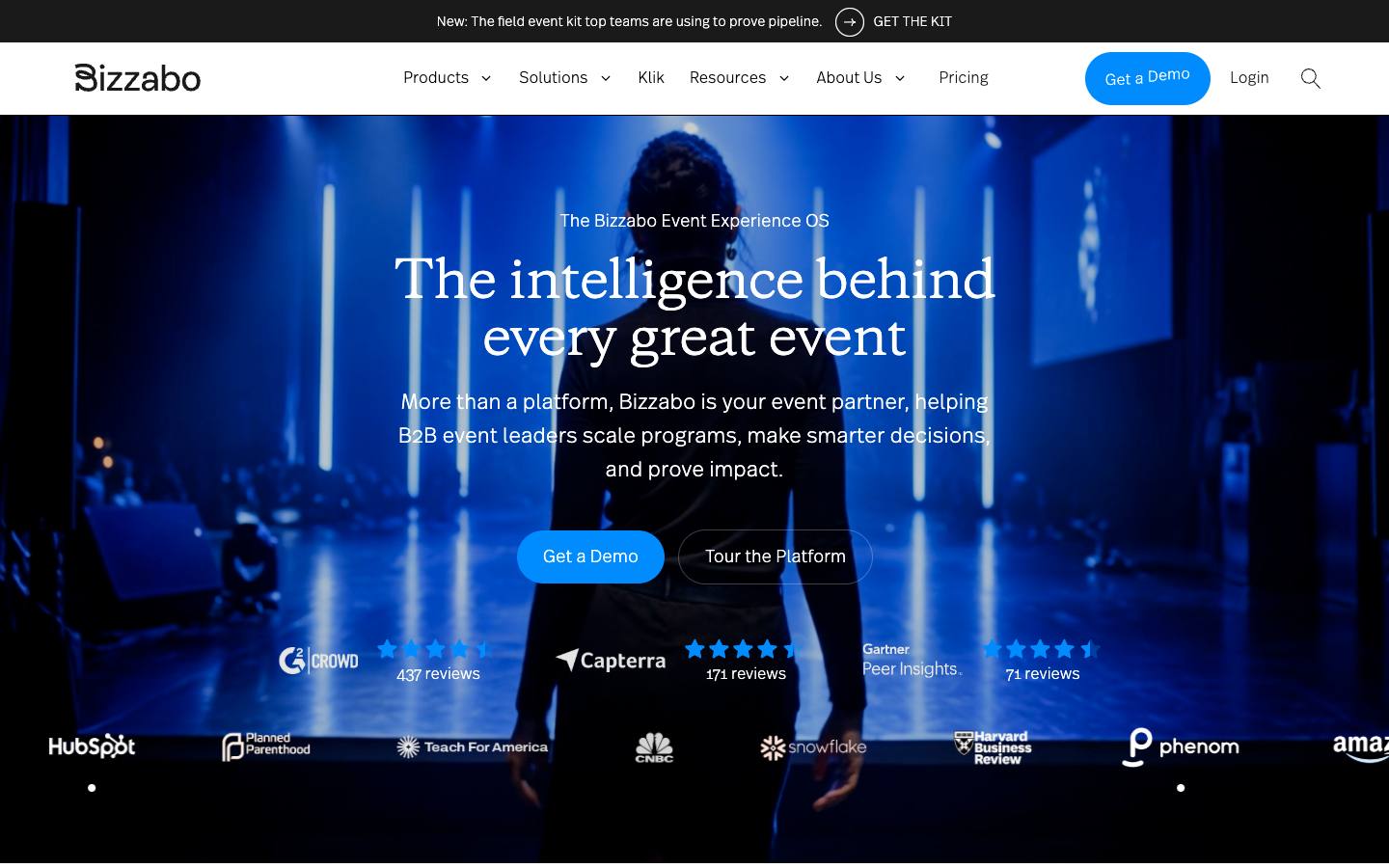
Bizzabo is an event platform for B2B corporate, agency and association teams with registration, websites, email, an app and insights and reporting across the program. Its Klik SmartBadge wearables capture onsite interactions and support contactless lead retrieval and check-in, which adds in-person engagement data that badge scans alone miss. Klik can also be used with other platforms.
More on BizzaboLess on Bizzabo
Founded: 2011 · HQ: New York, United States · Formats: In-person, Virtual, Hybrid, Webinar
Bizzabo was founded in 2011 and is based in New York, with $194 million raised through a Series E according to CB Insights. List pricing is $499 per user a month billed annually with a 3-user minimum, or from $17,999 a year, and its Capterra listing shows 4.37 from 171 reviews (checked October 2026). CRM integrations, sponsor and speaker portals, API access, SSO and Klik wearables are premium add-ons, and there's no single-event option. Customers include HubSpot for INBOUND, Phenom and Inductive Automation.
Klik SmartBadges add passive attendee tracking, gamification and live analytics alongside contactless lead capture, and since May 2025 they've been sold stand-alone for events on other platforms. Native connectors cover Salesforce, HubSpot, Marketo, Pardot and Oracle Eloqua. Bizzy, an AI copilot for attendees, launched in March 2026, and an agentic operating system for events was in preview in October 2026. Security documentation includes a SOC 2 Type 2 report under NDA, ISO 27001 and PCI DSS SAQ D v4, and support runs 24/7/365.
- SOC 2 Type II and ISO 27001 listed
What stands out
- Klik SmartBadge wearables record onsite interactions and enable contactless lead retrieval
- Event analytics and reporting across conferences and field events
- CRM integrations with Salesforce, HubSpot, Marketo and Oracle Eloqua
Worth checking
- CRM integrations, API access and Klik wearables are priced separately
- Annual license only, with per-seat pricing that rises with team size
Best suited for. Bizzabo fits mid-market and enterprise teams that host their own conferences and want wearable engagement data alongside registration and app reporting. If you mainly need pipeline from events you sponsor, Vendelux or Luminik fit better, and either way budget for the CRM integration add-on.

9. Cvent, best for large event programs already on Cvent that want attendee, survey and ROI reporting in one suite
Quote only
- Price
- Quote only
- Capterra
- 4.5/5 from 1,099 reviews
- App Store
- 4.8/5 from 40,670 ratings
- Languages
- Support offered in 12 languages; event sites support multiple languages via language management
- Syncs with
- Salesforce, HubSpot, Dynamics, Marketo
- Security
- SOC 2 Type II, ISO 27001, DPA
- Customers include
- 6sense, Cognizant, Purdue University
Cvent's event cloud includes insights and reporting on events and attendees, surveys and ROI reporting across a program, with its CventIQ AI layer applied through to ROI analysis. Because registration, the app, onsite check-in, lead capture and webinars can all run on Cvent, much of the engagement data is collected in one place. Native connectors cover the major CRMs and marketing automation platforms.
More on CventLess on Cvent
Founded: 1999 · HQ: Tysons Corner, Virginia · Team: 5,001-10,000 people · Formats: In-person, Virtual, Hybrid, Webinar
Cvent was founded in 1999, is headquartered in Tysons Corner, Virginia, and has been owned by Blackstone since a reported $4.6 billion take-private in 2023. It has 5,001 to 10,000 employees and the largest review base here: 4.48 from 1,099 Capterra reviews, while its Cvent Events app holds 4.85 from 40,670 App Store ratings (checked October 2026). Pricing isn't published; products are licensed individually under Professional (15 users) or Enterprise (unlimited users, API and SSO) tiers.
At Cvent CONNECT 2026 it announced more than 70 product updates and a Center for Event Insights. Its ownership of ON24 (closed April 2026) and Goldcast (late 2025) extends reporting to webinars and video. Native connectors cover Salesforce, Marketo Engage, HubSpot, Microsoft Dynamics and Oracle Eloqua, with a REST API and webhooks for the rest. Compliance is extensive, including SOC 1, SOC 2 Type II, ISO 27001 and 27701 and PCI DSS Level 1, and support runs 24/7 in 12 languages. Named customers include 6sense, Cognizant and Hitachi Energy.
What stands out
- Program-wide attendee analytics, surveys and ROI reporting
- Engagement data from registration, Attendee Hub, check-in, lead capture and webinars in one suite
- Native integrations with Salesforce, Marketo Engage, HubSpot, Microsoft Dynamics and Oracle Eloqua
Worth checking
- Reporting is strongest when most of your events run on Cvent
- No published pricing, and modules are licensed separately
Best suited for. Cvent fits large corporate and association teams that already run registration, apps, onsite and webinars on Cvent and want reporting from one source. If your events run on mixed platforms or you mostly sponsor other organizers' shows, a separate layer such as Vivastream or Vendelux will see more of the picture.

10. Bear Analytics, best for associations and trade show organizers tracking registration pacing and exhibitor ROI across a portfolio
From $900/month
- Price
- From $900/month
- Syncs with
- Salesforce, HubSpot
- Customers include
- RE+ Events, Biotechnology Innovation Organization, National Business Aviation Association
Bear Analytics sells Bear IQ, an analytics layer that combines registration, exhibitor, association management and marketing data into dashboards for event organizers. It tracks registration pacing against goal, audience acquisition and retention, and exhibitor performance, with year-over-year comparisons across a portfolio. It connects to many registration and AMS vendors used by associations.
More on Bear AnalyticsLess on Bear Analytics
Founded: 2013 · HQ: Arlington, Virginia · Team: 11-50 people · Formats: In-person, Virtual, Hybrid
Bear Analytics was founded in 2013 in Arlington, Virginia, and has 11 to 50 employees and $2.92 million raised according to CB Insights. It publishes prices: Starter from $900 a month covers 2,000 annual attendees and exhibitors, 10,000 prospect and alumni records, one module and one connector; Growth from $1,900 covers 5,000 attendees and two connectors; Business from $2,900 covers 10,000 attendees and three or more connectors; and Enterprise is quoted (pricing page, checked October 2026). Every tier includes unlimited events and users, and add-on modules run from free to $7,500.
Prebuilt connectors cover registration, housing, exhibitor and AMS systems that general BI tools lack, including Cvent, Swoogo, Swapcard, Map Your Show, A2Z Events, Maritz, CompuSystems, Expocad, Higher Logic, Fonteva and HubSpot. Predictive forecasting tracks registration against goal, and ranked prospect lists support exhibit sales. Customers include the National Association of Home Builders, Biotechnology Innovation Organization and RE+ Events. Its security page claims GDPR and CCPA compliance, an annual third-party review and penetration testing, but names no SOC 2 report.
What stands out
- Connectors for Cvent, Swoogo, Map Your Show, Maritz, CompuSystems, Salesforce, HubSpot and many AMS platforms
- Registration pacing reports and predictive forecasting against goal
- Published pricing from $900 a month (Starter) with unlimited events and users (pricing page, checked October 2026)
Worth checking
- Built for organizers measuring their own audience, not for sponsors measuring pipeline
- Pricing scales with attendee, exhibitor and prospect record volumes
Best suited for. Bear Analytics fits associations and trade show organizers who need registration pacing, retention and exhibitor ROI across a portfolio of shows. Corporate teams measuring their own pipeline from events will get more from Vendelux, hapily or RainFocus.

11. Explori, best for corporate and exhibition teams that need benchmarked survey evidence of event impact for leadership
Quote only
- Price
- Quote only
- Customers include
- Clarion Events, Zendesk, IMEX Group
Explori runs attendee, exhibitor and sponsor research and benchmarks the results against a database of more than 10,000 measured events. It reports across experience and advocacy, brand perception, attitudinal shift, commercial impact and portfolio performance, with AI summaries and automated PowerPoint reporting. Corporate teams use it to show leadership what a flagship event changed.
More on ExploriLess on Explori
Founded: 2012 · HQ: UK · Formats: Any format
Explori was founded in 2012 and is based in the UK, and its benchmark database comes from more than 10,000 events measured since then. Plans are listed as Lite, Pro and Enterprise without prices: Lite suits events of about 150 attendees with up to 3 custom questions, Pro adds all five measurement dimensions, AI analysis, unlimited questions and voice and video responses, and Enterprise adds multi-event portfolio licenses and custom benchmarks. Teams can run it themselves or have Explori's research team run programs end to end, with reports delivered in days.
Its AI groups open-text answers into themes with sentiment, and a conversational agent lets you query results. Survey responses can be linked to attendee profiles through registration data import, though no integration partners are named. Customers include Zendesk, Siemens, Dell, Informa, IMEX Group, Clarion Events and Philips, a mix of corporate event teams and exhibition organizers. Its privacy policy says it operates to GDPR standards as a minimum.
What stands out
- Benchmarks against 10,000+ events measured since 2012
- Measures brand and attitudinal impact, which CRM data can't show
- AI summaries and open-text theme analysis, plus executive dashboards
Worth checking
- Survey-based measurement, so it complements rather than replaces CRM pipeline reporting
- Prices aren't published, and integrations are limited to registration data import
Best suited for. Explori fits corporate event teams and exhibition organizers who need benchmarked evidence of brand impact and attendee or exhibitor satisfaction for leadership. If you need pipeline attribution in the CRM, look at Vendelux, hapily or RainFocus instead.

12. Zenus, best for organizers and exhibitors who want anonymous, sensor-based booth and session engagement data
Quote only
- Price
- Quote only
- Languages
- English
- Customers include
- APHA, ASCRS, IAEE
Zenus places smart cameras around event floors, booths and session rooms to measure impressions, dwell time, demographics and positive sentiment without storing identifiable personal data. A live dashboard and return-on-engagement reports help organizers prove value to sponsors and exhibitors. Exhibitors can add automated lead capture and dynamic displays.
More on ZenusLess on Zenus
Founded: 2015 · HQ: Austin, United States · Formats: In-person, Virtual
Zenus was founded in 2015 in Austin, Texas, and raised a $3.2 million seed round in 2022. Pricing is quoted per event based on camera coverage, and a free consultation and floor-plan coverage estimate help size the deployment. Customers named on its site include Dell, ServiceNow, Informa, Freeman, PCMA, IAEE and IMEX, and it has won event-industry innovation awards.
Cameras measure impressions, dwell time, age range, sex and positive sentiment in each zone, and the company calls its approach ethical facial analysis that doesn't store identifiable personal data. You can use its plug-and-play kit or connect your own cameras, and the site says each camera takes under 12 minutes to set up. Data is viewed on the live dashboard or pulled through its API; no CRM or marketing automation connectors are named. Support runs weekdays from 9am to 5pm Central, with after-hours cover for severe issues under its SLA. No formal security certifications are listed, and camera analytics may need legal review in some regions.
What stands out
- Objective engagement data that doesn't depend on surveys or badge scans
- Live dashboard across zones, sessions and booths
- Coverage estimator that uses your floor plan to size the deployment
Worth checking
- Camera-based analysis may need legal review and attendee communication in some regions, even when anonymous
- Quote-based pricing plus onsite hardware logistics
Best suited for. Zenus fits organizers and large exhibitors who want objective traffic and sentiment data for sessions, booths and sponsor areas without asking attendees to scan anything. If you need person-level engagement tied to CRM records, choose a platform such as Certain or Bizzabo instead.

13. Crowd Connected, best for conference organizers who want session attendance and stand dwell time without scanning queues
From £8/attendee
- Price
- From £8/attendee
- Try it
- Free plan, Free trial
- Languages
- English
- Customers include
- Medtech Summit, report it, Bett Show (Hyve)
Crowd Connected uses wearable tags, beacons and an app SDK to record which sessions each delegate attends and how long people spend at exhibitor stands, with no badge scanning. Organizers use the data to prove session and sponsor value, and the same infrastructure adds indoor navigation to event apps. It publishes per-delegate pricing with worked examples by event size.
More on Crowd ConnectedLess on Crowd Connected
Founded: 2013 · HQ: Guildford, United Kingdom · Formats: In-person
Crowd Connected was founded in 2014 and is based in Guildford, UK, with about $1 million in seed funding according to CB Insights. It publishes prices: attendee tracking is $10 per delegate plus a $6,000 activation charge in the US, or £8 per delegate plus £4,500 in the UK, including tag rental but excluding shipping and unreturned tags (pricing page, checked October 2026). Worked UK examples run from £9,000 for 500 delegates to £40,500 for 4,000, with a managed onsite service for 10,000+ delegates. Indoor positioning for event apps is a flat license from $8,500.
Beacons install in a few hours with no manual calibration because positioning uses machine learning, and a Location SDK brings blue-dot wayfinding into an organizer's own event app. Named partnerships include ExpoFP floor plans and ExpoPlatform. Customers include PCMA Convening Leaders, Informa Connect, CES, WHX Dubai and Farnborough Airshow. No CRM connectors or security certifications are published, so session and stand data reaches other systems through reports or the SDK.
What stands out
- Passive session attendance tracking, so no scanner staff at doors
- Stand footfall and dwell time for exhibitor and sponsor reports
- Published pricing: $10 per delegate plus a $6,000 activation charge in the US, including tag rental (pricing page, checked October 2026)
Worth checking
- Needs physical tags or beacons onsite, with extra costs for shipping and unreturned tags
- No named event platform integrations beyond floor plan partners
Best suited for. Crowd Connected fits conference and trade show organizers who want session attendance and stand dwell time captured passively, at a cost they can calculate before buying. Exhibitors measuring their own pipeline need a CRM-connected tool such as Vendelux or hapily instead.
Picks 6 to 13 are folded to keep the list short. Open any of them, or compare them all in the table above.
Also worth considering
Momentify, Swoogo, TRAKKER, Mobly, Captello, Heeet, HockeyStack, Dreamdata
The best event analytics software by use case
| If you need | Company size | Look at |
|---|---|---|
| Team sponsoring 20+ third-party conferences a year that has to prove pipeline | Mid-market, Enterprise | Vendeluxattributes CRM pipeline to the events you attended or sponsored |
| Enterprise running a portfolio of user conferences and field events on one platform | Enterprise | RainFocusone attendee data model with a dedicated Salesforce app |
| HubSpot team that both hosts events and exhibits at trade shows | Startup, Mid-market | hapilynative HubSpot records from $600 a month |
| Association or university that runs on Salesforce | Mid-market, Enterprise | Blackthornevent data lives in standard Salesforce dashboards |
| Tech marketing team with event data spread across five vendors | Enterprise | Vivastreamjoins API and file data into account-level views |
| Trade show organizer tracking registration pacing and exhibitor ROI | Mid-market, Enterprise | Bear Analyticsprebuilt connectors for registration, housing and AMS systems |
| Conference organizer proving session and stand value without scanning | Mid-market, Enterprise | Crowd Connectedpassive tracking at a published per-delegate price |
| Corporate team showing leadership the brand impact of a flagship event | Mid-market, Enterprise | Exploribenchmarks against 10,000+ measured events |
What results look like
Figures customers report in the vendors' own published case studies. They describe one customer each, not what every buyer should expect.
134+
Events per year
Autodesk with RainFocus · Case study
21,000
Total registrations
University of Wisconsin-Madison Division of Continuing Studies with Blackthorn · Case study
60%
App adoption rate
Compass with Bizzabo · Case study
45%
Increase in total registrations
RE+ Events with Bear Analytics · Case study
50+
Sessions
APHA with Zenus · Case study
How to choose
Background on what these tools do, how we ranked them and what to check before you buy. Open any topic.
What event analytics software actually is (and what it isn't)
Event analytics software measures what in-person, hybrid and virtual events do for the business. It collects registration, attendance, session, booth, meeting and lead data, matches people to accounts and CRM contacts, and reports results by event and across a whole program, ideally down to the pipeline and revenue that followed. Some tools capture that data themselves; others sit on top of the platforms you already use and join their exports.
It isn't product analytics, where an event means a click tracked in Google Analytics or Mixpanel, and it's narrower than marketing attribution software, which weighs every channel at once. It also differs from event intelligence platforms, which help you choose which third-party events to attend before you go, and from event survey software, which collects feedback without joining it to behavior or pipeline. Most registration and event management platforms include some reporting; dedicated analytics matters when data is spread across several tools.
For B2B event teams, the jobs are proving which events produced pipeline, comparing events and formats across a year, showing sponsors and exhibitors what they got, and spotting which sessions, booths and accounts drew real engagement so the next program is planned on evidence. Getting there usually starts with agreeing on CRM campaign statuses, then picking a tool that writes to them.
How we ranked these event analytics software tools
We ordered these tools by how well they tie event activity to pipeline for B2B teams, then by depth of engagement measurement. Each criterion can be checked on the vendor's own pages or in our research files.
1. Native CRM connection
We checked integration pages and our vendor profiles for native Salesforce, HubSpot or Marketo connections, or data stored in the CRM itself.
2. Pipeline attribution
We checked product pages for reporting that ties event participation to opportunities and revenue rather than attendance alone.
3. Engagement data captured
We recorded which signals each tool captures or ingests, such as sessions, booth visits, meetings, app activity, surveys or sensors.
4. Cross-event reporting
We checked vendor pages for portfolio dashboards and year-over-year comparisons across events.
5. Published pricing
We recorded prices from each vendor's pricing page in October 2026 and marked the rest as quote-only.
6. Security documentation
We checked trust centers and security pages for SOC 2, ISO 27001 and GDPR documentation, as recorded in our procurement research.
More on our process in the methodology.
What to look for in event analytics software
Start with the question your leadership asks, which for most B2B teams is how much pipeline and revenue events produced and which events to fund next year. Then check four things. First, data capture: the tool should collect or ingest registration, attendance, session, booth, meeting and lead scan data, not just registrations. Second, identity: it has to match people to accounts and to CRM contacts, or account-level reporting falls apart. Third, CRM connection: look for native Salesforce or HubSpot sync that writes event participation to campaigns or custom objects, so opportunities can be linked to events. Fourth, cross-event views: dashboards that compare events, regions and formats side by side, not a separate report per event. Tools that score engagement, such as Certain, or measure it passively, such as Zenus and Crowd Connected, add depth, but they only pay off once the CRM link works.
Hosted events vs. sponsored and attended events
Measurement looks different depending on whose event it is. At events you host, you own registration, the app and onsite data, so platforms like RainFocus, Certain, Cvent and Bizzabo can report engagement at session and attendee level, and hapily or Blackthorn can keep it native in your CRM. At other organizers' conferences and trade shows, you only see what you capture yourself: booth scans, meetings, and which target accounts were there. That's where Vendelux and Luminik fit, mapping attendees to your accounts before the show and tying the pipeline back afterwards. Most B2B teams spend heavily on both, so check whether one tool covers both sides (hapily does in HubSpot, and Vivastream ingests either) or whether you'll need two and a shared CRM reporting model.
Questions to ask vendors
Ask each vendor to show a real dashboard with your CRM connected, not a demo dataset. Then ask: Which data sources do you capture natively, and which come in by file or API? How do you match attendees to accounts and existing CRM contacts, and what match rate do customers see? What exactly do you write to Salesforce or HubSpot (campaign members, custom objects, activity records), and how often? Can we report sourced and influenced pipeline per event using our own attribution rules? Can we compare events across a year and across formats? Who can see the data, and how is personal data handled, especially for camera or tracking-based tools? Finally, ask what happens to historical data if you stop paying, since multi-year comparisons are the main reason to buy.
How much does event analytics software cost?
Published prices, checked October 2026, start around a few thousand dollars a year and climb into enterprise contracts. Luminik starts at $249 a month billed annually for sponsor-side pipeline tracking. hapily's HubSpot plans start at $600 a month billed annually, and Bear Analytics starts at $900 a month for organizer dashboards. Momentify's engagement scoring starts at $650 a month billed annually. Onsite tracking is priced per event: Crowd Connected lists $10 per delegate plus a $6,000 activation charge in the US. Vendelux, RainFocus, Certain, Cvent, Vivastream, Explori and Zenus quote on request. Platforms that include analytics within event management, such as Bizzabo, often price CRM integrations separately, so confirm the reporting you need is in the plan.
Event analytics vs. marketing attribution software
General marketing attribution tools, such as HockeyStack, Dreamdata and Heeet, model every channel at once, from paid search to email, and can treat events as one input. They're the right choice when you need to compare events against other channels in a single model. But they depend on event data already being in the CRM, and they don't capture what happened inside the event. Event analytics tools work the other way round: they collect engagement at sessions, booths and meetings, match it to people and accounts, and push it to the CRM, where an attribution model can use it. Many B2B teams need both, with an event tool feeding clean participation data to whatever attribution model marketing operations already runs. If you have no attribution tool, CRM-native options like hapily, Blackthorn and Vendelux's CRM attribution can cover event pipeline on their own.
Getting clean event data into your CRM
Most failed event measurement comes from data, not dashboards. Agree on a naming convention for event campaigns before the first event, decide which participation statuses count (registered, attended, visited booth, met with sales), and map each tool's fields to them. Make sure lead scans and meeting notes reach the CRM within days, not weeks, or sales follow-up and attribution windows slip. Native tools avoid sync issues entirely: hapily stores records in HubSpot and Blackthorn in Salesforce. For multi-platform programs, a unifying layer such as Vivastream or Bear Analytics can clean and join sources before they reach reporting.
Where this fits in your event tech stack
Event analytics sits between the tools that run and capture events and the systems that report revenue. Upstream are registration platforms, event apps, lead retrieval apps, meeting schedulers, surveys and onsite sensors, each holding part of the picture. Downstream is the CRM, where opportunities live, and often a marketing attribution tool or BI layer. Event platforms such as RainFocus, Certain, Cvent and Bizzabo report on their own events and push data to Salesforce, HubSpot or Marketo. CRM-native tools (hapily for HubSpot, Blackthorn for Salesforce) skip the sync entirely. Sponsor-side tools like Vendelux and Luminik attribute pipeline from other organizers' events, and Vivastream or Bear Analytics unify data across platforms. Whatever you choose, the CRM campaign and status model should be the shared language, so attribution and executive reporting read from one place.
FAQ
What is event analytics?
Is event analytics the same as Google Analytics events?
What metrics should B2B event analytics track?
How do you attribute pipeline to an event?
How much does event analytics software cost?
What's the difference between event analytics and marketing attribution software?
How can I measure engagement at in-person events?
What do I gain from separate event analytics software if my event platform has reporting?
Get a free event analytics software shortlist
Reading reviews only gets you so far. The right pick depends on your events, your team and the systems it has to sync with.
Our shortlist finder asks a few questions and matches you with tools that fit, using the same verified data as this guide.
You'll see published prices, security documents and CRM integrations side by side, and you can save tools to compare later.
It's free, there's no sign-up, and no vendor gets your details.
Ready? Build your shortlist in two minutes, or try the free cost per lead, meeting and opportunity calculator.
Get a free shortlistKeep reading
Ratings link to their source and are shown as published on the date of our last check. Read our methodology.