 vs

Slido vs Sync
Both are in our Audience engagement & gamification category. Slido is best for event and internal comms teams adding moderated Q&A and live polling to conference sessions, town halls and all-hands; Sync is best for conference organisers wanting audience interaction inside speakers' existing slides.
The short answer: Slido is a Cisco-owned Q&A and polling tool with a free plan for up to 100 participants, paid plans from €15/month billed annually, and ISO 27001 among its documented certifications. Sync is a two-year-old slide-sharing tool from $6/month per presenter that adds polls and quizzes inside the speaker's own deck. Choose Slido for moderated Q&A at scale and SSO; choose Sync to make a presenter's slides interactive on a small budget.
Built from each vendor's own website and our research profiles. How we research
Side by side
“Not published” means we couldn't find it on the vendor's own pages.
SlidoSyncStrengths and considerations
Slido
What stands out
- Very low friction for attendees: join by code in a browser with no account or app
- Native integrations into the main presentation and meeting tools
- Broad certification set from Cisco ownership, with EU-hosted infrastructure
Worth checking
- Point solution for engagement; no registration, event app or lead capture
- Increasingly bundled with Webex, so standalone roadmap may favor Cisco customers
- Plans are priced in euros excluding VAT and billed annually or per event; there's no monthly billing
Sync
What stands out
- Interaction embedded in the presenter's own deck rather than a separate app
- Low per-presenter pricing plus a short-term events plan
Worth checking
- Young company (founded 2023) with a mostly education and Latin American customer base
- No security certifications published
- Event plan is quote-based
Notable customers
Organizations each vendor names on its own website: customer stories first, then testimonials and logos.
The main difference between Slido and Sync
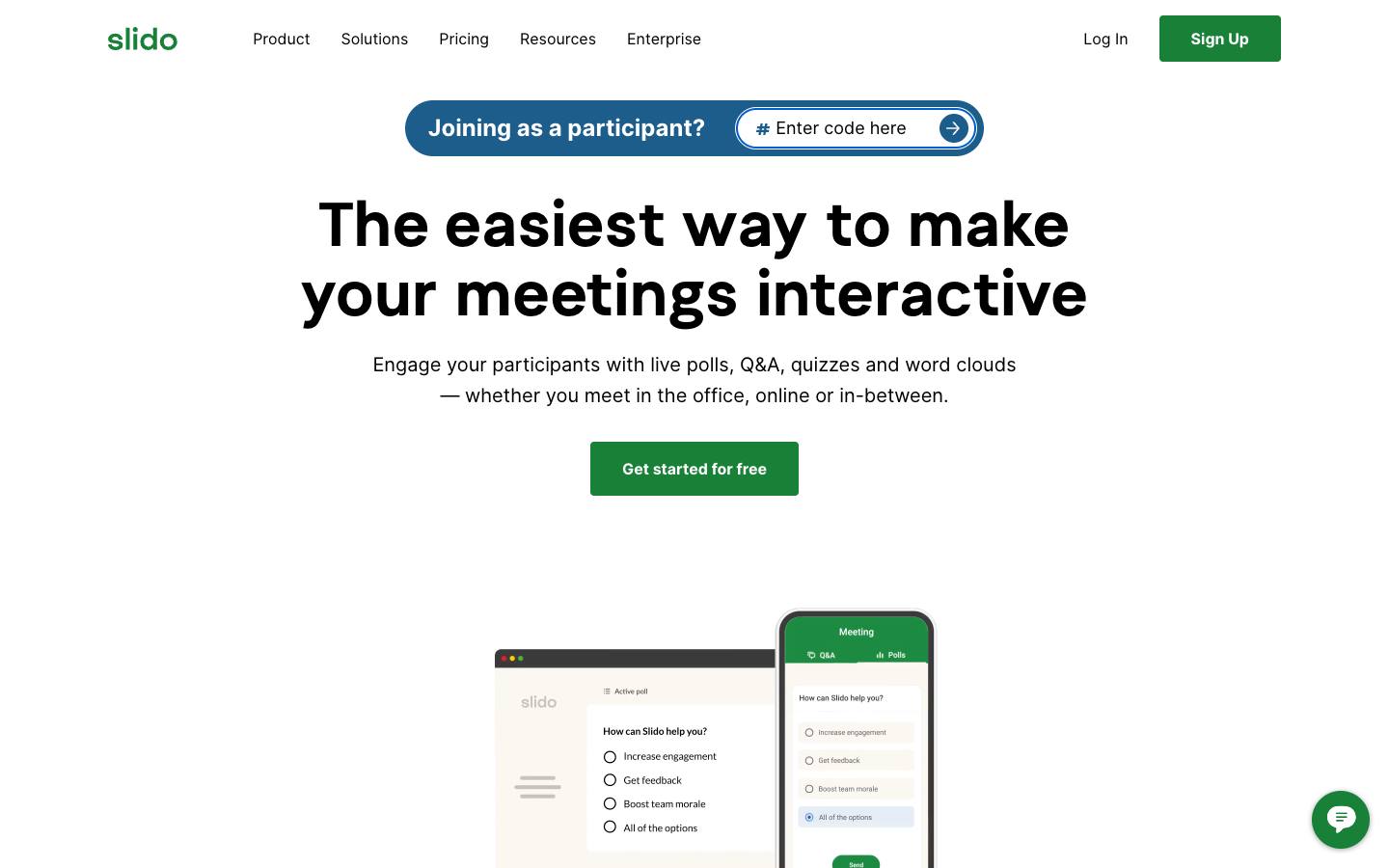
Slido runs alongside a presentation while Sync lives inside it. Slido offers anonymous or named questions with upvoting and moderation, live polls, word clouds, quizzes, idea boards and surveys. Attendees join by event code in a browser, and it plugs into PowerPoint, Google Slides, Webex, Teams and Zoom. It's a mature product, founded in 2012 and owned by Cisco, and it's used for conference sessions, town halls and all-hands meetings.
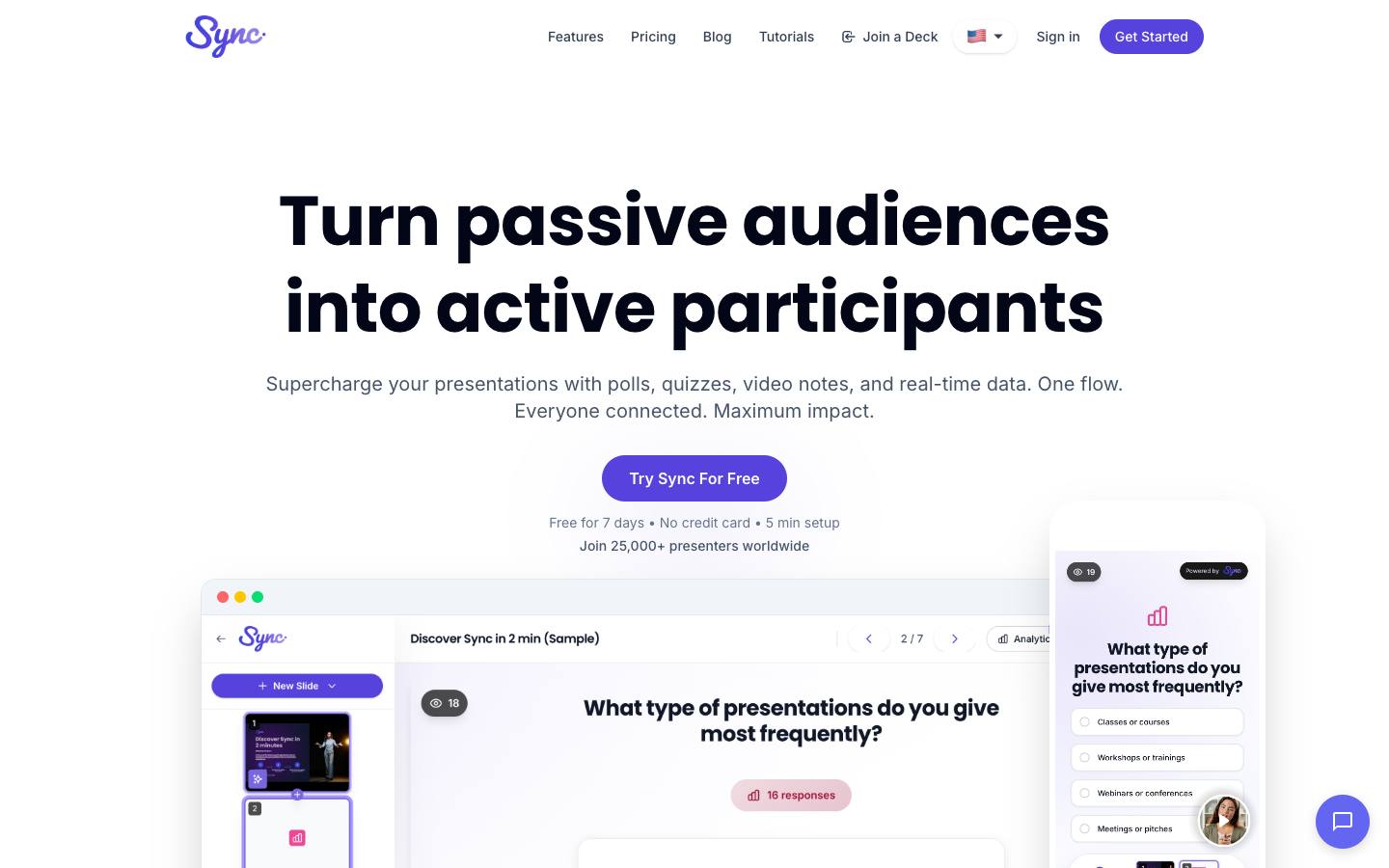
Sync takes the opposite approach: a presenter uploads a slide deck and attendees follow it on their own device via QR code or link, with no app or account. Polls, word clouds, quizzes and reactions attach to individual slides, and so do links, downloads and short video notes. AI can generate polls and quizzes from slide content. It's a small team (2 to 10 people) founded in 2023, with a customer base that skews toward education and Latin America.
Both support in-person, virtual and hybrid events, and both fit SMB and mid-market teams. Slido also lists enterprise customers.
Slido vs Sync pricing
Slido has a free Basic plan for up to 100 participants with basic audience Q&A and 3 polls per Slido. Engage is €15/month billed annually (€180/year) for 1 member and up to 200 participants. Professional is €60/month (€720/year) for 2 members and up to 1,000 participants, with Q&A moderation and branding. Enterprise is €150/month (€1,800/year) for 3 members and up to 5,000 participants with SSO and member provisioning. Prices exclude VAT, there's no monthly billing, and one-time plans cover an event of up to 7 days (checked October 2026).
Sync prices per presenter and has no free plan, but offers a 7-day free trial. Starter is $6/month per presenter billed annually ($72/year) for up to 100 participants per deck and 3 GB of storage. Pro is $10/month per presenter ($120/year) for up to 300 participants, AI polls and quizzes, removal of Sync branding and 10 GB. Business & Campus is custom, from 10 presenters. The Events Plan starts from $250 for 1 to 3 days and 100 to 2,000 participants (checked October 2026).
A single presenter with a small audience will pay less on Sync, while a team that needs moderation, larger rooms or SSO fits Slido's tiers.
Features and integrations
Each lists 15 integrations, but of different kinds. Slido's are presentation, meeting and identity tools: PowerPoint, Google Slides, Webex, Teams, Zoom, YouTube, Vimeo, Okta, OneLogin and Microsoft Entra ID. Sync's are content and learning tools: PowerPoint, Google Workspace, Canva, Kahoot, Miro, Prezi and LMSs such as Moodle, Canvas, Blackboard and Brightspace. Neither lists a CRM, Salesforce, HubSpot or a public API.
Slido's security documentation is far deeper: ISO 27001 with 27017, 27018, 27701, 22301 and 9001, EU infrastructure on AWS in Ireland and Germany, a DPA, SAML SSO and SCIM on Enterprise, and a VPAT. We didn't find a SOC 2 Type II report for either product, and we didn't find security certifications on Sync's public pages.
Which should you choose?
Choose Slido if you run large conference sessions or company-wide meetings and need moderated Q&A, participant limits up to 5,000, SSO or certificates for a security review. It also suits teams standardized on Webex, Teams, Zoom or PowerPoint.
Choose Sync if your speakers already have slide decks and you want interaction built into them, you teach or train, or you need a short-term Events Plan for a one- to three-day conference. Keep in mind how young the company is, and check support and security answers directly before a large event.