 vs

Slayte vs Zealous
Both are in our Abstract & conference management category. Slayte is best for scientific societies and professional associations running abstract-driven annual meetings; Zealous is best for teams running industry awards with entry fees and multi-round judging.
The short answer: Slayte is an association platform for abstracts, registration, awards, education credits and a branded event app, with floor prices of $7,500 for submissions and $12,500 for the app, and 16 listed integrations. Zealous is a submissions and judging tool for awards, open calls and exhibitor selection, with a free plan and paid plans from £26 a month billed annually. Choose Slayte for abstract-driven annual meetings; choose Zealous for juried awards and applications.
Built from each vendor's own website and our research profiles. How we research
Side by side
“Not published” means we couldn't find it on the vendor's own pages.
SlayteZealousStrengths and considerations
Slayte
What stands out
- Positioned as a layer on top of the AMS rather than a replacement
- Covers abstracts, awards, scholarships and CE in addition to events
- Gives starting prices in its FAQ
Worth checking
- Built for associations; corporate event marketing features aren't a focus
- SOC 2 documentation is available only on request
- Customer logos are mostly small and mid-sized associations
Zealous
What stands out
- Single subscription covers unlimited awards, grants and open calls
- Strong handling of large creative media files for judging
- Transparent published pricing in multiple currencies
Worth checking
- Customer base is concentrated in arts, culture and creative industries rather than B2B corporate events
- Not an event registration, ticketing or onsite tool
- SSO isn't mentioned; certifications cited are those of its Google Cloud hosting
Notable customers
Organizations each vendor names on its own website: customer stories first, then testimonials and logos.
Slayte
The main difference between Slayte and Zealous
Slayte runs the whole association meeting around its abstracts, while Zealous does one job, collecting and judging entries, and does it for any kind of program. Slayte covers registration and ticketing, abstracts and calls for proposals with multi-step review, speaker and committee management, awards and scholarships, continuing education credits and a branded event app with a virtual platform. It's designed to sit on top of an association management system and sync with products such as iMIS, Rhythm and Novi.
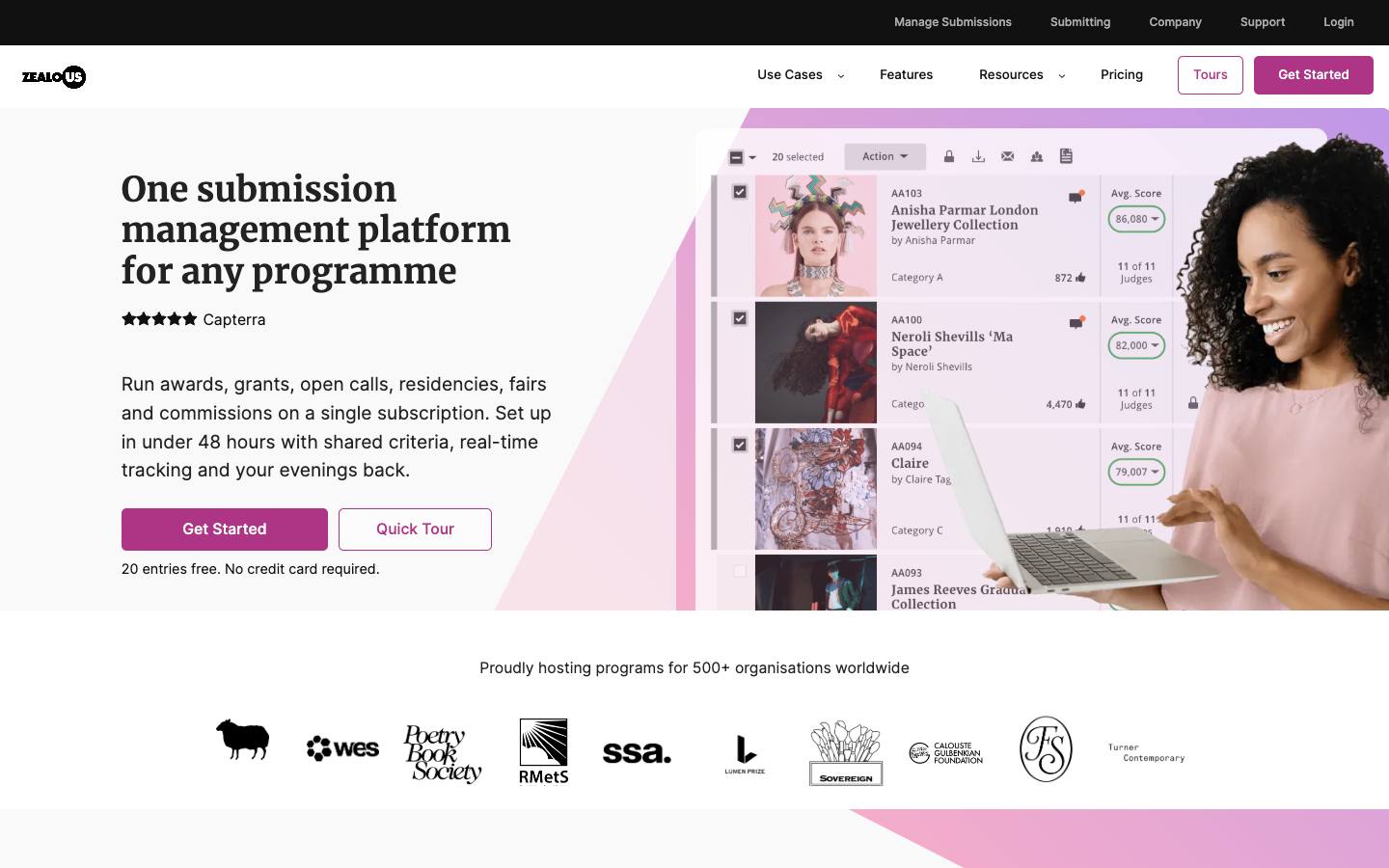
Zealous collects media-rich entries (images, large video files, audio, documents) with optional entry fees, then runs anonymous, criteria-based judging across multiple rounds, with optional public voting. Its uses include awards, grants, open calls, residencies and juried exhibitor selection at art, design, craft and trade fairs. It isn't a registration, ticketing or onsite tool, and the two overlap only where an event needs a call for submissions and a review process.
Slayte runs in-person, virtual and hybrid events for small and mid-sized organizations. Zealous also targets small and mid-sized teams, and is based in London.
Slayte vs Zealous pricing
Zealous publishes a full price ladder and Slayte publishes only floor prices. Slayte's lowest submissions tier is $7,500 and a virtual event or mobile event app subscription has a $12,500 minimum; the billing period isn't stated, and full pricing is a custom quote after a demo (checked October 2026). It has no published free trial.
Zealous has a free plan: 20 entries, 1 program and unlimited judges. Starter is £26 a month (£312 a year) for up to 75 submissions a year and one scoring round, with a 2.2% + 20p entry fee commission. Pro is £79 a month (£948 a year) for up to 300 submissions, unlimited scoring rounds, public voting and a 1-hour onboarding. Scale is £239 a month (£2,868 a year) for up to 1,000 submissions with Zapier and webhooks. Enterprise is quote-based, adds an uptime SLA and has no entry fee commission (checked October 2026). Plans can be taken month to month.
Both prices buy different things. Slayte's covers an event and abstract platform for an association, while Zealous's scales with the number of entries a year and covers unlimited programs and judges. A team that only needs to judge an awards program pays a small fraction of Slayte's floor price, but gets no registration or app.
Features and integrations
Slayte lists 16 integrations, mostly association and finance tools: iMIS, Rhythm, Novi AMS, reMembers (formerly Impexium), MemberClicks, MemberSuite, QuickBooks, Stripe, PayPal, Apple Pay, Google Pay, Authorize.Net, BluePay (Clover), Zapier, Zoom and Walls.io. It also documents a REST API covering calls, submissions and change subscriptions, and offers AI Review for submission reviews. Zealous lists 4: Stripe for entry fees, Zapier, webhooks and Google Analytics. Zapier and webhooks start on its Scale plan, and API keys are an Enterprise feature. Neither lists a Salesforce or HubSpot connector.
On security, we didn't find a SOC 2 report for either. Zealous publishes a data processing agreement and sub-processor list, stores data on Google Cloud in the UK with a failover data center in the EU, and links a public status page. Slayte says it's GDPR-compliant and names a data protection officer in its privacy policy, and it has a status site (checked October 2026).
Which should you choose?
Choose Slayte if you're a scientific society or professional association running an annual meeting built on abstracts, and you want registration, speakers, education credits and an app synced with your AMS. Customers include ASTMH, NASN, WEAI and PDK International. Many clients launch a first workflow within 4 to 6 weeks, with a dedicated customer success manager. It's built for associations rather than corporate event marketing.
Choose Zealous if you run an awards program, grant or open call, or need to vet exhibitor applications for a fair, and want a low-cost plan that scales with entries. Customers include BBH, the Gulbenkian Foundation, the Marketing Society and Turner Contemporary. Its base is mostly arts and creative organizations, and it isn't an event registration platform, so pair it with a ticketing tool if you need one.