 vs

Reviewr vs Sched
Both are in our Agenda & speaker management category. Reviewr is best for associations and non-profits running awards programs or calls for entry alongside events; Sched is best for conferences and festivals with large, multi-track agendas.
The short answer: Reviewr and Sched do different jobs and rarely compete head to head. Reviewr is a submission and review platform for awards, grants, scholarships and fellowships, with blind scoring and SOC 2 Type II certification. Sched is an event platform for agendas, registration, ticketing, check-in and badges, from $100 a month billed annually before its 50% promotion. Use Reviewr to judge entries and Sched to run the event, or both when an awards program sits beside a conference.
Built from each vendor's own website and our research profiles. How we research

Side by side
“Not published” means we couldn't find it on the vendor's own pages.
ReviewrSchedStrengths and considerations
Reviewr
What stands out
- Annual pricing that doesn't scale with reviewers or applications
- SOC 2 Type II certification at a small-vendor size
- Covers the full cycle through post-award reporting
Worth checking
- Not an event management platform; no registration, agenda or attendee features
- Primary focus is scholarships and grants rather than events
- No named third-party integrations beyond SSO, payments, API and webhooks
Sched
What stands out
- Strong footprint in education and professional development, including FERPA-oriented features and ClassLink
- Unlimited events per plan with small events (under 50 attendees) free
- Published discounts for nonprofits, education and government plus a 60-day money-back guarantee
Worth checking
- Plan prices aren't displayed publicly; expect add-ons for native apps, support and reporting
- Few native CRM or marketing automation integrations for B2B marketing teams
- ISO 27001 is listed as pending; SAML SSO was marked coming soon
Notable customers
Organizations each vendor names on its own website: customer stories first, then testimonials and logos.
Reviewr
- U.S. Chamber of Commerce Foundation
- City of Dayton
- March of Dimes
- USAID WomenConnect Challenge
- AACOM
- American Neurological Association
- American Organization for Nursing Leadership
- American Society for Cell Biology
- Army Scholarship Foundation
- Black Data Processing Associates
- JFK Library Foundation
- North Carolina Association of REALTORS
The main difference between Reviewr and Sched
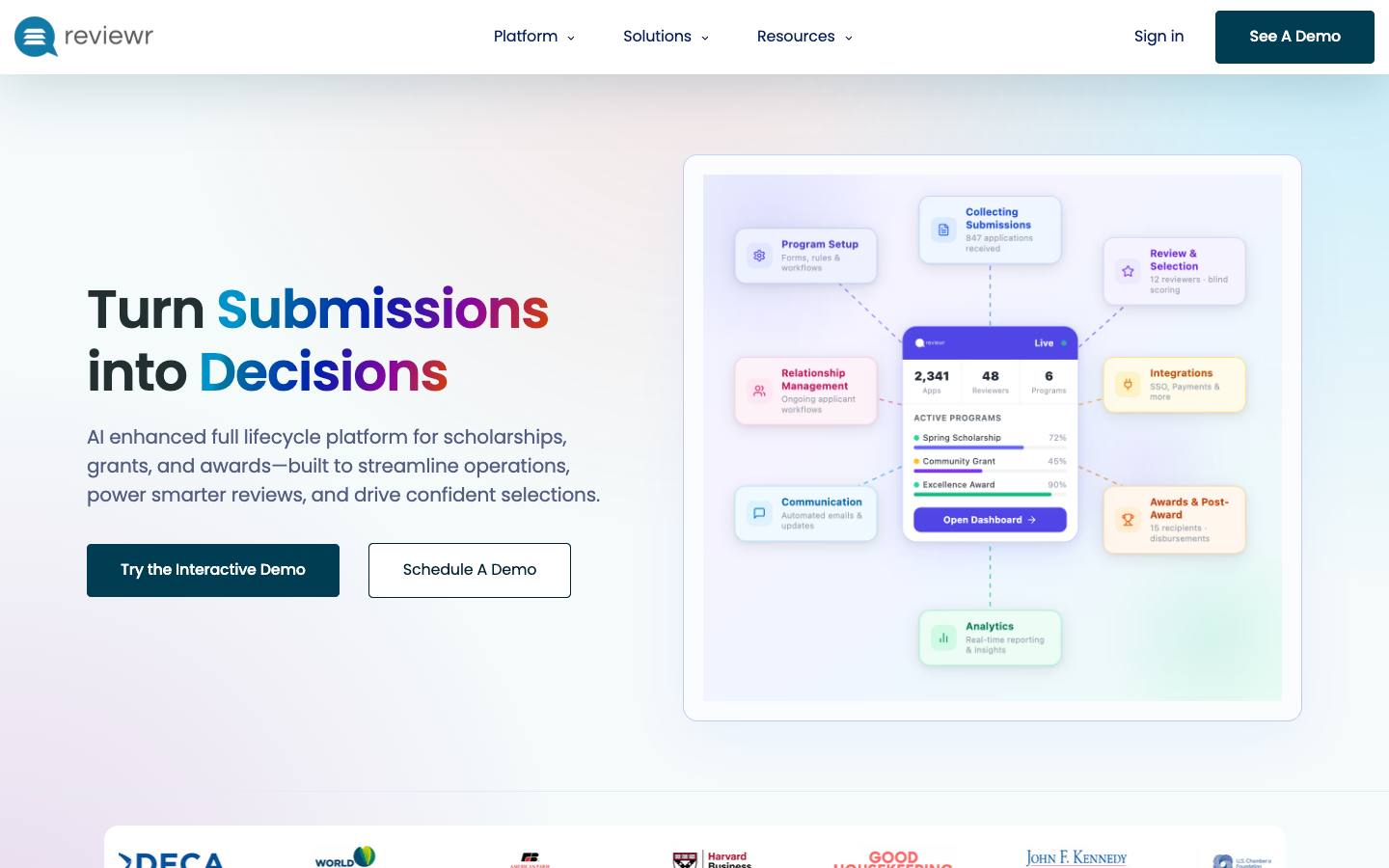
Reviewr manages programs where people apply and reviewers score: applicant portals with save-and-resume, a form builder with conditional logic, blind review with rubrics, conflict-of-interest controls, an audit trail and post-award reporting. Its page names customers including March of Dimes, the City of Dayton and the U.S. Chamber of Commerce Foundation. It has no registration, agenda or attendee features.
Sched builds the event itself: session schedules, speaker profiles, personalized attendee agendas, registration and ticketing, a basic call for papers, check-in with badges, sponsor tools and lead retrieval. The two touch only at speaker submissions, where Reviewr's multi-round scoring is deeper than Sched's basic call for papers on its Launch plan.
Pricing and fit
Reviewr is quote-based: one annual price scoped per program after a discovery call, and not tied to seats or application volume. Sched's Launch plan is $100 a month billed annually at 250 attendees, shown at $50 during a 50% promotion, with Boost at $250 ($125 promo) and Ultra at $376 ($188 promo), as checked October 2026. Sched also offers a free trial and a 60-day money-back guarantee.
Reviewr documents SOC 2 Type II certification, webhooks and API access. Sched's homepage cites SOC 2 Type II and its pricing includes API access on all plans. Neither lists CRM connectors.
Choosing Reviewr, Sched or both
Use Reviewr if your main task is running an awards program, call for entry, grant or scholarship cycle with auditable blind scoring. Use Sched if you need to run a conference with agenda, ticketing and onsite check-in. Use both when an association runs an awards program and an annual meeting, with Reviewr choosing winners or speakers and Sched publishing the schedule.