 vs

Blinq vs HiHello
Both are in our Lead capture & retrieval category. Blinq is best for sales and field marketing teams exhibiting at many third-party trade shows and conferences; HiHello is best for sales and field marketing teams that capture leads at trade shows and want them in the CRM with source attribution.
The short answer: Blinq and HiHello both pair digital business cards with trade show lead capture and native CRM sync, but they price lead capture very differently. Blinq charges per captured and enriched lead on top of its Business seats and adds AI notes and offline scanning, which suits teams that want rich lead records from a handful of shows. HiHello includes event lead capture in its per-seat Business plan with pooled monthly scans, which suits teams that exhibit often and want predictable seat-based costs.
Built from each vendor's own website and our research profiles. How we research
Quick verdict
Choose Blinq if:
- Its best fit describes you: sales and field marketing teams exhibiting at many third-party trade shows and conferences.
- You'd like a per-event pricing option.
- This matters to you: Lead capture works at any event without depending on the organizer's badge system.
Choose HiHello if:
- Its best fit describes you: sales and field marketing teams that capture leads at trade shows and want them in the CRM with source attribution.
- This matters to you: Combines employee brand tools (cards, signatures, backgrounds) with event lead capture in one platform.
Based only on what each vendor publishes. Ask both for a demo with your own event scenario before you decide.
Side by side
“Not published” means we couldn't find it on the vendor's own pages.
BlinqHiHelloStrengths and considerations
Blinq
What stands out
- Lead capture works at any event without depending on the organizer's badge system
- Combines contact enrichment, AI notes and CRM context in the scanning workflow
- Very low entry price for digital business cards, with a free plan
Worth checking
- Not an event management platform; it serves exhibitors and attendees, not organizers
- Per-lead charges can add up for high-volume booths unless an event package is negotiated
- Customer logo wall is labeled as users rather than formal case studies
HiHello
What stands out
- Combines employee brand tools (cards, signatures, backgrounds) with event lead capture in one platform
- Low per-seat entry price compared with dedicated lead retrieval apps
- Enterprise identity controls (SSO, SCIM, HRIS provisioning) and SOC 2 Type II
Worth checking
- Not an event management platform; doesn't handle registration or attendee experience
- Badge scanning depends on reading printed badges rather than show-provided lead retrieval feeds
- Scan limits apply on lower tiers
Notable customers
Organizations each vendor names on its own website: customer stories first, then testimonials and logos.
The main difference between Blinq and HiHello
The main difference is how each one charges for event leads: Blinq meters them per lead, while HiHello bundles them into seats. Both started as digital business card apps and now sell to sales and field marketing teams that exhibit at third-party trade shows and conferences, where reps scan badges and paper cards and push the contacts to the CRM.
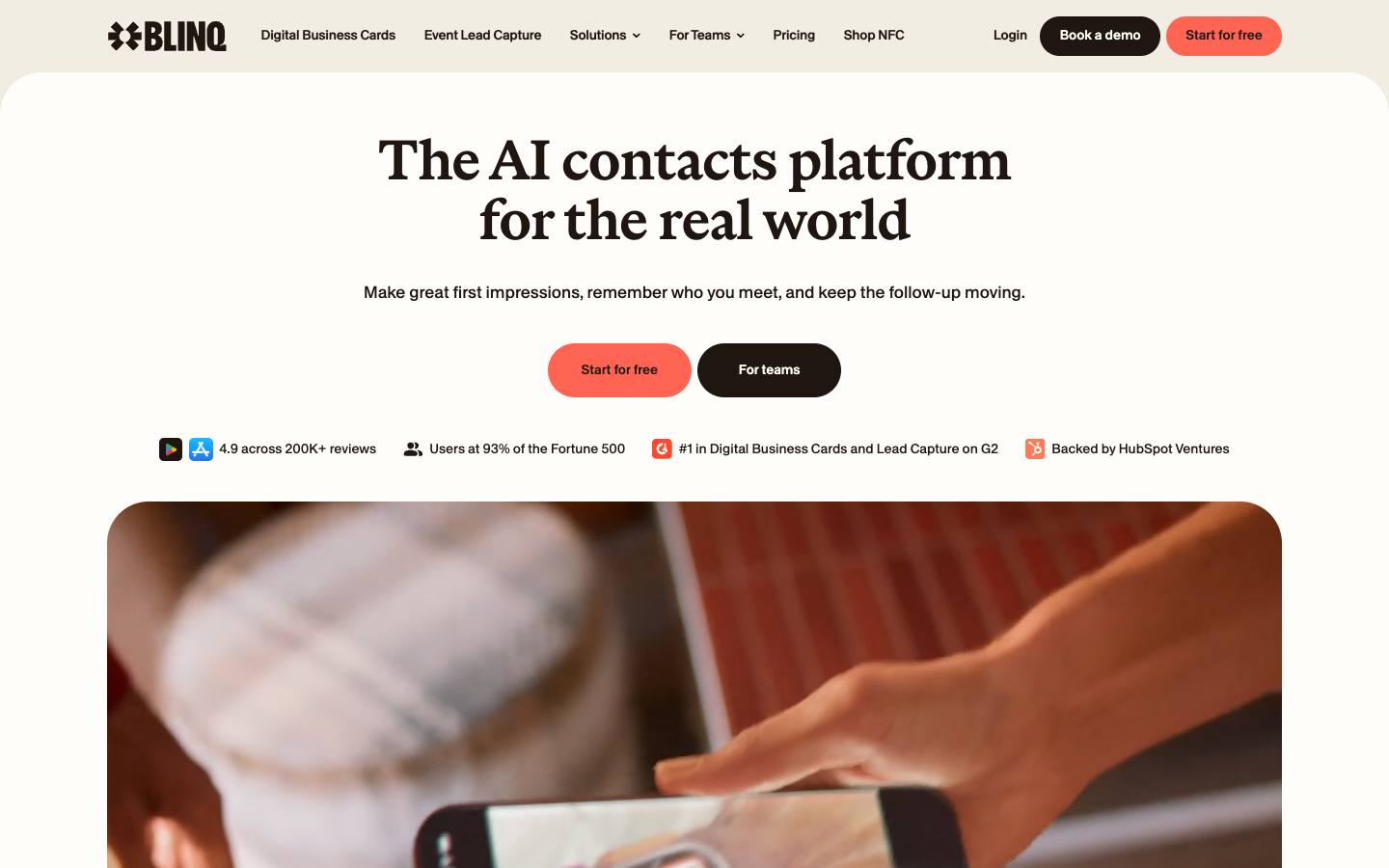
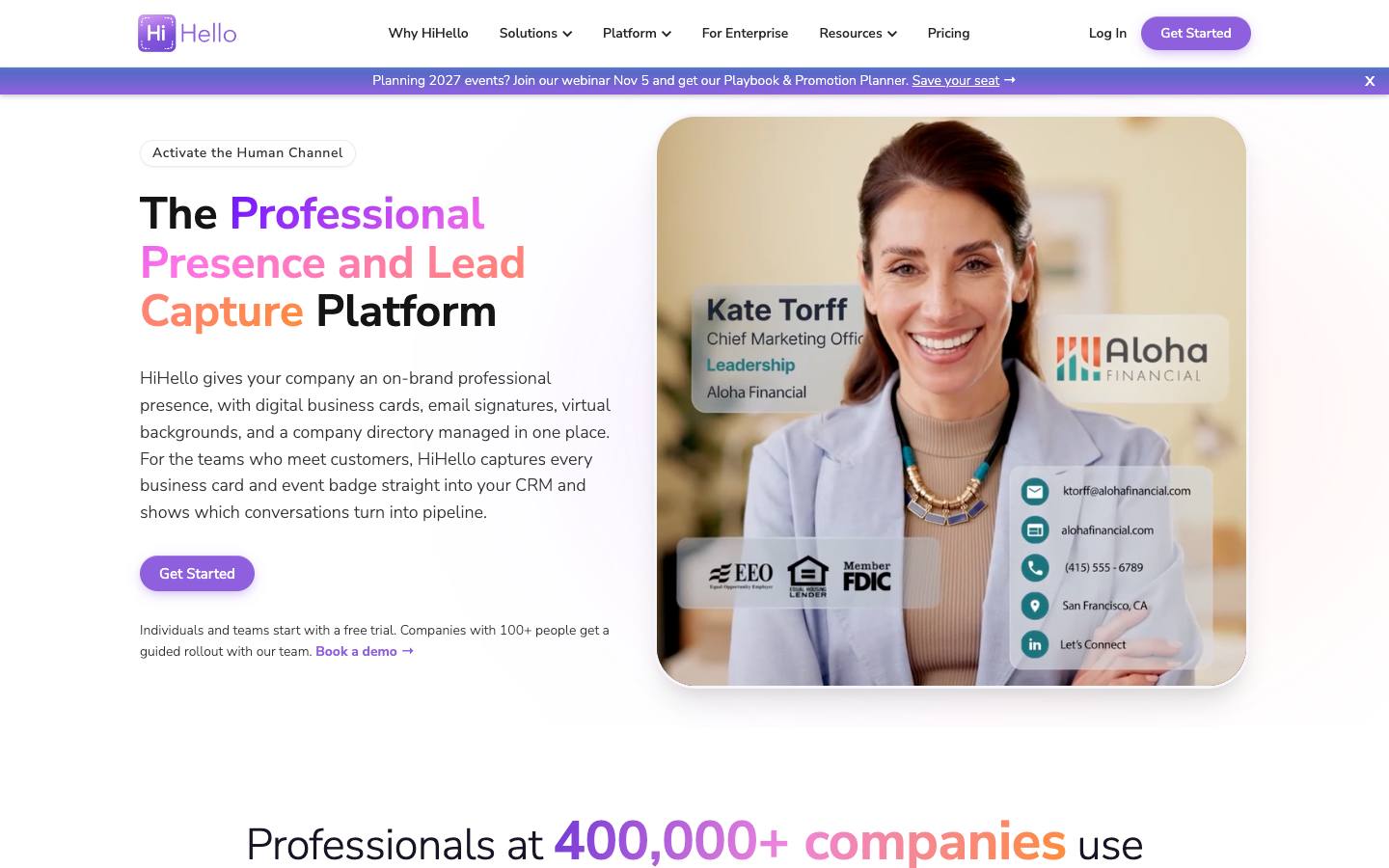
Blinq has pushed further into the booth workflow, with campaign-level qualification questions, an AI Notetaker that summarizes booth conversations into the CRM record and enrichment from more than 25 data providers. HiHello's emphasis is on central control of the employee brand (cards, email signatures, virtual backgrounds and a company directory) with lead capture, custom lead forms and enrichment added on the Business plan.
Neither product is an event management platform or an organizer's lead retrieval system. Both work as exhibitor tools that read printed badges and cards, so they don't depend on the show's official lead retrieval app.
Blinq vs HiHello pricing
On seat price the two are almost identical, but Blinq adds a per-lead charge for event capture while HiHello doesn't (checked October 2026). Blinq Business is $4.99 per user a month billed annually ($6.99 monthly) with a five-card minimum and a 30-day trial, and event lead capture costs $9.99 per lead captured and enriched, billed monthly on credit use. Blinq says unlimited plans and bulk discounts are available but doesn't publish them, and Enterprise is custom with enforced SSO and SCIM.
HiHello Business is $5 per user a month, or $60 per user a year, for 5 to 100 users, with a 14-day trial and a lower rate at 26 and 51 users. It includes event lead capture, Salesforce, HubSpot and Microsoft Dynamics sync, Google and Microsoft SSO and 50 scans per user a month pooled across the team. Enterprise (100+ users) is quote-based with unlimited scans, SAML SSO and SCIM.
To compare total cost, estimate your annual lead volume. A team capturing a few hundred leads a year will pay Blinq's per-lead charges on top of seats, while HiHello's cost stays tied to headcount unless you outgrow the pooled scan allowance.
Features that matter for trade show lead capture
For trade show teams, the features that matter are what you can scan, how leads are qualified and how cleanly they land in the CRM with event attribution. Both scan paper cards, event badges and QR codes with a universal scanner, both enrich contacts, and both auto-tag each lead to its event so post-show reports show where leads came from.
Blinq's event lead capture page describes offline scanning with sync when the device reconnects, preset qualification questions and tags (such as hot, warm or cold) that sync as structured CRM fields, and native connectors for Salesforce, HubSpot, Microsoft Dynamics, Zoho, monday.com, GoHighLevel and Marketo that map leads to the matching CRM campaign. If an organizer grants badge API access, Blinq can also pull full registration records.
HiHello's lead retrieval page lists Salesforce, HubSpot, Microsoft Dynamics 365 and Google Contacts with real-time sync, plus Zapier for other tools, and its FAQ mentions Marketo. It offers custom lead forms and consent capture on Business, though it publishes less detail than Blinq on qualification scoring, offline scanning and how leads map to Salesforce campaigns, so confirm those in a trial.
Which should you choose?
Choose Blinq if your team does a few major shows a year and wants the richest possible record per lead, with AI notes, structured qualification and campaign-level CRM attribution, and you're comfortable budgeting per lead. Choose HiHello if you exhibit frequently, want lead capture included in a predictable per-seat price and also want marketing or IT to govern cards, email signatures and virtual backgrounds for the whole company.
For companies over 100 users, both move to custom Enterprise pricing with SAML SSO and SCIM, so run a side-by-side trial at a real show and compare lead quality in your CRM before committing.